


Search is splitting in two. Half of it still looks like a list of blue links; the other half is an AI giving one answer and citing a few sources. Optimizing to be one of those cited sources is a new discipline, called answer engine optimization (AEO) or generative engine optimization (GEO). It overlaps with SEO but isn't the same, and the brands that learn it early get cited while competitors who optimized only for blue links disappear from the answer.
Key takeaways
- AEO (answer engine optimization) and GEO (generative engine optimization) are the practice of getting your content cited in AI-generated answers.
- AI answer engines, ChatGPT, Perplexity, Google's AI Overviews, synthesize an answer and cite a handful of sources, so the goal shifts from ranking to being quoted.
- They favor content that's clearly structured, factually dense, quotable in self-contained statements, well-defined, and authoritative.
- It overlaps with SEO (you must be crawlable and credible) but rewards extractability and clarity over keyword tactics.
- As zero-click AI answers grow, being the cited source becomes the visibility that matters.
What AEO and GEO are
Answer engine optimization is optimizing content so AI answer engines surface and cite it when they respond to a user. Generative engine optimization is the same idea named for generative AI specifically. Both respond to a shift in behavior: instead of searching and clicking, more people ask an AI and read its synthesized answer. In that world, the prize isn't a ranking position but a citation, being the source the model quotes and links. The page that gets cited captures the attention; the pages that merely ranked do not.
How AI answer engines choose sources
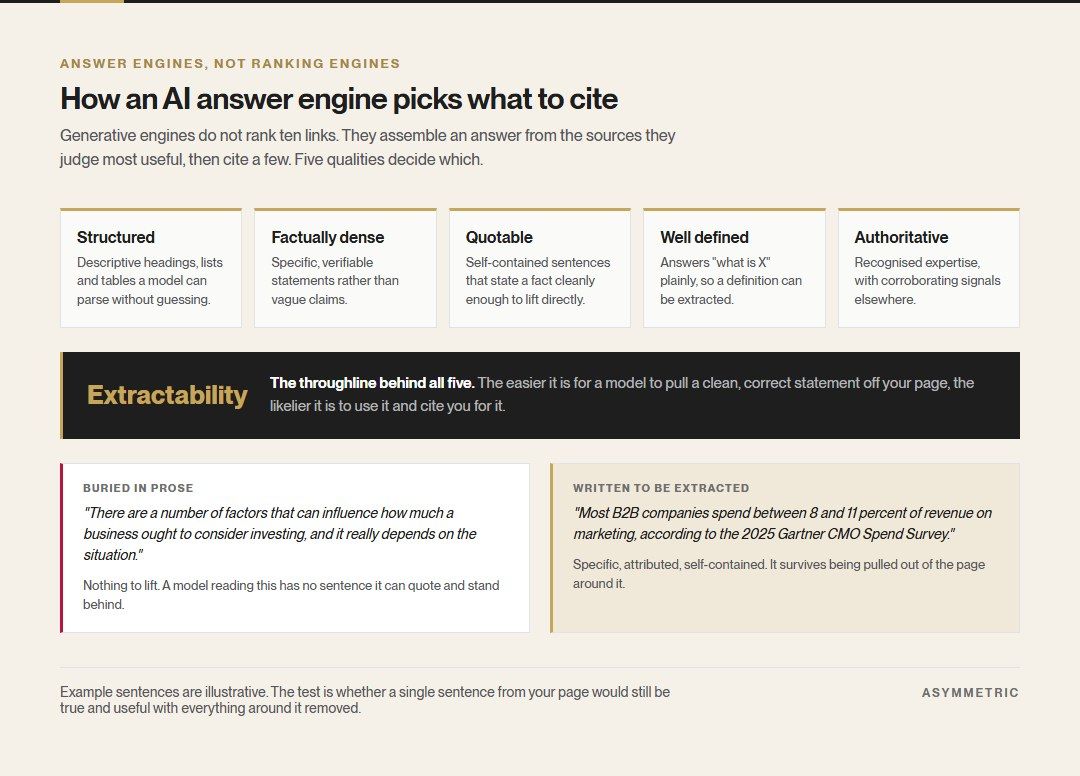
Generative engines don't rank ten links; they assemble an answer from sources they judge most useful and trustworthy, then cite a few. In practice they favor content that is:
- Clearly structured, with descriptive headings, lists, and tables the model can parse.
- Factually dense, with specific, verifiable statements rather than vague claims.
- Quotable, written in self-contained sentences that state a fact cleanly enough to lift directly.
- Well-defined, answering "what is X" plainly so the model can extract a definition.
- Authoritative, from a source with recognized expertise and corroborating signals.
The throughline is extractability: the easier it's for a model to pull a clean, correct statement from your page, the likelier it's to use and cite it.
How AEO differs from traditional SEO
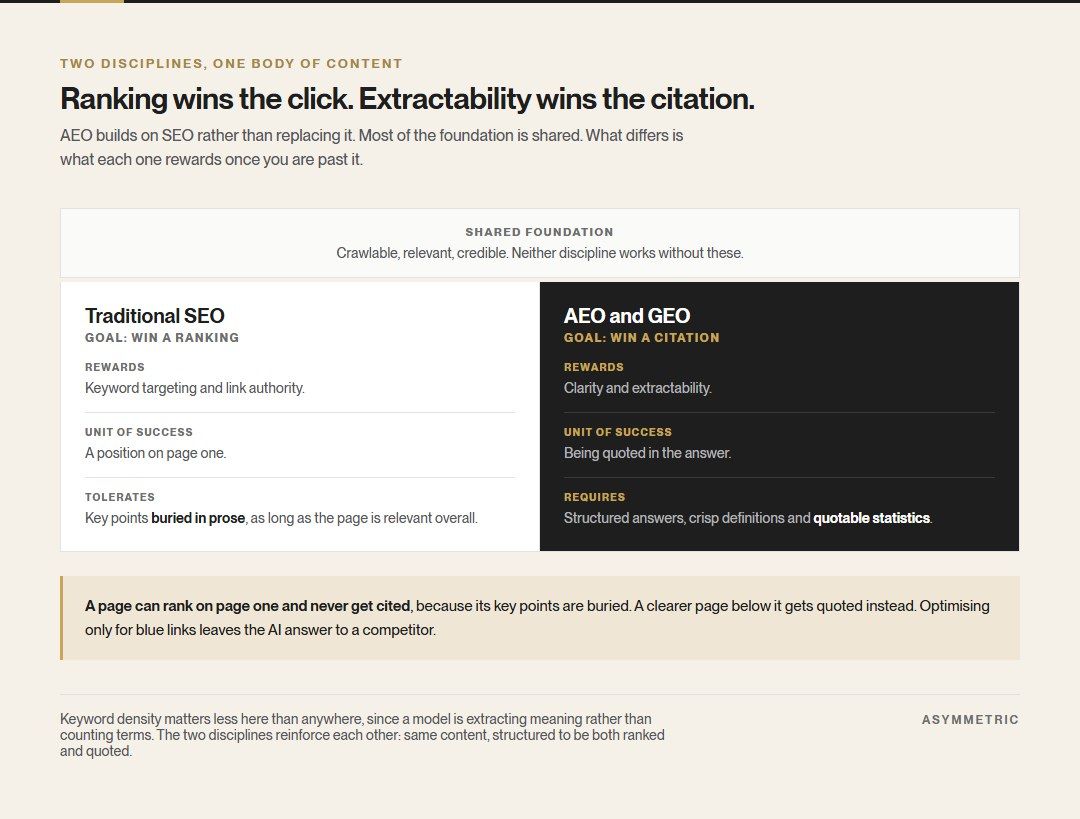
AEO builds on SEO but shifts the emphasis. You still need to be crawlable, relevant, and credible, that part is shared. But where classic SEO rewards keyword targeting and link authority to win a ranking, AEO rewards clarity and extractability to win a citation. A page can rank on page one and never get cited because its key points are buried in prose; a clearer page below it gets quoted instead. Structured answers, crisp definitions, and quotable statistics matter more than keyword density. The two disciplines reinforce each other, but optimizing only for blue links leaves the AI answer to a competitor.
How to optimize for answer engines
Write the way a model reads. Lead sections with a direct answer, then support it. Use clear headings that match real questions, and add a pillar-and-cluster structure so your topical depth is legible. Include self-contained, quotable facts and clear definitions. Add FAQ content that answers real questions in a sentence or two. Build genuine authority, since models weigh source credibility. And treat it as complementary to search engine marketing and SEO, not a replacement, the same content, structured to be both ranked and quoted.
How to do generative engine optimization: a working process
The principles are easy to agree with and harder to apply, so here's the order the work actually runs in.
Start by finding out whether you're cited today. Ask the engines the questions your buyers ask, in the words they use, and record which sources get named. This is tedious and it's the only honest baseline available, because there's no equivalent of a rank tracker that covers every engine reliably. Twenty questions, run across ChatGPT, Perplexity and Google's AI Overviews, will tell you more than any tool currently sold for the purpose.
Then look at who does get cited and why. Usually it's not the most authoritative page but the most extractable one: the page that answered the specific question in a sentence rather than burying it in three paragraphs of context. Read the cited source and find the sentence the model lifted. That sentence is the format you're competing with.
Next, rewrite for extraction rather than for flow. Lead each section with the direct answer and support it afterwards, which is the reverse of how most marketing content is written. Replace vague quantities with specific, attributable ones. Break claims that bundle three ideas into three sentences a model can quote separately.
Finally, add the structure the model needs to be confident: descriptive headings phrased as the questions people actually ask, FAQ blocks with self-contained answers, and tables where you're comparing things. None of this requires new research. Most of it is reformatting what a good article already contains so a machine can find the answer in it.
Tools for generative engine optimization, and what they can honestly tell you
A category of AI visibility tools has appeared quickly, and it's worth being clear about what they can and can't do. Most work by running a set of prompts on a schedule and recording which brands and sources appear in the answers. That's genuinely useful, and it's also a sampling exercise rather than a measurement.
The limitation is inherent to the technology rather than a flaw in any particular product. Generative answers vary between runs, between users, and between sessions, so a tool reporting that you appeared in a given percentage of answers is describing its own sample, not a stable ranking. Two tools running different prompt sets will disagree, and neither is wrong.
What they're good for is direction of travel. If your citation rate across a consistent prompt set climbs over a quarter, that's real signal. If a competitor starts appearing where you used to, that's worth investigating. What you shouldn't do is treat a weekly percentage as a metric to optimise, or pay for a tool before you've done the manual baseline, because the manual pass will teach you what to prompt for.
Server logs are the other half, and the half people forget. AI crawlers identify themselves, so your own logs will tell you which engines are fetching your pages and how often. That's first-party data about whether you're even in the running, and it costs nothing beyond the effort of looking.
What a GEO service should actually do for you
Because the category is new, the offers vary wildly, and some of what is sold as generative engine optimization is ordinary SEO with the label changed. A few things separate the real thing.
It should start with a citation baseline rather than an audit template. If nobody has established which questions you currently appear for, there's nothing to improve against and no way to demonstrate progress later.
It should change your content, not just your schema. Structured data helps machines understand a page and it doesn't make a buried answer quotable. Work that consists entirely of markup is treating a content problem as a technical one.
It should be honest about attribution. A cited answer often produces no click at all, so the value shows up as brand searches, direct traffic and better-informed inbound rather than as a tidy line in analytics. Anyone promising clean click attribution for AI citations is describing something the current tooling can't deliver.
And it should treat this as one search strategy rather than a separate budget. The same page, structured properly, can rank and be quoted. Splitting the two into competing programmes produces two thinner efforts and a reporting argument.
How AI Search Works
When a user submits a query to an AI answer engine, the system doesn’t browse the web in real time like a traditional search crawler (with some exceptions for tools with live search). Instead, it draws on its training data plus, in many cases, retrieval-augmented generation (RAG)-meaning it dynamically fetches relevant web content to supplement its answer.
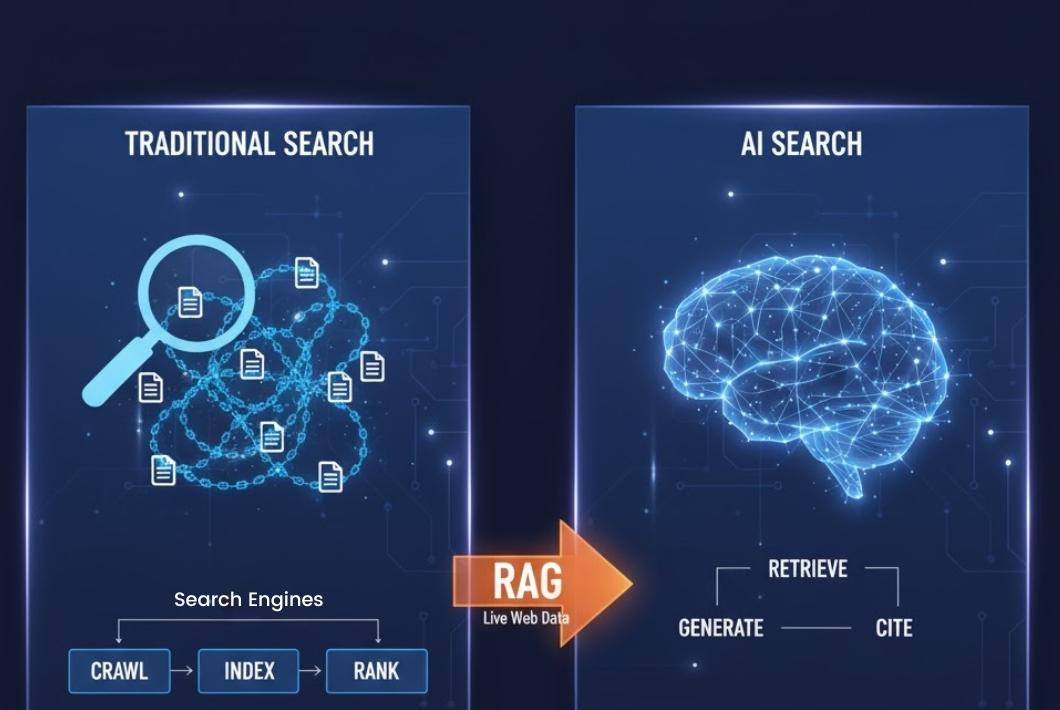
What this means practically: if your content is well-structured, clearly written, and directly answers the kinds of questions your prospective customers ask, AI systems are more likely to surface it. If your content is vague, jargon-heavy, or buried in slow-loading templates, you’ll be invisible regardless of your domain authority.
Why Independent Brands Have the Structural Advantage
Here’s the asymmetric reality: large brands are slower to adapt. Their content is produced by committee, reviewed by legal, and optimized for brand consistency rather than answer quality. Their websites are enormous, technically complex, and often filled with the kind of polished-but-hollow copy that AI systems actively deprioritize.
Independent brands-the kind that work with a team like Asymmetric-can move faster, write more specifically, and build the kind of topical depth that AI systems reward. The brands winning the answer game right now aren’t the biggest ones. They’re the most useful ones.

Usefulness, in AEO terms, means:
- Answering specific questions completely and directly
- Using plain language instead of filler phrases
- Organizing content so that key answers are easy to extract (clear headings, short paragraphs, explicit structure)
- Building topical authority around a focused area rather than trying to rank for everything
A regional senior living operator with five communities can build a stronger AEO presence in their specific market than a national chain-if they write the right content. A direct-to-consumer outdoor brand with deep expertise in a specific category can earn AI citations that its mass-market competitors can't match on specificity alone.
Brand Visibility in AI Tools: What Gets Measured
Traditional SEO metrics-rankings, impressions, organic traffic-don’t fully capture AEO performance. You need a different measurement framework.
- AI mention rate: How often does your brand appear in responses from ChatGPT, Perplexity, Google AI Overviews, and other tools when relevant queries are submitted?
- Citation quality: Are you being cited as the source of specific answers, or just referenced in passing?
- Answer position: In multi-source AI answers, are you appearing early in the response or buried at the end?
- Referral traffic from AI tools: Platforms like Perplexity and Bing Copilot generate trackable referral traffic. Monitor it as a leading indicator.
- Dark social and direct traffic shifts: Some AI-driven discovery doesn’t generate attributable referral traffic-users read the answer and handle directly. Watch for unexplained direct traffic growth.
Building a measurement framework now, before AI traffic is material for most brands, means you’ll have the baseline data to prove the investment when it starts driving results.

Get cited, not just ranked
If your competitors are showing up in AI answers and you're not, building content that earns the citation is the work we do.