


Why is advertising important? Advertising builds brand awareness, reaches new audiences, drives sales and leads, and keeps a business competitive in a crowded market. Without it, even a superior product loses to the one customers have actually heard of. Those are the standard reasons, and they're all true. But there's a deeper point most advertising advice skips: advertising increases an advantage, it doesn't create one. For a smaller business competing against a larger rival, understanding both halves, why advertising matters and what makes it pay, is the difference between spending that compounds and spending that disappears.
Key takeaways
- Advertising matters because it builds brand awareness, reaches a target audience, drives sales and leads, deepens loyalty, and keeps you visible against competitors.
- Its single most important rule: advertising increases a position, it can't manufacture one. Spend behind a sharp position and it compounds; spend behind a generic one and you pay to be ignored faster.
- Concentrate spend where a competitor is weak or absent rather than matching a larger rival dollar for dollar.
- Set the budget from strategy and opportunity, not a flat percentage, and measure on leads, customers, and revenue, not impressions.
- For a challenger, the position comes first; advertising is the force multiplier that carries it.
Advertising builds brand awareness
The first reason advertising matters is brand awareness. Customers can't choose a business they don't know exists, and they tend to buy from brands they recognize and trust. Consistent advertising keeps your brand in front of consumers, building the recognition that makes you the default choice when they're ready to buy. The companies that advertise consistently become the ones a consumer thinks of first, while advertisers who go quiet quietly fade from memory. Strong brand awareness compounds, too: the more familiar your brand, the more credible every future campaign becomes, and the cheaper it gets to win attention. For a challenger, building brand awareness within a specific audience is often the first job advertising does, because awareness of a clear position is what turns a stranger into a customer.
It reaches your target audience across media
Advertising lets you reach a defined target audience deliberately rather than waiting to be found. Modern media makes this precise. Social media advertising on platforms like Facebook and Instagram targets specific demographics and interests, Google search ads reach people at the exact moment they're looking, and display, video, and email campaigns extend that reach across the channels your audience already uses. You can aim a campaign at a single demographic, tailor the content and creative to what that group responds to, and adjust as the data comes in. The point isn't to be on every platform but to concentrate your advertising where your specific target audience actually pays attention. Choosing the right media and the right message for the right audience is what makes a campaign efficient rather than wasteful.
It drives sales and leads
Advertising's most measurable job is driving sales and leads. Well-aimed campaigns put your products and offers in front of customers who are ready to act, generating the leads and conversions that grow revenue. A well-made advertisement creates urgency, showcases what makes your products worth buying, and gives a prospect both a clear reason and a clear path to purchase. A strong campaign tied to a real offer turns awareness into customers, which is ultimately why businesses advertise at all: not for impressions, but for the sales and leads those impressions are meant to produce.
It builds customer loyalty
Advertising doesn't only win new customers; it keeps existing ones. Consistent presence and messaging build an emotional connection that turns one-time buyers into loyal customers, and brands that show up reliably are perceived as more trustworthy than those that appear and vanish. Advertising that speaks to customers' values and triggers genuine emotional responses deepens that loyalty, and loyal customers buy more, refer others, and resist competitors' offers. Retaining a customer through ongoing engagement is far cheaper than acquiring a new one, which makes customer loyalty one of advertising's most valuable returns.
It keeps your business competitive
In a competitive market, going quiet concedes ground. Advertising keeps your business visible while competitors are spending to take your customers, and a consistent presence signals strength and stability. For a challenger, the competitive value of advertising isn't about matching a larger rival's budget, which is a war of attrition you lose. It's about concentrating your advertising where the competitor is weak, generic, or absent, so a smaller business can win attention and customers it could never afford to fight for head-on.
The challenger's caveat: advertising increases a position
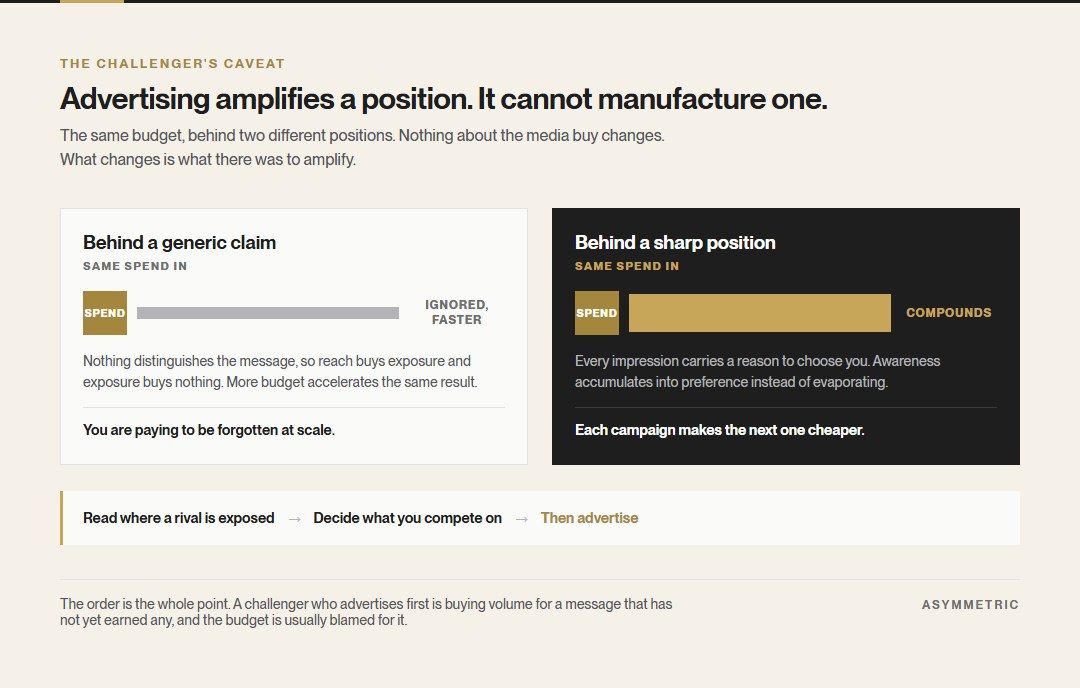
Here's the part the standard list of reasons leaves out. Advertising increases an advantage; it can't manufacture one. Spend behind a sharp, differentiated position and every dollar of brand awareness and every campaign compounds. Spend behind a generic claim and you're paying to be ignored faster. For a challenger, the position has to come first, found through an honest read of where a competitor is exposed and a clear decision about what you compete on. This is the heart of asymmetric marketing: advertising then carries that position to the market.
What it looks like when the position is right
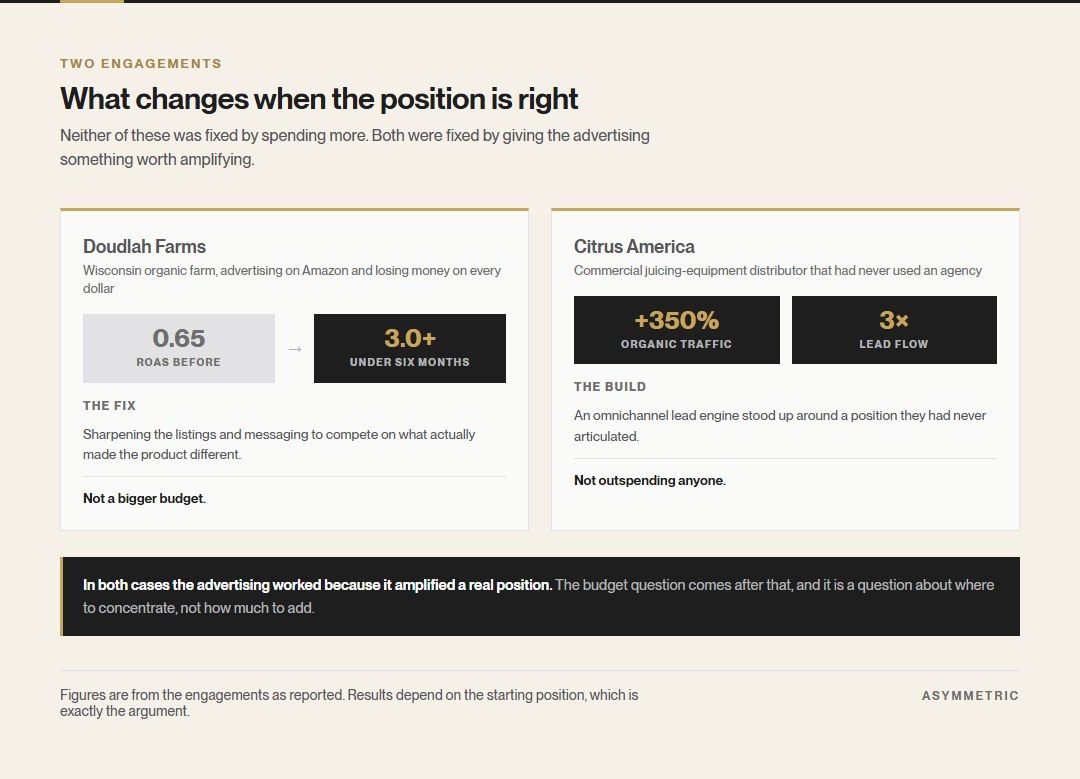
The difference is measurable. Doudlah Farms, a Wisconsin organic farm, came to us advertising on Amazon at a return on ad spend of 0.65, losing money on every dollar. The fix wasn't a bigger budget; it was sharpening the listings and messaging to compete on what actually made the product different, after which return on ad spend passed 3.0 in under six months. Citrus America, a commercial juicing-equipment distributor that had never used an agency, partnered with us to stand up an omnichannel lead engine; over the engagement organic traffic grew more than 350 percent and lead flow more than tripled. In both cases the advertising worked because it increased a real position, not because it outspent anyone.
How much to spend, and how to measure it
Because advertising is an investment rather than a cost, the real questions are how much to invest and how to know it's working. Set the budget from strategy and the opportunity, not a flat percentage, and concentrate it where it compounds. Then measure what matters: leads, customers, and revenue, not just impressions and reach. Track the campaigns and channels that actually produce customers and shift the budget toward them. Advertising done this way, behind a real position and measured on real outcomes, is one of the most important investments a business makes.
Put your advertising behind a real edge
If you're advertising and aren't sure it's increasing a genuine advantage, the fix is upstream of the ads, in the position they carry. That's the work we do.