

June 12, 2026
Business Wargaming for Service Operators: Rehearse Your Next Move Before You Have to Make It
Business wargaming for independent home & commercial service operators: what it is, how to run one, and how we compress it into a single day to map your territory before a franchise or PE rollup forces the fight.
By Mark Hope, Founder, President & Chief Strategy Officer, Asymmetric Marketing

Before any of this was about marketing, it was about twelve men and four hundred. A U.S. Army Special Forces team is built on a hard premise: a dozen operators are expected to train, lead, and field an irregular force more than thirty times their size, and to prevail against adversaries with far more resources. You don't win that fight with mass. You win it with asymmetry: speed, surprise, concentration, and a refusal to meet a stronger enemy where they're strong. It's also the reason this company is called Asymmetric. And it's why I have little patience for how most companies decide strategy: a smart team, an offsite, a deck, a round of nods, and a plan nobody pressure-tested against the one group guaranteed to attack it. In Special Operations you would never execute a plan you hadn't first wargamed against a thinking opponent. A business wargame removes the pretense that the step is optional.
This is the full guide to business wargaming for an independent operator: what a wargame is, the types, where the practice comes from, how to prepare and run one, and how we compress the whole thing into a single intensive day so you can map your territory before a national franchise or private-equity rollup forces the fight on you.
Key takeaways
- A business wargame is a structured, facilitated exercise in which your own team role-plays competitors to pressure-test a strategy before you commit budget to it.
- Its defining feature is adversarial role play: participants become the rivals and attack the plan, rather than analyzing competitors from a distance.
- It's not scenario planning, a SWOT analysis, or a competitor deck; it's the only one that puts a live decision through rounds of move and counter-move.
- The classic corporate format runs two days with around two dozen cross-functional people; for an independent operator we compress the same engine into a single intensive day focused on one territory decision.
- Run it before any move big enough that a franchise or rollup's response could sink it and costly to reverse: a territory expansion, a new service line, a pricing change, or a major commercial bid.
What a business wargame is
A business wargame is a structured, facilitated exercise in which your own team role-plays your competitors to pressure-test a strategy before you commit to it. It's sometimes called corporate war gaming, and in practice it usually takes the form of an intensive workshop where cross-functional leaders are split into teams, given a live strategic decision, and made to play it out through rounds of move and counter-move. The output isn't a document. It's a strategy that has already been attacked, and either held its ground or been rebuilt, before a dollar was spent proving it in the market.
The defining feature of business wargaming is role playing. Instead of analyzing competitors from a distance, participants become them, arguing and acting as those rivals genuinely would. A few terms recur. The company team plays your organization and runs its intended strategy. The competitor teams, often called red teams, play your most important rivals and try to beat you. A round is one cycle of move and counter-move: the company acts, the competitors respond, and the facilitator adjudicates what realistically happens. That shift from describing the competitive market to fighting on it is what separates a wargame from an ordinary strategy workshop.
The main types of business wargames
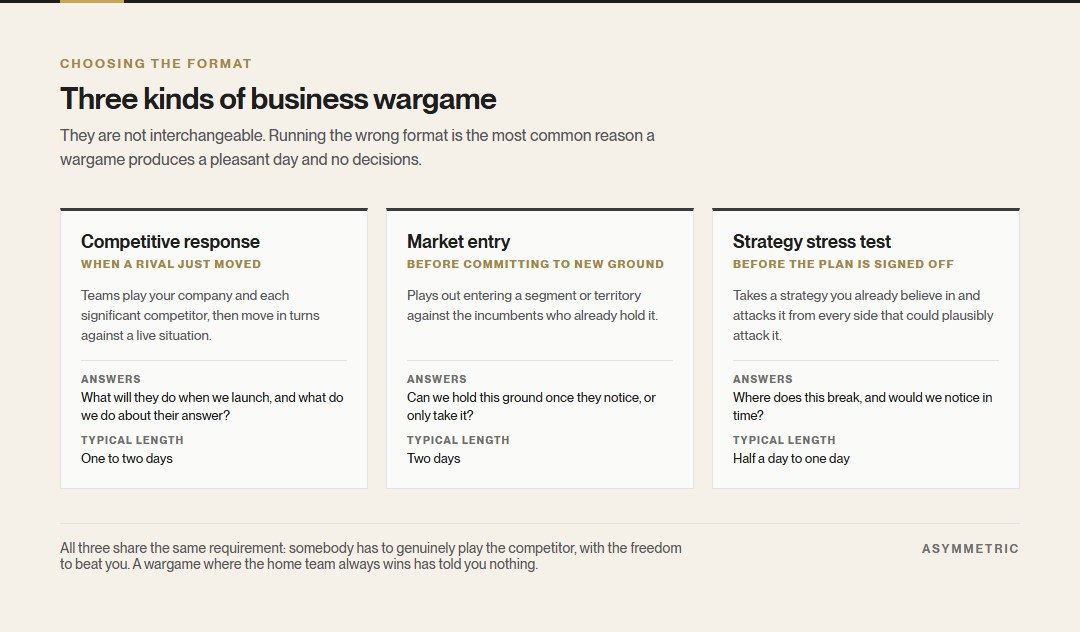
Wargames are tailored to the decision on the table, and a few types recur:
- Competitor wargame: the general case, stress-testing a strategy against how named rivals would respond. The red teams each play a specific competitor.
- Market-entry wargame: run before entering a new market or segment, to see how entrenched incumbents would defend their ground.
- Product-launch wargame: rehearses a launch against the price cuts, fast-follows, and channel moves competitors use to blunt new entrants.
- Pricing wargame: tests a pricing change against the retaliation it invites, since price moves are the fastest and most visible to copy.
- Crisis or red-team wargame: pressure-tests how the organization would respond to a competitor's attack, a disruptive entrant, or a shock to the market.
Formats vary too. Most valuable wargames run one to two days in person, but lighter half-day versions can test a single decision, and software-based business wargaming simulations exist for repeated or quantitative play. For most strategic decisions the elaborate simulation is unnecessary; the value is in the structured adversarial role play, not the tooling.
Where business wargaming comes from
The practice is adapted directly from the military, where war games have been used for centuries to rehearse decisions under uncertainty. Armies have long run war games ranging from map exercises and role-playing simulations to large computer simulations, all built on the same logic: rehearse the decision against a thinking adversary before the real cost is paid. Business wargaming takes that military discipline and applies it to corporate strategy, replacing terrain and forces with markets, competitors, and customers. The approach is now well established in corporate strategy, used by major consultancies and strategy teams to stress-test high-stakes decisions. The computer simulations and elaborate models of military wargaming are usually unnecessary in business; what transfers is the core mechanism of structured, adversarial role play that turns a static plan into a tested one.
A business wargame isn't scenario planning
The distinction matters, because the two get confused. Scenario planning imagines possible futures and asks what if the market shifts; it's passive and environmental. A business wargame is adversarial. It asks what a competitor does the moment you move, and what you do back. One studies the weather. The other fights an opponent who is trying to win. A wargame is also not a SWOT analysis or a competitor analysis deck, which describe the competitive environment without ever testing a decision inside it. Wargaming is the only one of these that puts a live strategic decision through rounds of move and response. It doesn't replace those tools; it consumes their output as the raw material a wargame then stress-tests.
Why strategy fails without rehearsal
Strategy rarely fails on analysis. Most leadership teams analyze well. It fails on what the competitor does next, the response nobody modeled. A plan that looks brilliant in a deck looks naive the instant a rival cuts price, copies the feature, or floods the channel you were counting on. A wargame forces that response into the room early, while changing course is still cheap. In one exercise, a company team opened with the conventional playbook of new product variants and bundled packages. In the first round, both teams playing competitors did exactly the same thing, and every projected advantage canceled out in front of everyone. That stalemate, visible in an afternoon instead of discovered in the next quarter's results, freed the team to stop fighting the head-to-head battle and design an asymmetric move instead. The wargame didn't hand them the answer. It made the dead end of the obvious path undeniable, which is what created room for a better one.
How to prepare for and conduct a business wargame
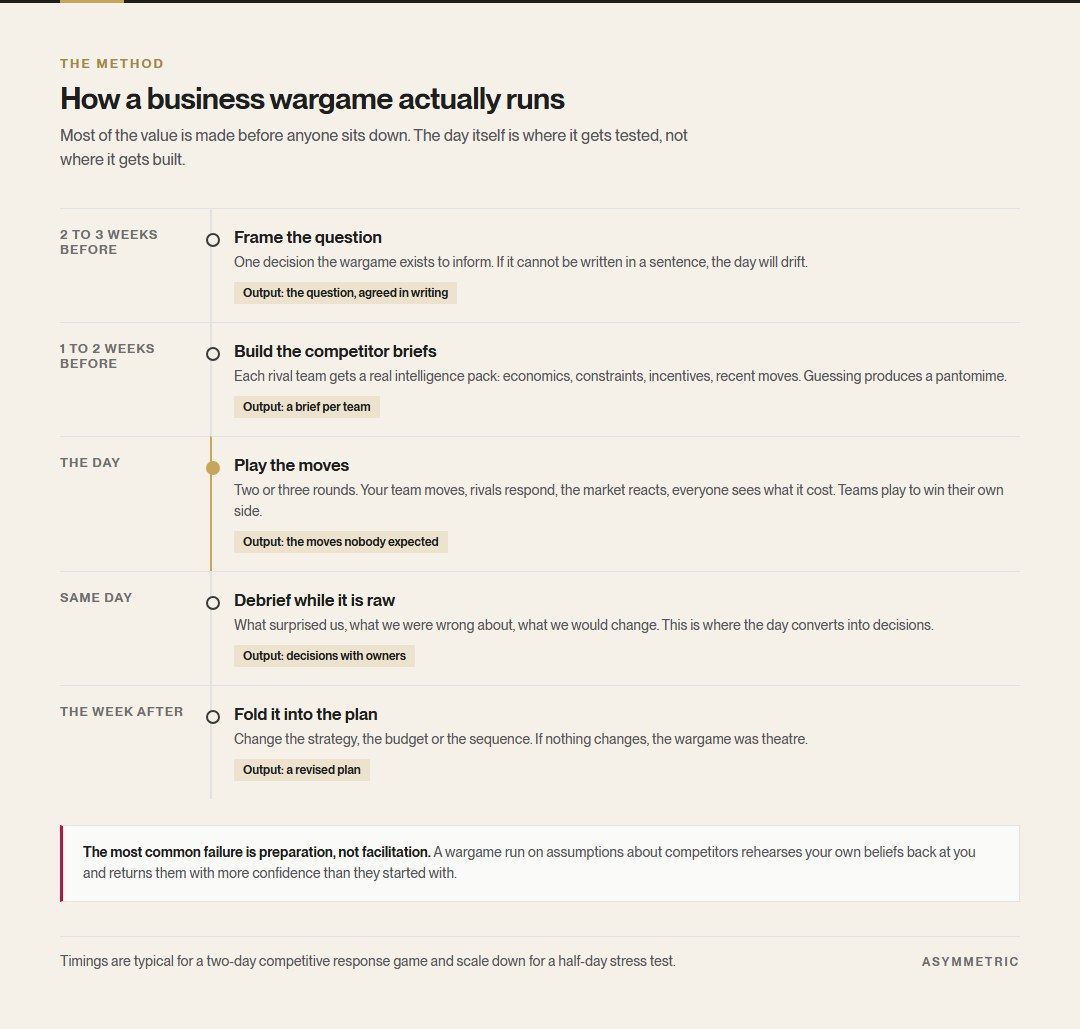
A wargame is only as good as its preparation. The work breaks into a clear sequence.
- Define the decision. Name the single strategic decision the wargame will test, a specific launch, repositioning, pricing move, or market entry, not a vague "review our strategy." A sharp question is what makes the rounds meaningful.
- Gather the intelligence. Brief every team with real competitive intelligence: each rival's position, economics, recent moves, and incentives, so the red teams play their competitor accurately rather than as a caricature.
- Build the teams. Assemble around twenty-four cross-functional participants with senior leadership included, then split them: one company team and two or three competitor teams, each assigned a specific rival to embody.
- Run the rounds. The company team makes its move; each competitor team responds as its rival genuinely would; the facilitator adjudicates the outcome. Repeat for several rounds so second- and third-order responses surface, not just the opening exchange.
- Debrief and decide. Reconvene as one group to extract what held, what broke, and what to change, then convert the findings into a revised plan everyone in the room watched get tested.
That structure is the template. The detail flexes with the decision, but the spine, define, intelligence, teams, rounds, debrief, holds for any business wargame.
How Asymmetric runs a business wargame: the method
For an independent operator we run a compressed, one-day version: the engine behind the 1-Day Pathfinder Sprint. Eight hours, your real numbers, your actual territory. We role-play the franchise and the rollup moving into your ZIP codes, and you rehearse the counter before it costs you a single job.
What that structure produces is often more than a tested strategy. Run it for a multi-truck HVAC or restoration operator and the room stops arguing about whether to expand and starts seeing exactly which routes the rollup will defend, which it will ignore, and where a faster local crew wins. The plan that survives the day is one the whole team will actually run on Monday.
What a business wargame surfaces
Run well, a wargame consistently surfaces a few things no deck does:
- The dead end: the obvious move both sides cancel out, found in round one instead of in next year's numbers.
- The asymmetric opening: the place a competitor can't or won't respond, where a smaller player wins.
- The blind spot: the rival move your plan had no answer for, exposed while it's still cheap to fix.
- The siloed truth: what your own organization already knows but has never shared across functions.
- Alignment: a leadership team that leaves believing the same plan, because they watched it tested rather than hearing it summarized.
That last point is decision-making as much as analysis. Teams that watch a strategy survive a wargame commit to it in a way no presentation achieves.
Common mistakes that waste a wargame
The exercise fails in predictable ways. The most common is treating it as theater, a scripted role-play that confirms the plan leadership already loves instead of genuinely attacking it. Running too few rounds is another: the obvious moves cancel in round one, and the real insight lives in the responses to the responses. Briefing the red teams with thin intelligence produces caricatured competitors whose moves teach nothing. Staffing the room with only junior people removes both the authority to change the plan and the cross-functional knowledge that makes the exercise valuable. And skipping the debrief leaves the insight in the room instead of in the revised strategy. Avoiding these is mostly a matter of honesty: the wargame has to be allowed to kill the plan, or it's not a wargame.
When to run a business wargame
A business wargame earns its place before any move large enough that a competitor's response could sink it, and reversible only at real cost. The common triggers are a major product launch, a repositioning, a pricing change, a market entry, or a portfolio overhaul, especially when the competitive market is shifting and the usual assumptions may no longer hold. The rule is simple: if the decision is big and expensive to undo, rehearse it before the market does. The two days you spend wargaming are the cheapest insurance you'll buy against a multi-quarter mistake in a volatile competitive environment.
Rehearse your strategy before the market does
If you have a big move coming, a territory expansion, a new service line, a major commercial bid, and a franchise or rollup that will fight you for it, that's exactly when to rehearse rather than improvise.
Frequently asked questions
What is a business wargame?
A structured exercise where your own team role-plays your competitors, a franchise, a PE rollup, or the aggressive shop one town over, to pressure-test a strategy before you commit real money. You rehearse the move and their counter-move while it's still cheap to change your mind.
How is the operator version different from a corporate wargame?
Same engine, compressed. The classic corporate format runs two days with two dozen people. For an independent operator we run a single intensive day on one territory decision with your real numbers, which is exactly what the 1-Day Pathfinder Sprint is.
When should a service operator run one?
Before any move big enough that a franchise or rollup's response could sink it: expanding into new routes, adding a service line, changing pricing, or chasing a large commercial contract.
Do I need a big team to run a wargame?
No. A corporate wargame uses two dozen people; an operator wargame needs you, your key decision-makers, and a facilitator who brings the competitive intelligence. The value is the adversarial rehearsal, not the headcount.
What does a wargame actually surface?
The dead-end move both sides cancel out, the asymmetric opening a rollup can't defend, the blind spot your plan had no answer for, and alignment, because a team that watched the plan survive commits to it in a way no slide deck achieves.
Is a wargame the same as a SWOT or scenario planning?
No. SWOT and scenario planning are passive: they list strengths or imagine futures. A wargame puts a live decision through rounds of move and counter-move against an opponent actively trying to beat you. It's the only one that rehearses the fight.
About the author

Mark Hope
Founder, President & Chief Strategy Officer, Asymmetric Marketing
Mark Hope is the Founder, President & Chief Strategy Officer of Asymmetric Marketing. His career spans elite military service, senior leadership at two of the largest companies in their categories, and founding several companies of his own. It's the common thread behind how Asymmetric helps smaller companies out-compete bigger ones.
Mark began his career in U.S. Army Special Operations, serving from 1977 to 1988 in the 1st and 3rd Battalions of the 75th Ranger Regiment and as an Operator in 1st Special Forces Operational Detachment–Delta (Delta Force). What that world runs on (careful planning, reading your opponent, and winning from a position of disadvantage) is the foundation of how he helps smaller companies win today.