

June 6, 2026
Hazardous Material Mitigation & B2B Logistics: Building an Acquisition Engine for Large-Scale Commercial Restoration
How commercial restoration and hazardous-material mitigation operators, mold, asbestos, smoke, build a B2B acquisition engine they control, with route-density mapping for heavy commercial dispatch and the authority that wins institutional contracts.
By Mark Hope, Founder, President & Chief Strategy Officer, Asymmetric Marketing

Most commercial restoration and hazardous-material mitigation operators, mold remediation, asbestos abatement, smoke and water mitigation, grow on referrals and legacy property managers, right up until that pipeline thins and there's nothing built to replace it. A referral network isn't an acquisition engine. This is how a commercial restoration operator builds one it controls.
Key takeaways
- Restoration operators that rely only on referrals and legacy property managers have no acquisition engine, and that's a strategic risk the moment a national franchise or PE-backed rollup moves into the territory.
- Your technical depth, hazmat certifications, IICRC credentials, large-loss capability, is the acquisition asset; the job is to make it visible to the facility managers and insurers who route the work.
- The channels that win commercial restoration are authority with facility managers and insurers, Local Services Ads and local SEO for emergency response, and automated speed-to-lead, because a mitigation job goes to whoever mobilizes a crew first.
- Generic 'we do restoration' messaging fails; specific authority on a high-stakes niche, large-loss asbestos, commercial smoke, institutional mold, is what wins the high-margin contracts a rollup competes for.
- The asymmetric move is to own a specific high-margin niche and a tight geography deeply, with the route density and dispatch speed a centralized national chain can't match locally.
Why referrals alone are a fragile strategy
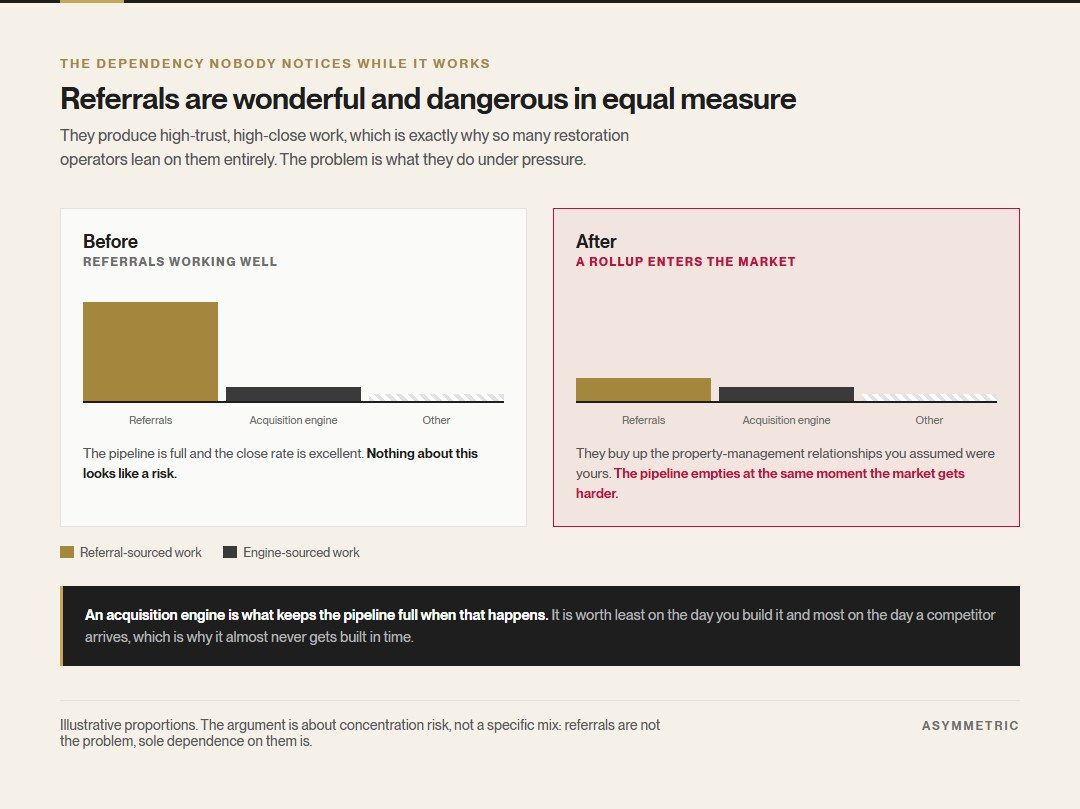
Referrals are wonderful and dangerous in equal measure. They produce high-trust, high-close work, which is why so many restoration operators lean on them entirely, and they vanish exactly when a rollup floods the market and starts buying up the property-management relationships you assumed were yours. An acquisition engine is what keeps the pipeline full when that happens.
Make technical expertise visible
The defining feature of a serious restoration operator is genuine technical depth: hazmat handling, large-loss capability, code-compliant remediation. The facility managers and insurers who route high-ticket work are evaluating exactly that, so the job is to make it visible and instantly reachable, not to bury it behind a generic brochure site.
The channels that win commercial restoration
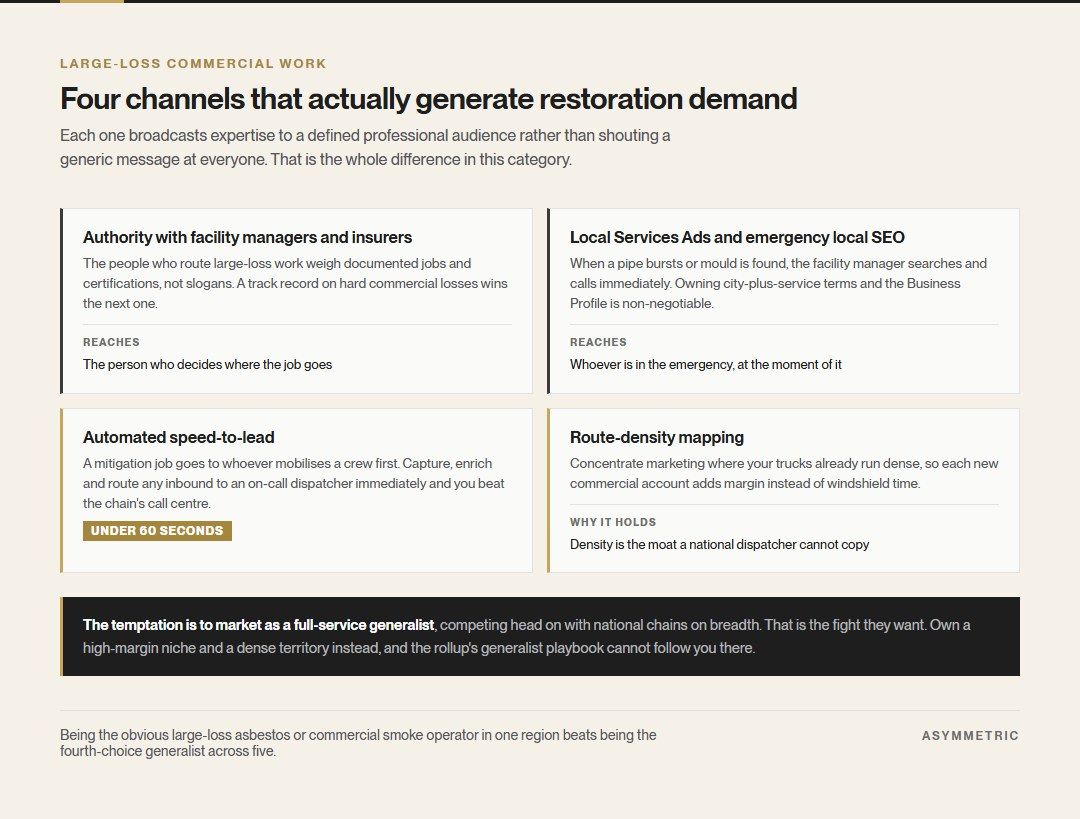
A few channels consistently generate commercial restoration demand:
- Authority with facility managers and insurers: the people who route large-loss work weigh documented jobs and certifications, not slogans. A track record on hard commercial losses wins the next one.
- Local Services Ads and emergency local SEO: when a pipe bursts or mold is found, the facility manager searches and calls now. Owning the city-plus-service terms and the Google Business Profile for emergency response is non-negotiable.
- Automated speed-to-lead: a mitigation job goes to whoever mobilizes a crew first. Capture, enrich, and route the inbound to an on-call dispatcher in under sixty seconds and you beat the chain's call center every time.
- Route-density mapping: concentrate marketing where your trucks already run dense, so each new commercial account adds margin instead of windshield time. Density is the moat a national dispatcher can't copy.
The common thread is that each channel broadcasts expertise to a defined professional audience, rather than shouting generic messages at everyone.
The strategy underneath: own a niche
How long the sales cycle actually runs, and what that changes
Commercial restoration and remediation work arrives on two completely different clocks, and a lead generation approach that only serves one of them will underperform whichever it neglects.
The emergency clock runs in minutes. A pipe bursts, mould is found, a spill happens, and the facility manager calls whoever answers. Nothing about relationship-building helps at that moment; being findable and reachable is the whole game, and the job goes to the first crew that can mobilise.
The retainer clock runs in months or longer. A multi-property agreement involves procurement, insurance review, references and a budget cycle, and it's decided by people who need to justify the choice internally. Speed is irrelevant here; documented capability and existing relationships are everything.
The mistake is running one system for both. An operator built entirely for emergencies wins call-outs and never converts them into recurring revenue. One built entirely for retainers has a slow, considered process and loses the two-in-the-morning jobs that would have introduced them to those accounts in the first place.
The connection between the two is worth being deliberate about: an emergency call handled well is the cheapest possible introduction to a facility manager who controls a retainer. Treating call-outs as transactions rather than as the top of the retainer funnel leaves most of their value on the table.
Certifications and documentation as marketing assets
In most industries certifications are hygiene. In hazardous material work they're closer to the product, because the buyer is making a risk decision on behalf of an organisation and needs something to point at.
The practical implication is that certifications belong on your site as substance rather than as a badge row in the footer. Which certification, what it permits you to handle, what it required, and what it means for the buyer's liability. A facility director assembling a recommendation needs that detail, and if your site doesn't supply it they will use whoever's site does.
The same applies to documented process. A written emergency-response commitment with an actual time on it, a description of how a site is assessed, and evidence of multi-property coverage are all things a buyer can forward internally. That's the test worth applying to every page: could the person who wants to hire you send this to their boss and have it answer the objection?
Project documentation is the underused half. Anonymised accounts of hard jobs, with the conditions, the approach and the outcome, do more to establish capability than any claim about experience. They're also the content most likely to be cited when somebody searches for a specific contamination or loss type, because almost nobody publishes it.
The temptation for a smaller operator is to market as a full-service generalist, competing head-on with national chains on breadth. That's the fight they want. Own a high-margin niche and a dense territory instead: be the obvious large-loss asbestos or commercial smoke operator in your region, and the rollup's generalist playbook can't follow you there.
Build the acquisition engine
If your restoration operation is running on referrals and wants an acquisition engine it controls, built on the technical depth and route density you already have, that's the work.
Frequently asked questions
How does a commercial restoration operator build an acquisition engine?
Stop depending on referrals. Combine authority with facility managers and insurers, Local Services Ads and emergency local SEO, automated speed-to-lead that mobilizes a crew in under sixty seconds, and route-density mapping so each new account adds margin. That's a pipeline you control.
Why is speed-to-lead critical in restoration?
A mitigation job, mold, asbestos, smoke, water, goes to whoever mobilizes first. Automated capture, enrichment, and dispatch to an on-call crew in under sixty seconds beats a national chain's call center and the operator still checking voicemail.
Should a restoration operator be a generalist or specialize?
Specialize. Owning a high-margin niche (large-loss asbestos, commercial smoke, institutional mold) and a dense territory beats competing on breadth against a national chain. Niche plus density is a moat their generalist playbook can't copy.
How does route density help win commercial contracts?
Concentrating work where your trucks already run dense lowers cost per job and speeds response, the two things facility managers and insurers actually buy. A centralized national dispatcher can't match local density, which is exactly where an independent wins the retainer.
How long does environmental consulting lead generation take to work?
Longer than most owners expect. Commercial and institutional buyers run procurement cycles measured in months, and first contact often comes well before a contract exists. Plan for a year of consistent visibility rather than a quarter, and measure signed retainers rather than form fills, because lead counts move long before revenue does.
What makes environmental consulting lead generation different from other B2B marketing?
The buyer is usually managing risk, not shopping for a service. Certifications, documentation, and a visible track record do more than clever positioning, because the person choosing you has to defend that choice internally. Technical credibility published in public tends to outperform advertising here.
About the author

Mark Hope
Founder, President & Chief Strategy Officer, Asymmetric Marketing
Mark Hope is the Founder, President & Chief Strategy Officer of Asymmetric Marketing. His career spans elite military service, senior leadership at two of the largest companies in their categories, and founding several companies of his own. It's the common thread behind how Asymmetric helps smaller companies out-compete bigger ones.
Mark began his career in U.S. Army Special Operations, serving from 1977 to 1988 in the 1st and 3rd Battalions of the 75th Ranger Regiment and as an Operator in 1st Special Forces Operational Detachment–Delta (Delta Force). What that world runs on (careful planning, reading your opponent, and winning from a position of disadvantage) is the foundation of how he helps smaller companies win today.