

October 1, 2024
Deconstructing Franchise Marketing Strategy: How Independent Operators Systematically Out-Convert the Brand Playbooks
Franchise marketing runs on two layers, a shared national brand and the local marketing each unit needs to get chosen. Here's how an independent operator exploits the centralized, generic playbook and out-converts the franchise in its own ZIP codes.
By Mark Hope, Founder, President & Chief Strategy Officer, Asymmetric Marketing

Franchise marketing runs on two levels at once: the national brand every location shares, and the local marketing each unit needs to actually get chosen. Understand how that machine works and its weakness is obvious. The national layer is centralized, generic, and slow; the local layer, where the customer actually buys, is run by franchisees who are operators, not marketers. That seam is exactly where an independent operator out-converts them.
The reason is simple. A franchise customer almost always buys locally: they search for the service near them, read local reviews, and choose among a handful of options on the map. National awareness only gets the franchise considered; the local layer decides who wins the job. A franchise spends millions to be considered, then hands the deciding moment to a generic playbook. You don't have to.
Key takeaways
- Franchise marketing operates on two levels: a centralized national brand and the local marketing each unit needs to be found and chosen. The national fund is their strength; the generic local execution is their weakness.
- Franchise customers buy locally, so the local layer is decisive, and it's the layer a fast independent dominates with route density and hyper-targeted Local Services Ads.
- The practical local levers, local search, reviews, Local Services Ads, and locally tuned offers, are the same ones an independent out-executes, because a franchisee runs them from a national template and you run them for one territory you know cold.
- A franchise system only works if franchisees can run the playbook, and most are operators, not marketers. Centralized marketing that has to be idiot-proof across a thousand units is generic by design. Generic is beatable.
- Franchises set budget as a national pool spread evenly across markets that are nothing alike, which is capital inefficiency. An independent concentrating capital in a few dense ZIP codes buys far more ground per dollar.
The two layers of franchise marketing
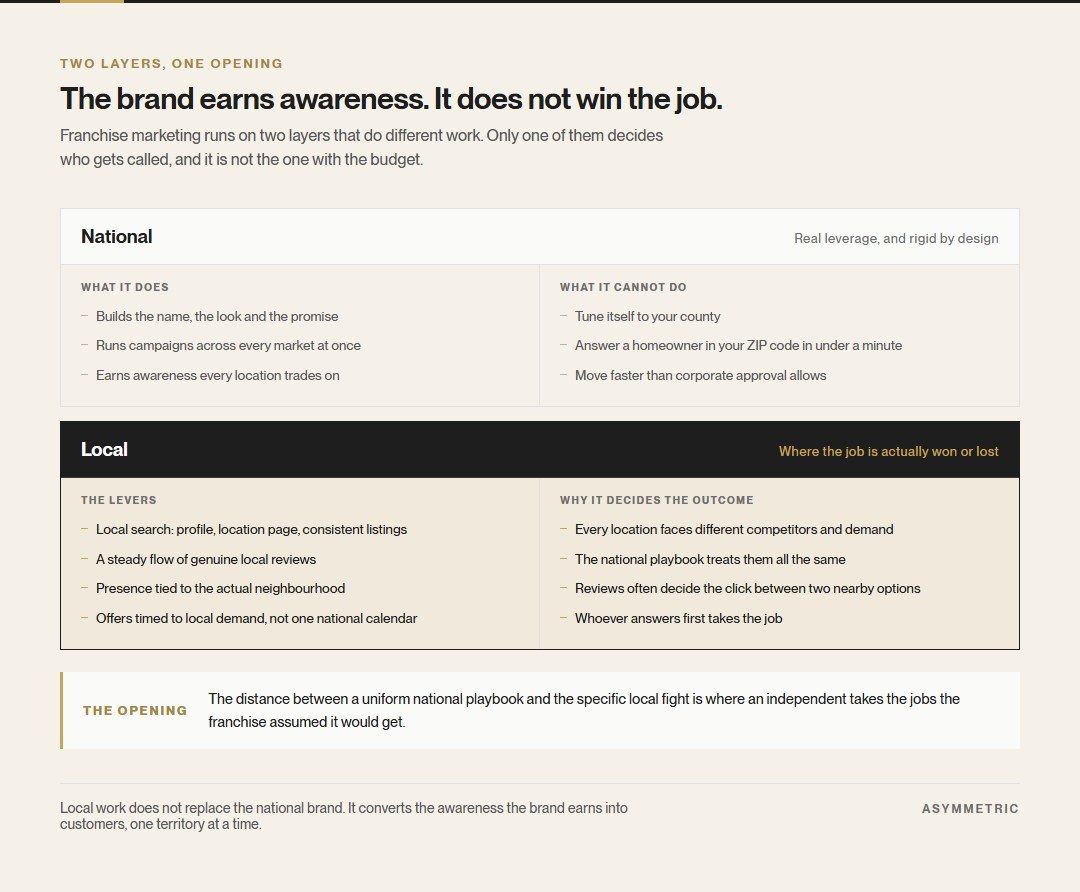
National marketing builds the brand every location trades on: the name, the look, the promise, the campaigns that run across markets. It's real leverage, and it's also rigid. A national ad fund can't tune itself to your county, can't answer a homeowner in your ZIP code in under sixty seconds, and can't move faster than corporate approval allows. The brand earns awareness; it doesn't win the job.
The local layer is where franchise marketing is won
A franchise doesn't win at headquarters; it wins, or loses, one local market at a time. Each location faces different competitors, different demand, and different price sensitivity, and the national playbook treats them all the same. That gap between the uniform playbook and the specific local fight is the opening. An independent who owns route density and answers first takes the jobs the franchise assumed it would get.
What local franchise marketing actually includes
For most franchise categories, the practical levers are concrete:
- Local search: an accurate Google Business Profile, a location page that ranks for the city-plus-service terms buyers use, and consistent listings across directories.
- Reviews: a steady flow of genuine local reviews, which often decide the click between two nearby options.
- Local social and community: a presence tied to the actual neighborhood, not just reshared national posts.
- Local offers: promotions tuned to local demand and timed to the market, rather than a single national calendar.
None of this replaces the national brand. It converts the awareness the brand earns into customers at each location.
Enabling franchisees to market locally
What a franchisee can change, and what they cannot
Most franchise marketing advice ignores the constraint that defines the job: a franchisee doesn't control the brand. Knowing where the boundary sits is what separates useful local work from a compliance argument.
Usually fixed by the agreement: the logo, the core brand assets, the national campaign creative, and often the claims you may make about the product or service. Attempting to work around these is a fast route to a difficult conversation and rarely produces much upside anyway.
Usually yours to control: your Google Business Profile and the photographs on it, how quickly you respond to an enquiry, which local terms your location page targets, whether you ask customers for reviews and how consistently, your presence in the actual community, and how you handle a lead once it arrives.
That second list is where local competition is decided, and none of it requires permission. The response-time advantage in particular is entirely within a franchisee's gift and is frequently the difference between winning and losing a job against both the chain next door and the independent across town.
The practical move is to stop treating brand constraints as the reason local marketing is hard. They constrain the message; they don't constrain the speed, the local relevance, or the reputation, and those decide most outcomes.
Here's the vulnerability stated plainly. A franchise marketing system only works if franchisees can run it, and most are operators, not marketers, so corporate ships them generic, localizable templates. You're not running a template. You run hyper-targeted Local Services Ads, a review engine, and automated speed-to-lead built for one territory. Against a generic playbook, specific wins.
Splitting the budget between national and local
Measuring local franchise marketing properly
National reporting tends to measure brand-level metrics that tell an individual location almost nothing. A location needs a smaller and more specific set.
Start with local visibility: whether you appear in the map pack for your main city-plus-service terms, and where. This is the single strongest predictor of local enquiry volume and it can be checked without any tooling by searching from within your service area.
Then measure response speed, because it's the metric most within your control and least reported centrally. Time from enquiry to first human contact, tracked as a median rather than an average, since one very slow response will hide behind a good mean.
Then review velocity: not the star rating alone, which moves slowly, but how many genuine reviews arrived this month. A steady flow signals an active business to both customers and the algorithm, and a rating that hasn't moved in a year signals the opposite regardless of how high it is.
Finally, count jobs won by source in the crudest way available, which is asking. National attribution won't tell an individual location where its work came from, and the person who booked the job usually knows.
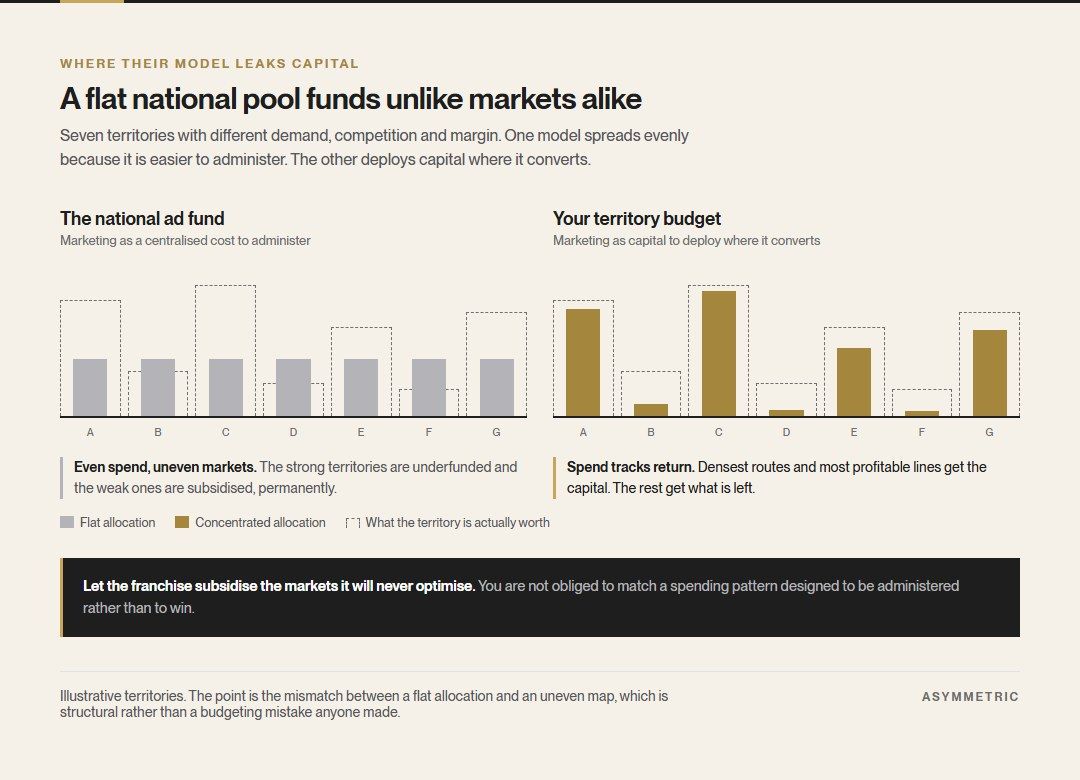
The budget question is where their model leaks capital. A flat national pool spread evenly funds markets that are nothing alike at the same rate, treating marketing as a centralized cost to administer rather than capital to deploy where it converts. You do the opposite: concentrate capital in your densest, most profitable routes and let the franchise subsidize markets it will never optimize.
Build franchise marketing that wins locally
If you're an independent competing against a franchise with a strong national brand, the brand isn't the fight. The local layer is, and that's where their centralized, generic playbook is weakest. Out-convert them there with route density, hyper-targeted Local Services Ads, and automated speed-to-lead, and the national fund becomes money spent making you look like the obvious local choice.
Frequently asked questions
How can an independent operator beat a franchise locally?
By attacking the layer franchises are weakest at: local execution. A franchise customer buys locally, but the franchisee runs a generic national template. Concentrate route density, hyper-targeted Local Services Ads, a steady review flow, and automated speed-to-lead in your ZIP codes and you out-convert the brand where the job is actually decided.
Isn't a franchise's national ad fund an advantage?
It buys awareness, not the job. A national fund is centralized, generic, and slow; it can't tune to your county or answer a lead in under sixty seconds. It gets the franchise considered, then hands the deciding moment to a playbook you can out-execute locally.
What is the franchise's biggest marketing weakness?
Generic-by-design local execution. Because the playbook has to work across hundreds of operators who aren't marketers, it's built for the average market, not yours. An independent tuned to one territory beats the average every time.
Where should an independent concentrate budget against a franchise?
Where they spread thin: your densest routes and most profitable service lines. Franchises spread a national pool evenly across unlike markets. Concentrating capital in a few ZIP codes you know cold buys far more ground per dollar.
What is franchise marketing?
Franchise marketing runs on two layers. The national layer builds the brand and is funded by an ad fund every franchisee pays into. The local layer covers what an individual location does in its own market. The national layer is what people notice, but the local layer is where franchise marketing is won or lost.
Do franchisees pay for marketing?
Almost always. Most franchise agreements require a percentage of revenue paid into a national ad fund, and many set a minimum local spend on top of that. It's worth reading what the fund actually buys, because a franchisee paying into national brand advertising still needs budget for the local work that makes their own phone ring.
About the author

Mark Hope
Founder, President & Chief Strategy Officer, Asymmetric Marketing
Mark Hope is the Founder, President & Chief Strategy Officer of Asymmetric Marketing. His career spans elite military service, senior leadership at two of the largest companies in their categories, and founding several companies of his own. It's the common thread behind how Asymmetric helps smaller companies out-compete bigger ones.
Mark began his career in U.S. Army Special Operations, serving from 1977 to 1988 in the 1st and 3rd Battalions of the 75th Ranger Regiment and as an Operator in 1st Special Forces Operational Detachment–Delta (Delta Force). What that world runs on (careful planning, reading your opponent, and winning from a position of disadvantage) is the foundation of how he helps smaller companies win today.