

June 14, 2026
How Independent Service Operators Out-Maneuver Franchises and Rollups
Independent home & commercial service operators have real advantages over franchises and PE rollups, speed, route density, focus, and local relationships. Here's how to use them to take territory.
By Mark Hope, Founder, President & Chief Strategy Officer, Asymmetric Marketing

Independent service operators have never had more ways to out-maneuver larger competitors. The advantages that once belonged only to scale, reach, production, distribution, are eroding, while the advantages of being small and local, speed, focus, route density, and real relationships, are getting stronger. That matters now more than ever, because the franchise and the private-equity rollup moving into your market are betting you don't know how to use them.
Key takeaways
- Independent operators can't win by outspending or out-reaching a franchise or rollup; trying is the most common way they lose.
- Their real advantages are speed, route density, niche depth, and closeness to customers, all things a centralized rollup makes harder.
- The winning tactics concentrate limited capital where a larger competitor is weak, slow, generic, or absent.
- Community and a sharp position build loyalty and meaning a giant's budget can't manufacture.
- This is asymmetric competition: change the terms so the incumbent's size stops being the deciding factor.
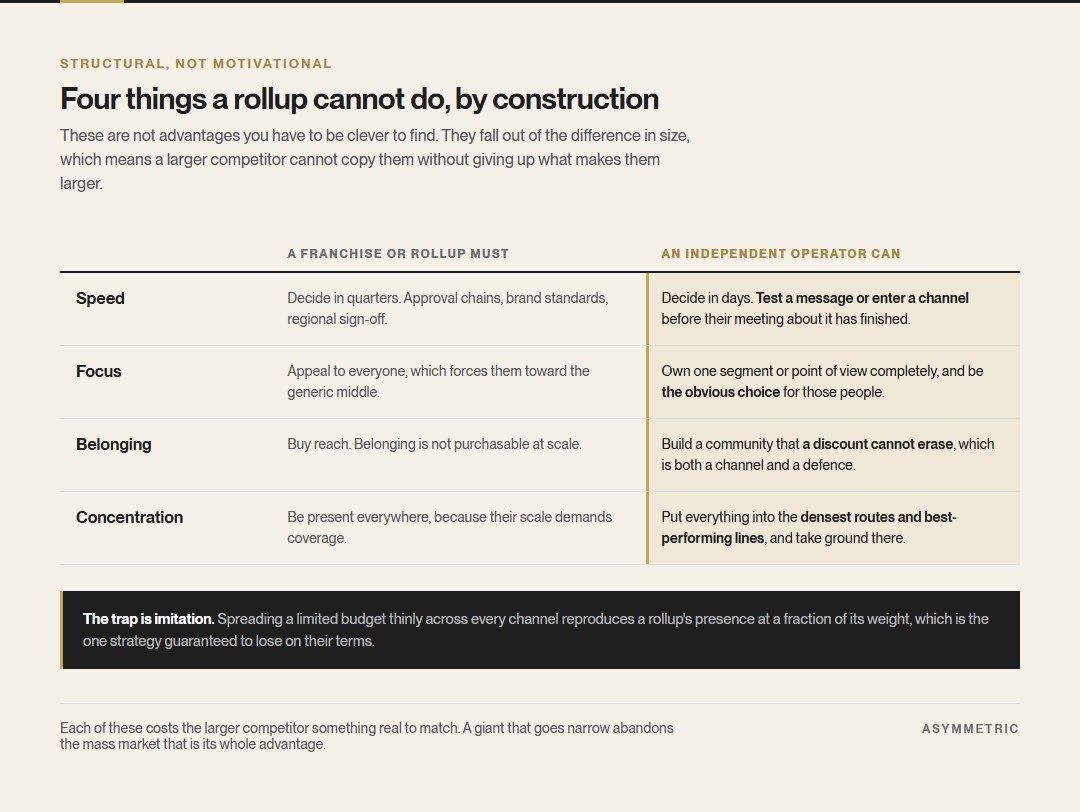
Move faster than a big competitor can
A large company decides in quarters; a small one can decide in days. Speed is an advantage scale can't buy. A small brand can test a message, enter an emerging channel, or respond to a cultural moment before a big competitor's approval chain has finished meeting about it. Treating speed as a deliberate weapon, shipping and learning while the giant deliberates, compounds into an edge over time, the operational version of getting inside a competitor's decision cycle.
Marketing tactics for a small business, ranked by what they cost you
Advice for small businesses usually arrives as a list of channels with no sense of what each one demands. The more useful sort is what a tactic costs in the currency you're actually short of, which for most operators is attention rather than money.
Cheap in money, expensive in attention: local search and reviews. Claiming and maintaining a Google Business Profile, keeping listings consistent, and asking every satisfied customer for a review costs almost nothing and demands a habit somebody has to own. It also produces the highest-intent enquiries you'll get, because the person searching already has the problem.
Cheap in both, and underused: answering the questions your buyers actually ask. Most operators know the six questions every prospect raises on a first call. Writing a clear answer to each one, on your own site, does more than a content calendar because it meets people at the moment of doubt rather than at the moment of scrolling.
Expensive in money, cheap in attention: paid search on narrow, high-intent terms. This is where a small budget can genuinely compete, because relevance rather than spend decides placement, and a precisely matched advertiser can outrank a larger one paying more.
Expensive in both, and usually a mistake early: broad social, brand campaigns, and anything measured in impressions. Not because they never work, but because they need scale to pay back, and scale is the thing you don't have.
Go narrow where they must go broad
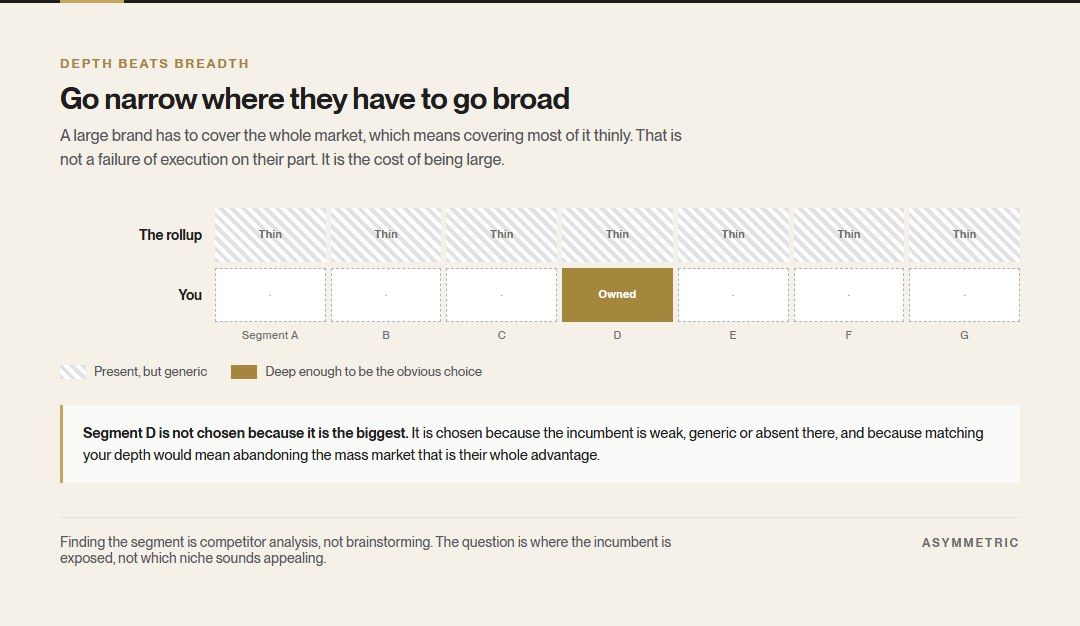
A big brand has to appeal to everyone, which forces it toward the generic middle and leaves the edges underserved. A small brand can own one specific segment, need, or point of view completely, and be the obvious choice for the people who share it. Depth in a niche beats breadth, because the giant can't match the focus without abandoning the mass market that's its whole advantage. Finding that underserved edge is a matter of honest competitor analysis: where is the incumbent weak, generic, or absent?
Build a community a giant can't buy
Small brands can build genuine relationships with their customers that large companies struggle to replicate. Customers who feel ownership of a brand become advocates, and that affinity is a moat: it is loyalty a competitor can't erase with a discount. A giant can buy reach; it can't easily manufacture belonging. For a small brand, community is both a marketing channel and a defense.
Concentrate, don't spread
The single biggest mistake an operator makes is spreading a limited budget thinly across every channel, mimicking a rollup's presence at a fraction of the budget. Concentrate it instead: your densest routes, your most profitable service line, the ZIP codes where you already win. That's where limited capital takes ground.
How to choose which tactics to drop
Concentrating is easy to agree with and hard to do, because dropping a channel feels like giving up ground. The question that makes it tractable isn't which tactic performs best but which one you would notice stopping.
Take everything currently running and, for each, ask what would happen if it paused for a quarter. Some will have an obvious answer: enquiries would fall, and you can name roughly by how much. Others will produce a pause and a justification about awareness. The second group is where the budget is leaking.
The harder version is dropping something that does work in order to do something else properly. A tactic returning modestly while consuming half your attention can be worth stopping so the remaining half becomes whole. Operators rarely fail from picking the wrong channel; they fail from running six at a quarter of the required effort each.
One practical rule: whatever you keep, resource it until it's genuinely good before adding anything alongside it. A single channel run properly beats four run adequately, and it's far easier to tell whether it's working.
Compete on your terms, not theirs
If you're an operator losing ground by trying to play the rollup's game, the way to win is to change the game: faster, sharper, and concentrated where they can't follow.
Frequently asked questions
How can a small service company compete with a big franchise or rollup?
Not by matching their spend. By using the advantages scale erodes: speed, route density, niche focus, and real local relationships. Concentrate limited capital where the rollup is weak, slow, or absent and you change the terms of the fight.
What is the biggest mistake operators make against bigger competitors?
Spreading a limited budget thinly across every channel to mimic a rollup's presence at a fraction of the budget. Concentration beats imitation every time.
Why does being small actually help?
A franchise or rollup decides in quarters and runs one centralized playbook across many markets. A local operator can decide in days and tune to a single neighborhood. Speed and focus are advantages scale can't buy back.
How do I start competing asymmetrically?
Find the opening: the service line, route, or customer the rollup is too big to serve well, then concentrate there. A 1-Day Pathfinder Sprint maps exactly where that opening is in your territory.
What are the best marketing tactics for a small business?
The ones that are cheap in money and repayable in attention: local search and reviews, and clear answers to the questions buyers actually ask on a first call. Both meet people who already have the problem, which is why they convert better than broad awareness activity. Narrow, high-intent paid search is the other place a small budget competes well, because relevance rather than spend decides placement. Broad social and brand campaigns aren't wrong, but they need scale to pay back and scale is the thing you don't have.
How does a small business compete with a larger competitor's marketing budget?
Not by matching it. A larger rival has to appeal to everyone, decide in quarters, and cover every market at once, which forces it toward the generic middle and leaves the edges underserved. A smaller operator can decide in days, own one segment completely, and concentrate its entire budget where the larger competitor is weakest. The trap is spreading a limited budget thinly across every channel to imitate a bigger presence, which reproduces their coverage at a fraction of the weight and loses on their terms.
How do you decide which marketing tactics to stop?
Ask what would happen if each one paused for a quarter. Some have an obvious answer, where enquiries would fall and you can roughly say by how much. Others produce a pause and a justification about awareness, and that second group is where budget is leaking. Operators rarely fail from picking the wrong channel; they fail from running six at a quarter of the required effort each. Whatever you keep, resource it until it's genuinely good before adding anything alongside it.
About the author

Mark Hope
Founder, President & Chief Strategy Officer, Asymmetric Marketing
Mark Hope is the Founder, President & Chief Strategy Officer of Asymmetric Marketing. His career spans elite military service, senior leadership at two of the largest companies in their categories, and founding several companies of his own. It's the common thread behind how Asymmetric helps smaller companies out-compete bigger ones.
Mark began his career in U.S. Army Special Operations, serving from 1977 to 1988 in the 1st and 3rd Battalions of the 75th Ranger Regiment and as an Operator in 1st Special Forces Operational Detachment–Delta (Delta Force). What that world runs on (careful planning, reading your opponent, and winning from a position of disadvantage) is the foundation of how he helps smaller companies win today.