

June 12, 2026
Winning Commercial Facilities Contracts: How Commercial Service Providers Secure High-Ticket Inbound Retainers with Senior Living Networks
How an independent commercial service provider positions itself as the automated, preferred emergency-response vendor for senior living networks and multi-property institutional complexes, and wins high-ticket recurring facilities retainers.
By Mark Hope, Founder, President & Chief Strategy Officer, Asymmetric Marketing

Winning a facilities-services contract with a senior living network is one of the highest-stakes B2B sales an independent operator can make. These are multi-property institutional complexes that need reliable emergency response, HVAC, plumbing, and restoration, and they sign recurring, high-ticket retainers with vendors they trust. This is how a commercial service provider positions itself to win that work.
Key takeaways
- Winning facilities retainers is a long, high-trust B2B decision involving regional facility directors, procurement, and on-site managers, so positioning must address the whole buying committee, not a single contact.
- A real plan aligns positioning, relationships, and an automated response system toward signed recurring retainers, not one-off jobs or raw leads.
- Positioning matters because vendors look alike on paper. The plan must prove what makes you the lower-risk choice: certifications, large-loss capability, and a guaranteed response time across every property in the network.
- The path to these contracts runs through facility-director relationships, references from comparable institutions, and a documented emergency-response process, reinforced by being instantly reachable when something breaks.
- Reliability is the product: response time, transparency, and an automated speed-to-lead system that proves you'll pick up at 2 a.m. matter more than clever creative.
Start with research and positioning
Most vendors describe themselves identically: licensed, insured, responsive. That makes selecting one feel like a coin flip, which is exactly why procurement defaults to the incumbent or the national chain. Position on the specifics a facility director actually loses sleep over: guaranteed multi-property response times, large-loss and hazmat capability, and a single automated intake that covers every building in the network.
The moves that win the contract
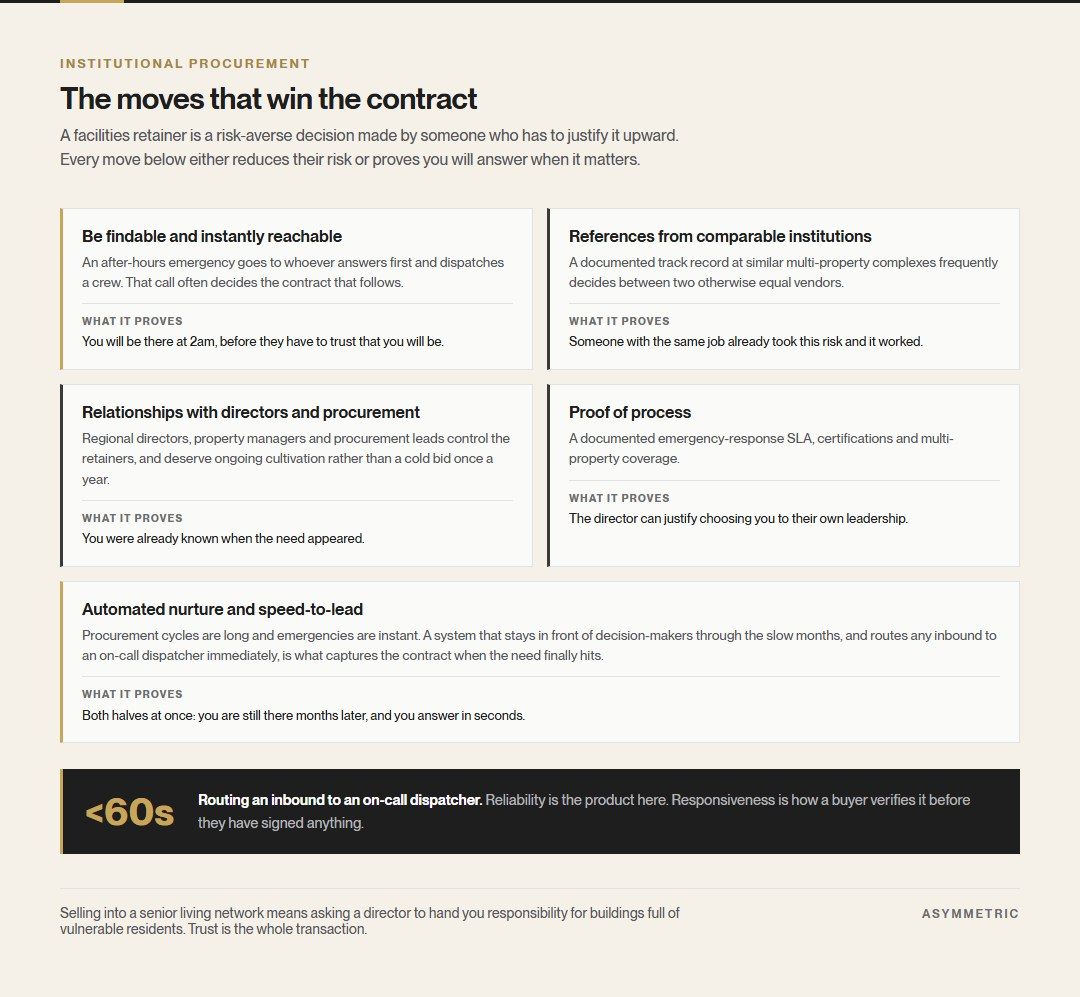
Winning facilities contracts works as a system across a few moves:
- Be findable and instantly reachable: when a facility manager has an after-hours emergency, the vendor who answers first and dispatches a crew gets the call, and often the contract that follows.
- References from comparable institutions: in a risk-averse procurement decision, a documented track record at similar multi-property complexes often decides between vendors.
- Facility-director and procurement relationships: regional directors, property managers, and procurement leads control the retainers and deserve deliberate, ongoing cultivation, not a cold bid once a year.
- Proof of process: clear documentation of your emergency-response SLA, certifications, and multi-property coverage that lets a director justify choosing you to their own leadership.
- Automated nurture and speed-to-lead: because procurement cycles are long and emergencies are instant, a system that stays in front of decision-makers and routes any inbound to an on-call dispatcher in under sixty seconds captures the contract when the need finally hits.
Reliability is the product
Selling into a senior living network isn't about a feature; it's about earning enough trust that a facility director will hand you responsibility for buildings full of vulnerable residents. That trust is built on proven reliability and instant responsiveness, which is precisely what automated speed-to-lead and a documented SLA demonstrate before you've signed a thing.
Measure signed retainers, not leads
Who actually decides, and what each of them needs
A facilities retainer is rarely one person's decision, and pitching it as though it's explains most losses. Three roles usually matter, and they want different things from the same conversation.
The facility or maintenance director is the one who feels the pain and usually initiates. They need to know you'll answer when a building has a problem at an inconvenient hour, and they judge that on responsiveness and on whether you understand their type of property. This is the person your emergency response and your speed-to-lead are aimed at.
The regional or operations lead controls the budget and thinks in terms of risk across multiple sites. They need consistency and coverage, and they're the reason multi-property references matter more than any individual job. Their question is whether you can do this reliably at every location, not whether you did it well once.
Procurement or compliance holds the veto. They're not evaluating quality; they're checking insurance, certifications, documented process and whether the paperwork will survive scrutiny. A proposal that impresses the director and fails here goes nowhere, and it usually fails silently.
The practical consequence is that your materials need to serve all three without asking any of them to read the others' section. The director needs the response commitment, the regional lead needs the coverage and references, and procurement needs the documentation, and the easiest way to lose is to send one document written for whichever of them you happened to meet.
Why senior living networks are harder, and worth it
Selling into senior living carries a weight that ordinary commercial facilities work does not, and pretending otherwise tends to show.
The buildings are full of vulnerable residents, which raises the consequence of every failure and lengthens every approval. Work that would be routine in an office block involves considerations about disruption, safety and resident welfare that a vendor who hasn't done it will underestimate visibly in the first meeting.
Regulatory and family scrutiny compounds it. A facility director is accountable not only to their organisation but to residents' families, and that accountability shapes what they can risk on an unproven vendor. Caution here's not obstruction; it's the job.
What makes it worth the difficulty is the other side of the same coin. Contracts that are hard to win are hard to displace. A vendor who has proven reliability across a network, and whose documentation has already survived procurement, isn't swapped out for a marginally cheaper bid, because the cost of being wrong is far higher than the saving.
That's the asymmetry to plan around. The barrier that makes the first contract slow is the same barrier protecting you afterwards, which makes the effort of the first one an investment rather than a cost of sale.
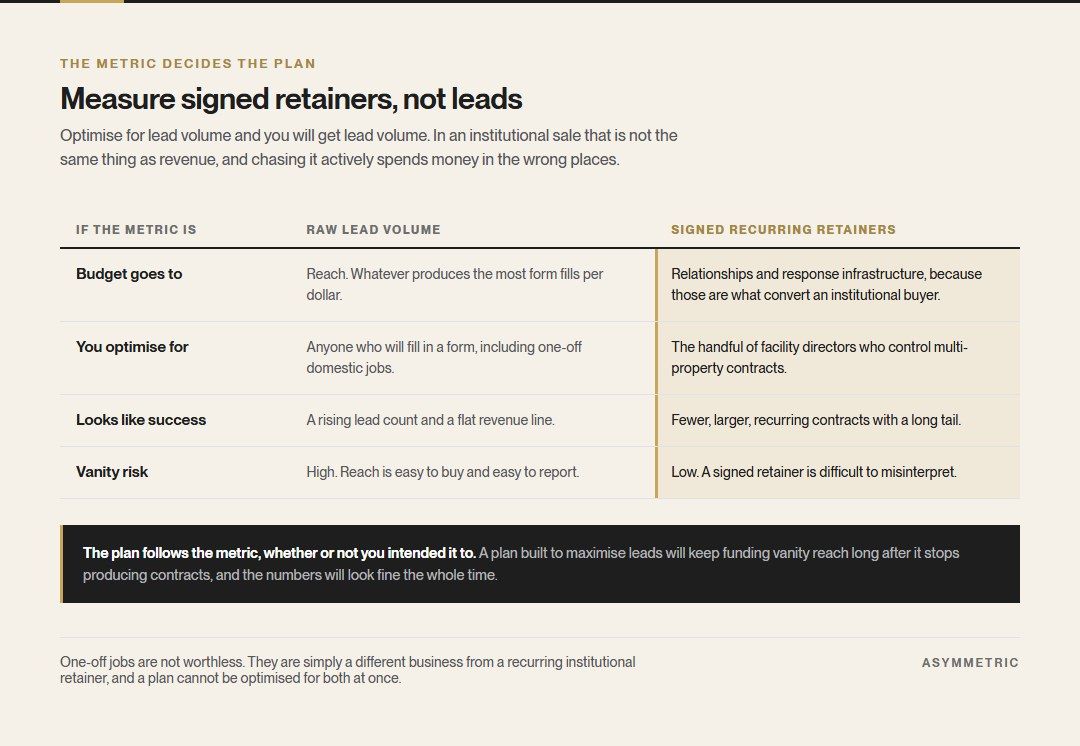
The metric that matters is signed recurring retainers, not raw lead volume or one-off jobs. A plan optimized to that outcome concentrates capital on the relationships and the response infrastructure that convert an institutional buyer, and ignores vanity reach.
Build the system that wins the contracts
If you're a commercial service operator who wants to win high-ticket recurring retainers from senior living networks and other multi-property institutions, building that positioning and the automated response system behind it is the work.
Frequently asked questions
How does a service provider win facilities contracts with senior living networks?
Position as the lower-risk, faster-responding vendor: certifications and large-loss capability, references from comparable institutions, cultivated facility-director relationships, and automated speed-to-lead that proves you answer and dispatch instantly across every property.
Who actually makes the buying decision?
A committee: regional facility directors, procurement, and on-site managers. Recurring retainers are awarded on trust and documented reliability, so your positioning has to speak to all of them, not a single contact.
Why does speed-to-lead matter for institutional facilities work?
Emergencies are instant and procurement is risk-averse. A vendor who captures, enriches, and dispatches an after-hours call to an on-call crew in under sixty seconds proves the reliability a facility director is buying, and often wins the retainer that follows.
What separates the winning vendor from the rest?
Specifics, not slogans. Guaranteed multi-property response times, hazmat and large-loss capability, a documented SLA, and references from similar complexes let a director justify the choice to leadership. That's how an independent beats both the incumbent and the national chain.
How long is the sales cycle for senior living facilities contracts?
Months, usually. These are institutional buyers with procurement steps, insurance requirements, and more than one person who can say no. Treat early conversations as positioning rather than selling, and track signed retainers instead of leads, because lead volume can look healthy for a long time before anything gets signed.
What should a senior living marketing plan measure?
Signed retainers and the revenue behind them. Lead counts flatter a plan that isn't working, because institutional buyers make contact early and often. Response time, the number of qualified conversations, and contracts signed give a truer picture than anything at the top of the funnel.
About the author

Mark Hope
Founder, President & Chief Strategy Officer, Asymmetric Marketing
Mark Hope is the Founder, President & Chief Strategy Officer of Asymmetric Marketing. His career spans elite military service, senior leadership at two of the largest companies in their categories, and founding several companies of his own. It's the common thread behind how Asymmetric helps smaller companies out-compete bigger ones.
Mark began his career in U.S. Army Special Operations, serving from 1977 to 1988 in the 1st and 3rd Battalions of the 75th Ranger Regiment and as an Operator in 1st Special Forces Operational Detachment–Delta (Delta Force). What that world runs on (careful planning, reading your opponent, and winning from a position of disadvantage) is the foundation of how he helps smaller companies win today.