

November 5, 2024
The Franchise Monopolization Playbook: How Independent Service Providers Block Venture-Backed Territory Expansion
How venture- and PE-backed franchise systems expand territory, and how an independent service provider exploits their bloated compliance, slow corporate approvals, and weak local speed-to-lead to block them.
By Mark Hope, Founder, President & Chief Strategy Officer, Asymmetric Marketing

A franchise strategy is the system that lets one proven business model expand across many markets: the engine behind the venture- and private-equity-backed rollups now buying up service territories. It covers objectives, a replicable model, brand standards, and a playbook. Understand that machine and you can block it, because everything that makes it scalable also makes it slow, compliance-heavy, and generic at the one thing that wins jobs, local speed.
Key takeaways
- Franchise strategy is the system that lets one model expand across many markets; it's also what a venture-backed rollup uses to monopolize a region, location by location.
- A franchise is won, or blocked, one local market at a time. Each location faces different competitors and demand, and corporate can't fight every local battle for it.
- Their scale comes with drag: bloated compliance structures and slow corporate approvals that make a national chain weak at fast local speed-to-lead, the exact gap an independent attacks.
- A rollup runs one centralized playbook across dozens of markets; it can't tune to your county, answer a lead in under sixty seconds, or move faster than its approval chain allows.
- An independent blocks expansion by concentrating capital and speed where the chain is slowest: dense local routes, hyper-targeted Local Services Ads, and automated speed-to-lead that beats a corporate phone tree every time.
The part most guides leave out is this: that playbook is table stakes, not an edge. Every franchisor has objectives, standards, and a training manual, and none of it is why one franchise system beats another. Franchises don't win at headquarters. They win, or lose, one local market at a time, where each location faces a different set of competitors and the corporate brand counts for far less than most franchisors assume.
The corporate playbook is necessary, not your advantage
A replicable model, consistent quality, and a training system are required to scale, and they're exactly why a rollup is slow. Every local decision runs through brand standards and corporate approval. That consistency is real leverage at headquarters and dead weight in a fast local fight, where the job goes to whoever answers first.
Where franchises actually win: one market at a time
The real competitive action is local, and it's where a venture-backed chain is most exposed. A location in your market competes against different rivals, at different price points, with different demand, while corporate optimizes for the average. An independent who owns the territory and the speed-to-lead wins the jobs the chain's spreadsheet already counted.
Read each market before you spend in it
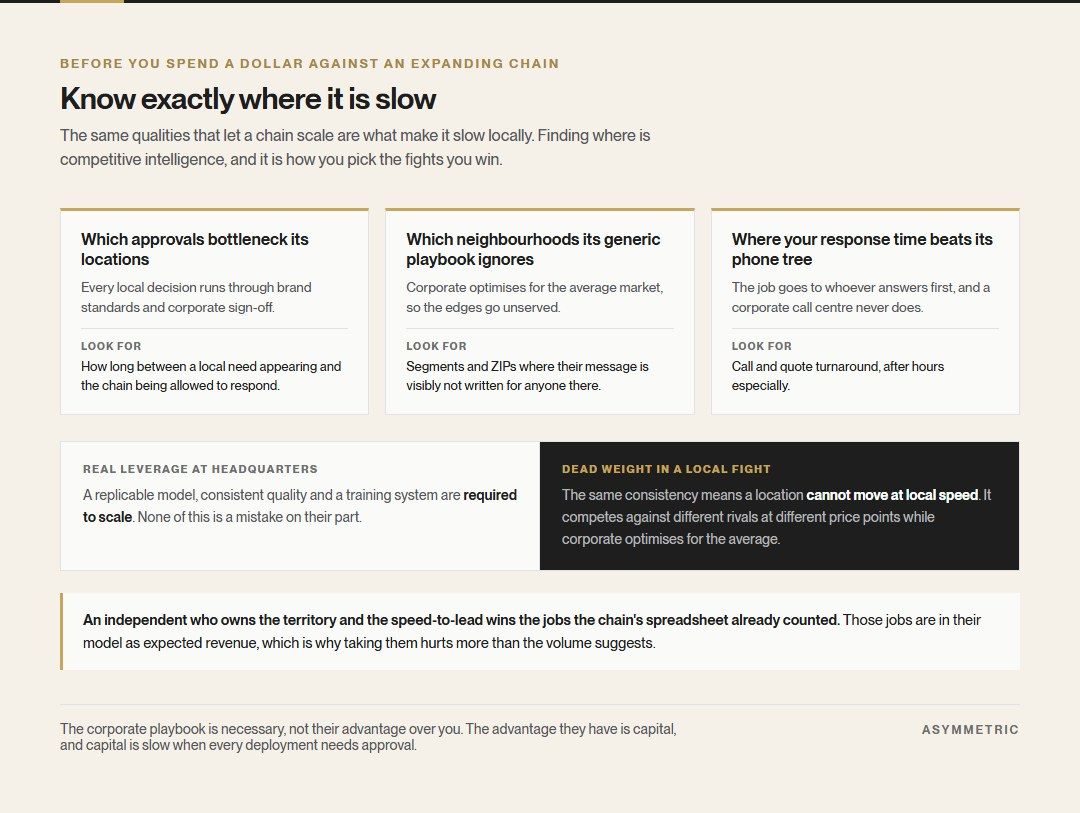
Before you spend a dollar against an expanding chain, know exactly where it's slow: which approvals bottleneck its locations, which neighborhoods its generic playbook ignores, and where your response time crushes its corporate phone tree. That's competitive intelligence, and it's how you pick the fights you win.
Budget by market, not by formula
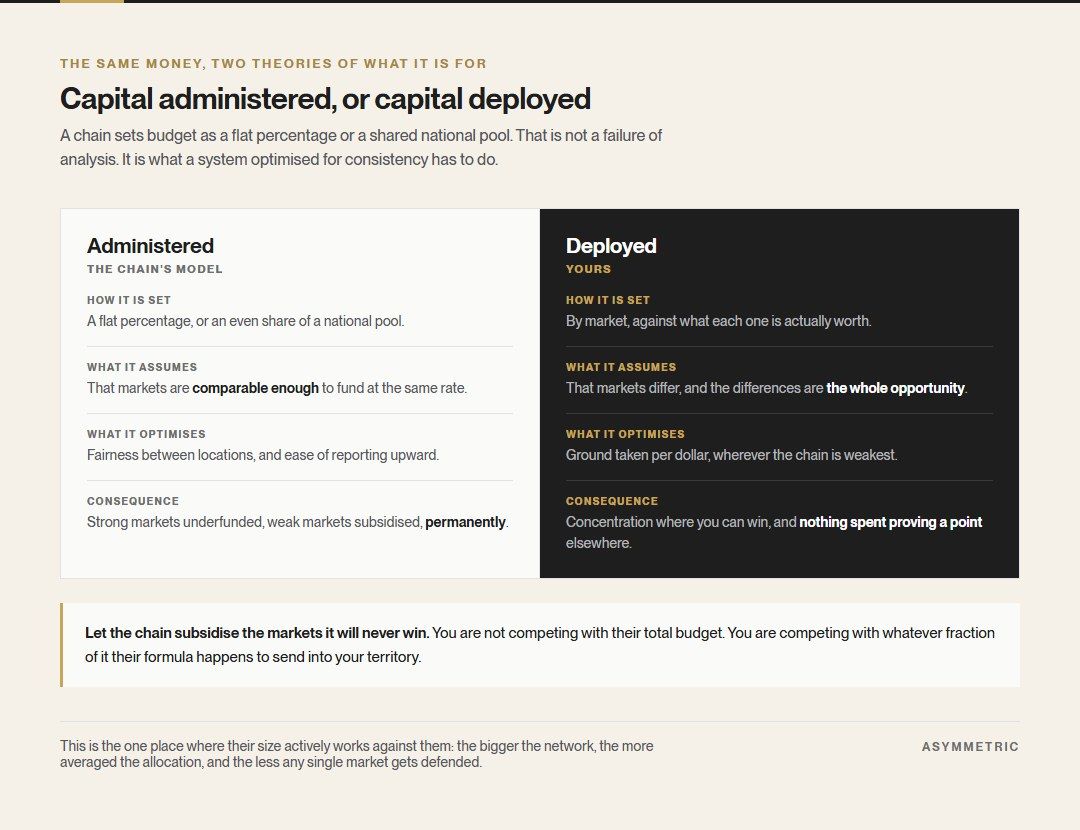
A chain sets budget as a flat percentage or a shared national pool, spreading capital evenly across markets that are nothing alike. That's capital administered, not deployed. You do the opposite: concentrate capital where the chain is weakest and let it subsidize markets it will never win.
Local presence is the practical lever
How to tell when a chain is entering your market
Territory expansion is visible well before the trucks arrive, and the operators who prepare are the ones watching for it rather than reacting to it.
Hiring is the earliest signal. Job postings for a market where the chain has no presence usually precede opening by months, and they name the roles, which tells you what kind of operation is coming. Setting a saved search on the major boards for your metro costs nothing.
Paid search is the second. A chain testing a market frequently buys ads there before it opens, to gauge demand. Checking the ads on your main service terms every few weeks, from a local IP, will show you a new bidder before anything physical appears.
Property and permits are the third and most concrete, and they're public. Commercial lease filings and permit records for the categories the chain operates in are searchable in most jurisdictions.
The point of watching isn't anxiety, it's timing. A chain entering a market is at its weakest in the first year, before it has local reviews, local relationships or route density. That window is when concentrating your spend in the affected postcodes costs least and achieves most, and it closes.
What to do in the first ninety days of a chain arriving
The instinct is to cut price, and it's the one response that plays directly to their advantage: they can fund a price war longer than you can and they know it.
The first move is to secure the relationships that are actually at risk. Commercial accounts, referral partners and repeat customers are worth a personal conversation before the chain's sales effort reaches them, not after. Most will stay if asked; almost none will stay if ignored while somebody else asks.
The second is to make your local proof unmissable. A new entrant has no local reviews and no local track record, and that asymmetry is at its largest in their first months. Any effort spent gathering reviews and visible local work pays back fastest in exactly this window.
The third is to concentrate rather than spread. The temptation is to defend everywhere at once, which thins your budget precisely when it needs to be dense. Pick the postcodes and the service lines where you're strongest and where they're weakest, and hold those completely.
And the fourth is patience with the parts you can't defend. Some volume will go, particularly the price-led end of the market. Losing that segment deliberately, while holding the profitable one, is a better outcome than defending all of it badly.
For most service categories the buyer searches locally, with 'near me' and city-plus-service terms. Local SEO, accurate listings, reviews, and Local Services Ads decide the click, and a fast independent runs all of them tighter than a chain running them from a template.
Equip franchisees to win locally
A chain's strategy only works if the people running each location can execute a centralized playbook, and they execute it generically. You're not executing a template across a thousand units; you're running automated speed-to-lead and route-dense acquisition for one territory you know cold. Specific and fast beats uniform and slow.
Build a franchise strategy that wins locally
If a venture-backed chain is expanding into your territory leaning on corporate brand and uniform campaigns, the gap between its national playbook and the local fight is your opening. Block the expansion with route density, hyper-targeted Local Services Ads, and automated speed-to-lead it's structurally too slow to match.
Frequently asked questions
How can an independent block a franchise from expanding into its territory?
Attack the speed gap. A franchise scales through compliance and corporate approval, which makes it slow locally. Concentrate route density, hyper-targeted Local Services Ads, and automated speed-to-lead that answers leads in under sixty seconds, and you take the jobs the chain's expansion model already counted on.
Why are venture-backed chains weak locally?
Everything that makes them scalable, brand standards, centralized playbooks, approval chains, makes them slow and generic in a single market. They optimize for the average market; an independent tuned to one territory beats the average.
What is speed-to-lead and why does it matter against a chain?
It's how fast you capture, enrich, and respond to an inbound lead. A high-ticket service job often goes to whoever answers first. Automated speed-to-lead beats a corporate phone tree and a franchisee checking email hourly, which is where chains routinely lose local jobs.
Where should an independent fight a chain, and where shouldn't it?
Fight where the chain is slow and generic: dense local routes, your most profitable service lines, neighborhoods its template ignores. Don't fight its national brand head-on. Concentrate capital where your speed and local knowledge decide the outcome.
What is a franchise strategy?
For the chain, a franchise strategy is a repeatable model rolled out market by market, funded centrally and standardized so each location performs predictably. For an independent competing against one, the useful read is the opposite: that standardization is what makes a chain slow to respond locally, and local response is where an independent wins.
How do you know when a chain is entering your market?
Watch the signals that come before the opening: commercial real estate changing hands, hiring posts for a location that doesn't exist yet, and local ad spend appearing on terms you normally own. Those show up months ahead, which is enough time to lock in the customers a new entrant would otherwise take.
About the author

Mark Hope
Founder, President & Chief Strategy Officer, Asymmetric Marketing
Mark Hope is the Founder, President & Chief Strategy Officer of Asymmetric Marketing. His career spans elite military service, senior leadership at two of the largest companies in their categories, and founding several companies of his own. It's the common thread behind how Asymmetric helps smaller companies out-compete bigger ones.
Mark began his career in U.S. Army Special Operations, serving from 1977 to 1988 in the 1st and 3rd Battalions of the 75th Ranger Regiment and as an Operator in 1st Special Forces Operational Detachment–Delta (Delta Force). What that world runs on (careful planning, reading your opponent, and winning from a position of disadvantage) is the foundation of how he helps smaller companies win today.