

September 21, 2024
Master Decision-Making With the OODA Loop
The OODA loop, John Boyd's Observe-Orient-Decide-Act cycle, gets reduced to four boxes. Its real lesson is tempo: the competitor who decides and acts faster, on better orientation, gets inside the other's loop and makes their moves irrelevant. Here's how a challenger uses it to out-decide a bigger rival.
By Mark Hope, Founder, President & Chief Strategy Officer, Asymmetric Marketing

The OODA loop is a decision cycle with four stages: Observe, Orient, Decide, Act. The fighter pilot and military strategist John Boyd developed it to explain why some pilots consistently won dogfights against technically superior aircraft. Boyd's answer wasn't better planes. It was a faster, better decision cycle. The pilot who could observe the situation, orient to it, decide, and act before an opponent finished the same loop controlled the fight.
Most business write-ups reduce the OODA loop to four boxes and a diagram, which misses the point Boyd spent his life making. The loop isn't a checklist you complete once. It's a continuous feedback loop, and the whole advantage comes from running it faster and more accurately than the people you compete against. Speed and quality of decision-making, not the diagram, are the weapon.
Key takeaways
- The OODA loop, Observe, Orient, Decide, Act, is John Boyd's model of winning by cycling through decisions faster than an opponent.
- The decisive phase is Orient: how you interpret what you observe, shaped by experience, culture, and mental models.
- You win not by being right once but by out-cycling a rival's ability to react, getting inside their decision loop.
- In business it's the case for tempo: the speed and quality of decisions are a weapon a bigger budget can't buy.
- It pairs with strategy, OODA is how you execute an asymmetric position faster than the incumbent can respond.
Who created the OODA loop, and why it matters
John Boyd was a U.S. Air Force fighter pilot, instructor, and strategist whose ideas changed modern military doctrine. As an instructor he was known as Forty-Second Boyd, for a standing bet that he could defeat any opponent in simulated air combat within forty seconds, starting from a position of disadvantage. Boyd won it consistently, and he wanted to understand why. With mathematician Thomas Christie, Boyd developed energy-maneuverability theory, which explained aircraft performance in terms of how quickly a plane could change its energy state, and that work changed how fighter aircraft were designed and evaluated.
Boyd's deeper contribution came when he generalized the lesson beyond aircraft. Studying air combat and then military history, Boyd found that what separated winners was the tempo of decision-making under uncertainty. The OODA loop was the result. Boyd's ideas spread far past the Air Force: the U.S. Marine Corps built much of its maneuver-warfare doctrine on Boyd's thinking, and John Boyd is now regarded as one of the most influential military strategists of the twentieth century. The Marine Corps embrace of Boyd is telling, because maneuver warfare is precisely about using superior tempo and faster decision-making to defeat a stronger, slower opponent, which is the same problem a challenger faces in business.
The four stages of the OODA loop
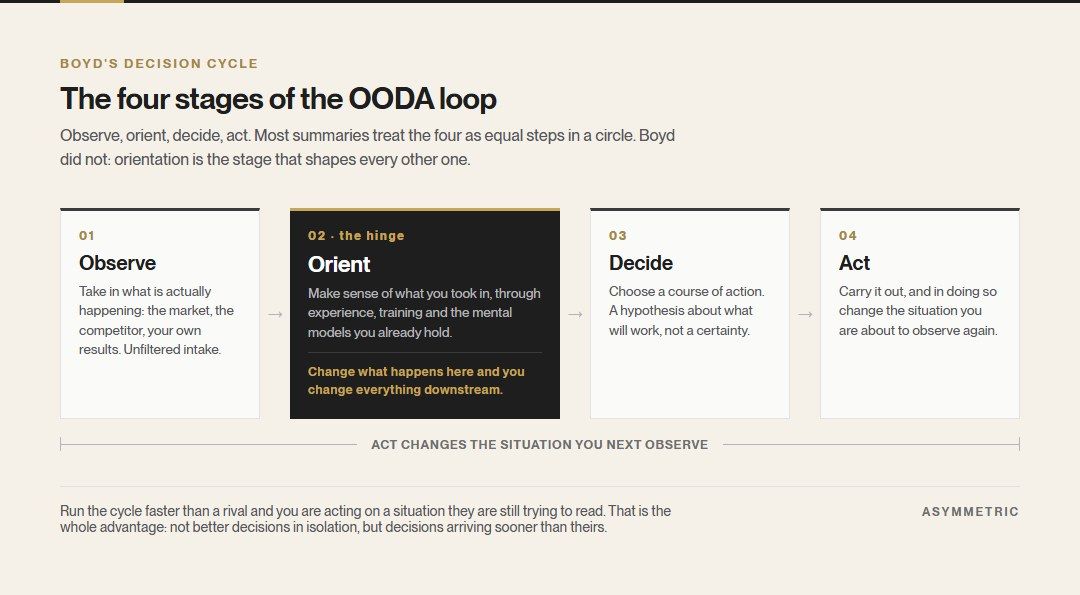
Observe. Take in the situation as it actually is: what the market, the customer, and the competitor are doing right now, not what your plan assumed.
Orient. Make sense of what you observed, filtered through experience, mental models, and context. Boyd considered orientation the most important stage, and most treatments rush past it.
Decide. Choose a course of action based on that orientation, held as a hypothesis about what will work rather than a guarantee.
Act. Execute, then immediately observe the result and begin again. The action feeds the next observation, which is why it's a loop and not a line.
Orientation, mental models, and feedback
Boyd emphasized orientation because it shapes every decision that follows. Two competitors can observe the same market and the same competitor move and reach opposite conclusions, because they orient through different experience, assumptions, and mental models. Orientation is, in effect, the set of mental models you use to make sense of what you observe, and those mental models are built from culture, prior experience, and analysis. A team whose mental models are out of date reads new information wrong and decides wrong, no matter how fast it moves.
This is also where feedback enters, and why the OODA loop is best understood as a feedback loop rather than a circle. Every action produces a result you observe, and that feedback updates your orientation and your mental models for the next cycle. Boyd drew the loop with multiple feedback loops, not one clean circle, precisely because feedback at every stage is what lets the loop learn. A team that acts but never builds feedback into its orientation isn't really running an OODA loop; it's just repeating itself faster. Sound decision-making depends on tight feedback loops that keep your mental models current.
What the OODA loop is really about: speed, timing, and tempo
The deepest lesson of the OODA loop is tempo: the speed and timing of your decisions relative to a competitor's. When you consistently cycle through observation, orientation, decision, and action faster than a competitor, you get inside their loop. But speed alone isn't the point; timing is. Acting faster at the wrong moment wastes the advantage, while acting decisively at the moment a competitor can't respond is what wins. Your moves land before they have finished reacting to the last one, so their decisions are always aimed at a situation that has already changed. The competitor isn't beaten by one brilliant move. They're beaten by a tempo they can't match, until their decision-making becomes irrelevant. For a challenger facing a larger, slower incumbent, this combination of speed and timing is among the most useful ideas in competitive strategy, because a smaller organization can often decide and act faster, and that tempo is an advantage size can't buy.
Getting inside a competitor's loop
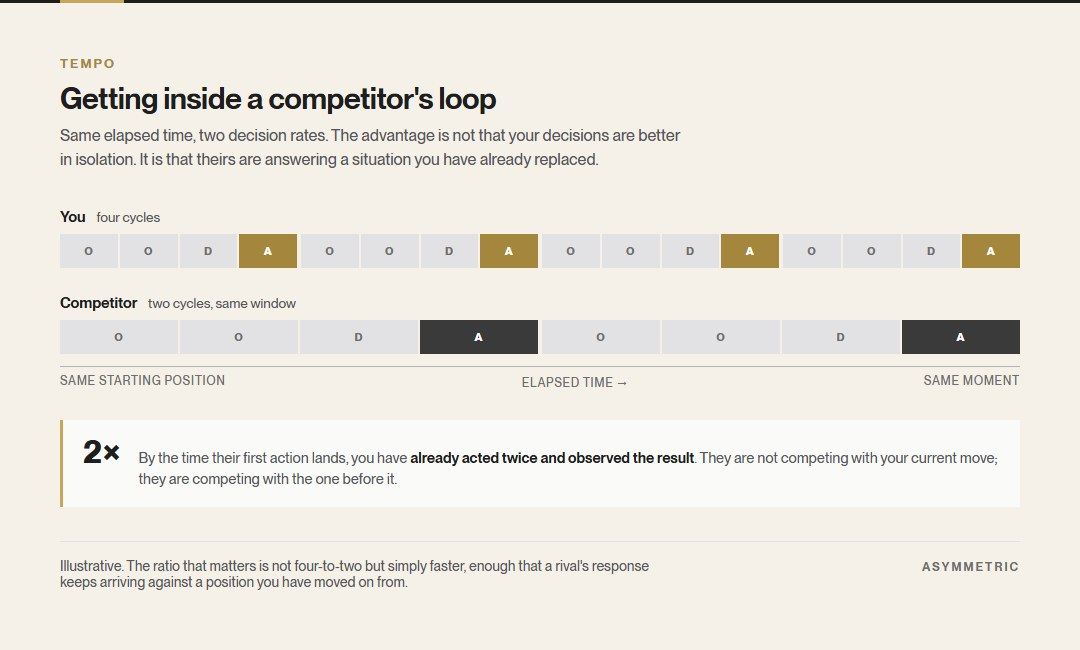
Consider a small challenger against an established incumbent. The challenger ships an action, observes how the market and the competitor respond, and adjusts within days. The incumbent runs on a quarterly cycle, with layers of approval between observing a problem and acting on it. By the time the incumbent has noticed the challenger's first move, secured sign-off, and responded, the challenger has already acted twice more. The incumbent's response, well made and on time by its own calendar, lands on a situation that no longer exists. Nothing here required the challenger to be smarter or better funded. It required a shorter loop and faster decision-making. This is what Boyd meant by operating inside an adversary's tempo, and it's why decision speed is a structural advantage a smaller company should guard rather than give away by imitating the incumbent's slower process.
Centers of gravity: where to apply your tempo
Boyd also wrote about attacking an adversary's centers of gravity, the few things that hold their ability to compete together. A center of gravity might be a key supplier relationship, a reputation, a core customer segment, or the cash flow that funds everything else. The point of identifying a center of gravity is focus. Out-cycling a competitor on a trivial front wins nothing, but out-cycling them at a real center of gravity forces reactions they can't sustain. Tempo and centers of gravity work together: fast decision-making aimed at nothing important is wasted speed, while fast decision-making aimed squarely at a competitor's center of gravity is decisive. So before you press a tempo advantage, identify the center of gravity where faster action actually disrupts the adversary, and concentrate your speed there rather than spreading it across moves that don't matter.
Using the OODA loop in business
Applied to business, the OODA loop is less a tool you run in a meeting and more a discipline you build into how the organization operates. Observation depends on a real, continuous read of the market and competitors rather than an annual review. That's the job of competitive intelligence: a standing feed of what rivals are doing and where they're exposed, so your orientation reflects the current situation and not a stale one. Decision speed depends on whether the people closest to the market are helped to act, or whether every decision waits for an approval that slows the loop to a crawl. The organizations that out-cycle their competitors are usually the ones that pushed real decision-making authority to the edge and fed it good intelligence and fast feedback.
Where the OODA loop fits in strategy
The OODA loop sits inside a broader discipline of competing under uncertainty. Boyd's work belongs to the same lineage as the rest of the strategic canon, and it pairs naturally with two ideas in particular. Planning to win across several futures rather than predicting one keeps your orientation sound when the situation shifts. And a business wargame is where a team rehearses its own loop against a thinking competitor, finding out before any money is spent whether it can observe, orient, decide, and act faster than the rival will. The loop is the engine. Foresight keeps it pointed the right way, and the wargame is where you test it.
Where teams get the OODA loop wrong
The most common mistake is treating it as a linear, one-time process: observe, then orient, then decide, then act, then stop. The whole value is in cycling continuously and letting each action and its feedback change the next observation. The second mistake is chasing speed without orientation, which only produces faster bad decisions, since a fast loop built on poor mental models just reaches the wrong decision sooner. The third is having no genuine observation or feedback at all, so a team believes it's running the loop while actually reacting to its own assumptions. A real OODA discipline fixes all three: it runs continuously on real feedback, it grounds orientation in an honest read of the market, and it's fast because decision-making authority sits close to the people who can see what is actually happening.
Out-cycle your competition
If a larger competitor is out-resourcing you and you would rather out-decide them, building the tempo, the market read, and the feedback that let you operate inside their loop is the work we do.
Frequently asked questions
What is the OODA loop?
The OODA loop is a four-stage decision cycle (Observe, Orient, Decide, Act) created by military strategist John Boyd. It describes how a competitor takes in a situation, orients to it, decides, and acts, then repeats continuously as a feedback loop. Its core lesson is that running the loop faster and with better orientation than an opponent is what wins, in air combat and in business alike.
Who created the OODA loop?
John Boyd, a U.S. Air Force fighter pilot and strategist nicknamed Forty-Second Boyd for beating any opponent in simulated combat within forty seconds from a disadvantage. Boyd co-developed energy-maneuverability theory, then generalized his findings into the OODA loop. His thinking shaped U.S. Marine Corps maneuver-warfare doctrine, and John Boyd is considered one of the most influential military strategists of the twentieth century.
Why is orientation the most important stage of the OODA loop?
Because orientation shapes every decision that follows. It's the set of mental models you use to interpret what you observe, built from experience, culture, and analysis. Two competitors can observe the same facts and reach opposite conclusions depending on their mental models, so a fast loop built on poor orientation just reaches the wrong decision sooner. The edge comes from orienting accurately, kept current by tight feedback loops.
How do you use the OODA loop in business?
Build it into how the organization operates. Feed observation with continuous competitive intelligence so your read of the market is current, orient through honest mental models of your rivals, push decision-making authority to the people closest to the market, and apply your tempo at a competitor's center of gravity rather than spreading speed thinly. The goal is to decide and act faster than a competitor can react, letting a smaller company out-maneuver a larger one.
What are the weaknesses of the OODA loop?
It's a model of decision tempo, not a planning method, so it tells you to move faster without telling you where to go. Teams that adopt the OODA loop without a strategy make quick decisions in no particular direction. It also assumes you can observe accurately, which breaks down when your information is late or wrong.
What is the difference between the OODA loop and PDCA?
PDCA (Plan, Do, Check, Act) is built for improving a process you already run, on a cycle you control. The OODA loop is built for competing against someone who is reacting to you. PDCA optimizes, OODA out-paces. If nobody is adapting against you, PDCA is usually the better fit.
About the author

Mark Hope
Founder, President & Chief Strategy Officer, Asymmetric Marketing
Mark Hope is the Founder, President & Chief Strategy Officer of Asymmetric Marketing. His career spans elite military service, senior leadership at two of the largest companies in their categories, and founding several companies of his own. It's the common thread behind how Asymmetric helps smaller companies out-compete bigger ones.
Mark began his career in U.S. Army Special Operations, serving from 1977 to 1988 in the 1st and 3rd Battalions of the 75th Ranger Regiment and as an Operator in 1st Special Forces Operational Detachment–Delta (Delta Force). What that world runs on (careful planning, reading your opponent, and winning from a position of disadvantage) is the foundation of how he helps smaller companies win today.