

June 4, 2026
Competitor Analysis: A Complete Guide to Finding the Weakness You Can Attack
Most competitor analysis ends in a grid nobody acts on. This guide runs it the way that ends in a move: the five steps, the dimensions, the frameworks, and how to find the weakness you can own.
By Mark Hope, Founder, President & Chief Strategy Officer, Asymmetric Marketing

Open any competitor-analysis template and you get the same artifact: a giant grid, features down the side, competitors across the top, checkmarks in the boxes. A team spends a week filling it in, presents it, and acts on none of it. A competitor matrix isn't strategy. It's homework. The purpose of analyzing a competitor isn't to catalog them. It's to find the one place they can't or won't defend well, so you can compete there, on terms that favor you. The best output of a competitor analysis isn't a spreadsheet. It's a single sentence: they can't defend X, so we own it. This is the complete guide to running a competitor analysis that ends in that sentence, instead of a grid you file and forget.
I have run this from both sides of the table, as SVP of Sales and Marketing at a billion-dollar company with market position to defend, and as the founder of a platform built from nothing with everything to take. The discipline is the same in both seats, and so is the failure mode: confusing describing a competitor with finding their weakness.
Key takeaways
- Competitor analysis is the process of identifying your competitors and evaluating their products, pricing, positioning, and marketing to find where you can win, not to catalog them.
- The goal is a single sentence, "they cannot defend X, so we own it," not a feature grid you file and forget.
- Cover both direct competitors (same product, same customers) and indirect competitors (same problem, different solution), since the threat that displaces you is often one you weren't watching.
- The five steps: identify the right competitors, analyze them across the dimensions that decide the market, apply a framework, find the weakness that doesn't overlap your own, and turn it into a move.
- It's a point-in-time read; the standing version is competitive intelligence, refreshed as the market shifts.
What competitor analysis is
Competitor analysis, also called competitive analysis, is the process of identifying the companies you compete with and evaluating their products, pricing, positioning, marketing, and strengths and weaknesses, so you can find where you can win. It comes in two flavors of competitor. Direct competitors sell a similar product to the same customers; indirect competitors solve the same problem a different way and can steal demand you never saw coming. A complete analysis covers both, because the threat that displaces you is often an indirect competitor you weren't watching.
The job isn't parity ("let us match their features") or reassurance ("see, we are better"). Both are traps that keep you fighting on a competitor's terms. The job is to locate exploitable weakness: a segment they under-serve, a channel they ignore, a position gone generic, a promise they can't keep at scale. A bigger competitor is strong somewhere; they're never strong everywhere. Analysis is the search for the where-they-aren't.
The competitor analysis process, in five steps
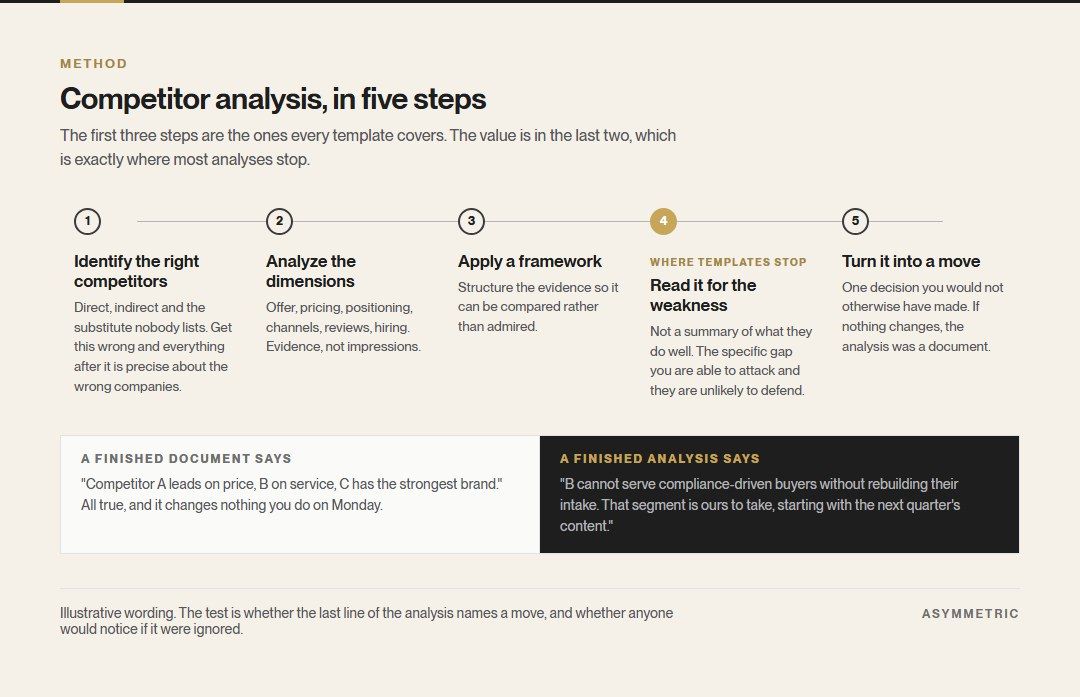
A competitor analysis that ends in a decision follows five steps. First, identify the right competitors, direct and indirect, using evidence rather than reputation. Second, analyze each across the dimensions that decide the market, reading every one for vulnerability. Third, apply a framework that organizes the data into structure rather than a pile of facts. Fourth, find the weakness, the place a competitor is exposed that doesn't overlap your own. Fifth, turn that finding into a move and keep the read current as the market shifts. The rest of this guide walks each step.
Step one: identify the right competitors
Naming your competitors is itself an analysis, and the obvious names are often wrong. We weight several signals rather than trusting reputation: keyword and SERP overlap shows who actually appears where your buyers search, shared backlink sources show who competes for the same industry attention, and, where paid media runs, auction data shows who is literally bidding against you. This surfaces both the direct competitors you expect and the indirect competitors quietly taking demand. The competitor you feel is your rival often isn't the one taking your customers.
Step two: analyze the dimensions
Once you know who, dissect each competitor across the dimensions that actually decide a market, each read for vulnerability rather than completeness:
- Positioning and messaging: what they claim to be, and where the claim has gone soft, generic, or shared word-for-word with three rivals.
- Product and product features: a structured feature comparison of what they offer and where their product is thin.
- Pricing: structure, anchors, and where it's rigid or indefensible.
- Marketing channels and promotion: which channels they invest in, their traffic sources, and where they're absent.
- Market share and share of voice: how much of the market and of the conversation they own, and where it's slipping.
- Content and SEO: what they rank for and the content gaps their buyers are searching for that they never answer.
- Reputation and customer feedback: what customer reviews, ratings, and win/loss patterns reveal about weaknesses they would never advertise.
- Customer experience and customer journeys: where their buying process frustrates customers and leaves an opening.
The deliverable isn't a competitor encyclopedia. It's a shortlist of gaps you can act on. A useful shorthand is the four P's of the marketing mix, product, price, place, and promotion: run each competitor through the four and you've covered most of what decides a purchase.
Step three: apply a framework
A framework turns observation into structure. A SWOT analysis sorts each competitor's strengths and weaknesses against your own. Porter's Five Forces maps the wider industry, rivalry, buyer and supplier power, new entrants, and substitutes, so you read a single competitor in the context of the whole market. Competitive benchmarking measures you against rivals on the dimensions customers actually care about, not a vanity feature count. The framework matters less than using one; structure is what stops a competitor analysis from collapsing into an undifferentiated list.
Methods and tools for competitor analysis
Beyond the frameworks, a few methods and tools turn raw observation into usable analysis. Feature comparisons map products side by side. Market analysis and market intelligence tools pull organic and paid visibility, traffic sources, and content gaps from search data, while AI tools and chatbots increasingly speed the gathering. Many competitor analysis templates and tools exist, free and paid, but the tools matter less than the discipline of reading everything for one thing: where a competitor is exposed.
Step four: read it for the weakness templates skip
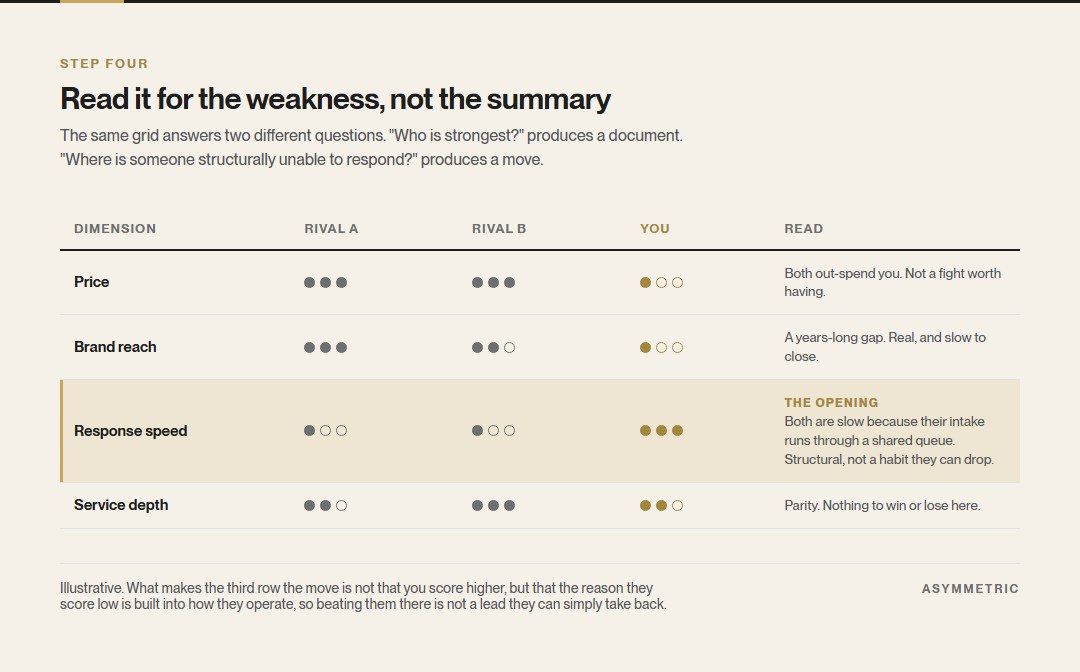
Data isn't insight. A filled-in grid is structured description until someone reads it comparatively. The read that matters asks three questions at once: where is their weakness, where is yours, and where do those two not overlap? That non-overlap, what they're bad at that you happen to be good at, in a segment that matters, is your line of attack. A great competitor analysis compresses a week of grids into one defensible move. A particularly productive vein is conquest analysis: the "[competitor] alternative" and "[competitor] vs" searches a rival's own brand generates, which reveal both their dissatisfied buyers and an obvious move, to intercept that demand with content built to win it.
Step five: turn analysis into a move
Analysis that ends in a slide is wasted; run with discipline, it ends in growth. Response Team One, a residential and commercial remediation company, was our agency of record for several years. They operated thirty branches, and remediation is won one local market at a time, so we ran comprehensive competitor analysis market by market, dissecting each branch's competitive set to determine the messaging, channel, and pricing that would make them the number-one choice in that specific market. The analysis didn't just generate leads; it informed where the company grew, showing which markets to enter and which similar businesses to acquire where they had no presence. We helped them expand their location count and make strategic acquisitions, and were instrumental in improving the operating metrics that turned the company into an attractive target. The arc ended in a very successful sale. The grid never does that. The move does.
Keep it ongoing
A competitor analysis is a point-in-time read, and markets shift. Competitors reposition, market share moves, new entrants appear, and a read that was accurate last year can be wrong now. Refresh it on a cadence, watching market trends and market shifts, so your picture stays current. The continuous, standing version of this discipline is competitive intelligence, which keeps answering "where is their weakness?" as the market moves rather than once a year. And before you commit a major move the analysis surfaces, it's worth pressure-testing in a business wargame against the competitors who would respond.
Run an analysis that ends in a move
If you want a competitor analysis that hands you a decision you can act on, where to compete, what to own, which market to take, instead of a grid you file and forget, that's the work we do.
Frequently asked questions
What is competitor analysis?
Competitor analysis, also called competitive analysis, is the process of identifying the companies you compete with and evaluating their products, pricing, positioning, marketing, and strengths and weaknesses so you can find where to win. Its purpose isn't to catalog rivals but to locate the weakness you can attack, ideally reduced to one sentence: they can't defend X, so we own it.
What are the 5 steps of a competitor analysis?
Identify the right competitors (direct and indirect, by evidence not reputation); analyze each across the dimensions that decide the market, read for vulnerability; apply a framework such as SWOT or Porter's Five Forces to give the data structure; find the weakness that doesn't overlap your own; and turn that finding into a move, then refresh the read as the market shifts.
How do you do a competitor analysis?
Work the five steps: name your real competitors using SERP, backlink, and ad-auction overlap; dissect each across positioning, product, pricing, channels, share, content, reputation, and customer experience; organize it with a framework; then read for the non-overlap between their weaknesses and your strengths. The output should be a decision, where to compete and what to own, not a grid.
What are the 4 P's of competitor analysis?
The four P's come from the marketing mix: product, price, place, and promotion. Running each competitor through the four is a quick way to cover most of what decides a purchase, what they sell, what they charge, where they sell it, and how they promote it, and to spot where each is exposed.
What is the difference between direct and indirect competitors?
Direct competitors sell a similar product to the same customers; indirect competitors solve the same problem a different way and can take demand you never saw coming. A complete analysis covers both, because the threat that displaces you is often an indirect competitor you weren't watching.
What tools are used for competitor analysis?
Frameworks like SWOT, Porter's Five Forces, and competitive benchmarking organize the analysis, while market-intelligence and SEO tools pull rivals' organic and paid visibility, traffic sources, and content gaps, and AI tools increasingly speed the gathering. The tool matters less than the discipline of reading everything for one thing: where a competitor is exposed.
About the author

Mark Hope
Founder, President & Chief Strategy Officer, Asymmetric Marketing
Mark Hope is the Founder, President & Chief Strategy Officer of Asymmetric Marketing. His career spans elite military service, senior leadership at two of the largest companies in their categories, and founding several companies of his own. It's the common thread behind how Asymmetric helps smaller companies out-compete bigger ones.
Mark began his career in U.S. Army Special Operations, serving from 1977 to 1988 in the 1st and 3rd Battalions of the 75th Ranger Regiment and as an Operator in 1st Special Forces Operational Detachment–Delta (Delta Force). What that world runs on (careful planning, reading your opponent, and winning from a position of disadvantage) is the foundation of how he helps smaller companies win today.