

November 15, 2024
What Is Search Engine Marketing? A Complete Guide for Beginners
Search engine marketing buys visibility at the top of search results through paid ads. It's one of the fastest ways a challenger can compete with a larger rival, but only if you bid where the incumbent is weak instead of fighting for the expensive head terms. Here's how SEM works.
By Mark Hope, Founder, President & Chief Strategy Officer, Asymmetric Marketing

Search engine marketing, or SEM, is the practice of buying visibility in search engine results through paid ads, so your business appears at the top of the page when someone searches for what you sell. It's one of the fastest ways to put an offer in front of people at the exact moment they're looking for it. The term once covered both paid and organic search, but in normal use today it means paid search advertising, the pay-per-click ads served by Google Ads and Microsoft Advertising across the major search engines.
For a smaller company, SEM is one of the few channels where you can compete with a much larger rival almost immediately. Organic rankings take months to build. A paid search campaign can be live this afternoon, in front of the same buyers the incumbent has spent years earning. The catch is that everyone can see the same opportunity, so winning at SEM is less about showing up and more about being disciplined regarding where, and how, you spend.
Key takeaways
- Search engine marketing (SEM) usually means paid search advertising: bidding on keywords to appear at the top of results and paying per click.
- It runs on an auction of bid plus relevance (Quality Score), so more relevant ads win better placement at a lower cost.
- Its advantage is speed and control; the trade-off is that the traffic stops the moment you stop paying.
- The real levers are keywords, ad relevance, landing pages, and conversion tracking, not just budget.
- SEM is strongest paired with SEO: paid search finds what converts fast, and organic makes those wins durable.
What search engine marketing is
SEM places your ad in the search results for chosen keywords. When someone searches a term you bid on, you enter an auction, and if you win, your ad appears above or alongside the organic listings, usually marked as sponsored. You pay when someone clicks, which is why the model is called pay-per-click, or PPC. This is distinct from search engine optimization, which earns organic placement over time without paying for each click. The two are complementary, and we cover how to choose between them in SEO vs SEM.
How SEM works: the ad auction
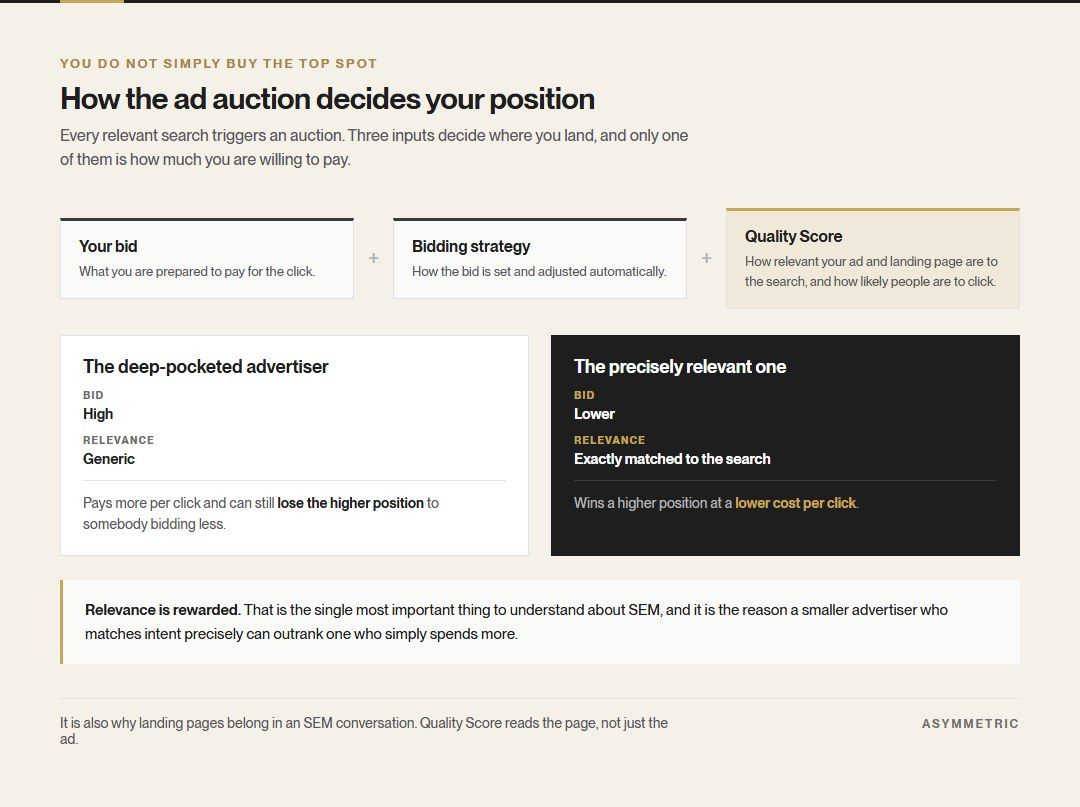
You don't simply buy the top spot. Every time a relevant search happens, the search engine runs an ad auction, and your position is decided by a combination of your bid, your bidding strategy, and your Quality Score. Quality Score reflects how relevant your ad and landing page are to the search and how likely people are to click. A more relevant advertiser can win a higher position while paying a lower cost-per-click than less relevant advertisers who bid more. That's the single most important thing to understand about SEM: relevance is rewarded, so the advertiser who matches the searcher's intent most precisely gets better placement at a lower cost.
Keywords and intent
Everything in SEM starts with keywords, and not all keywords are equal. Broad head terms have high volume and high competition, and they're where deep-pocketed incumbents concentrate their spend. Specific, longer search queries usually convert better and cost less, because they signal a buyer who knows exactly what they want. Keyword research is the work of finding the terms where intent is high and competition is thin, and match types let you control how loosely or tightly your ads trigger. A campaign that bids on the right narrow terms beats one that sprays budget across expensive head terms it can't afford to own.
Match types and negative keywords
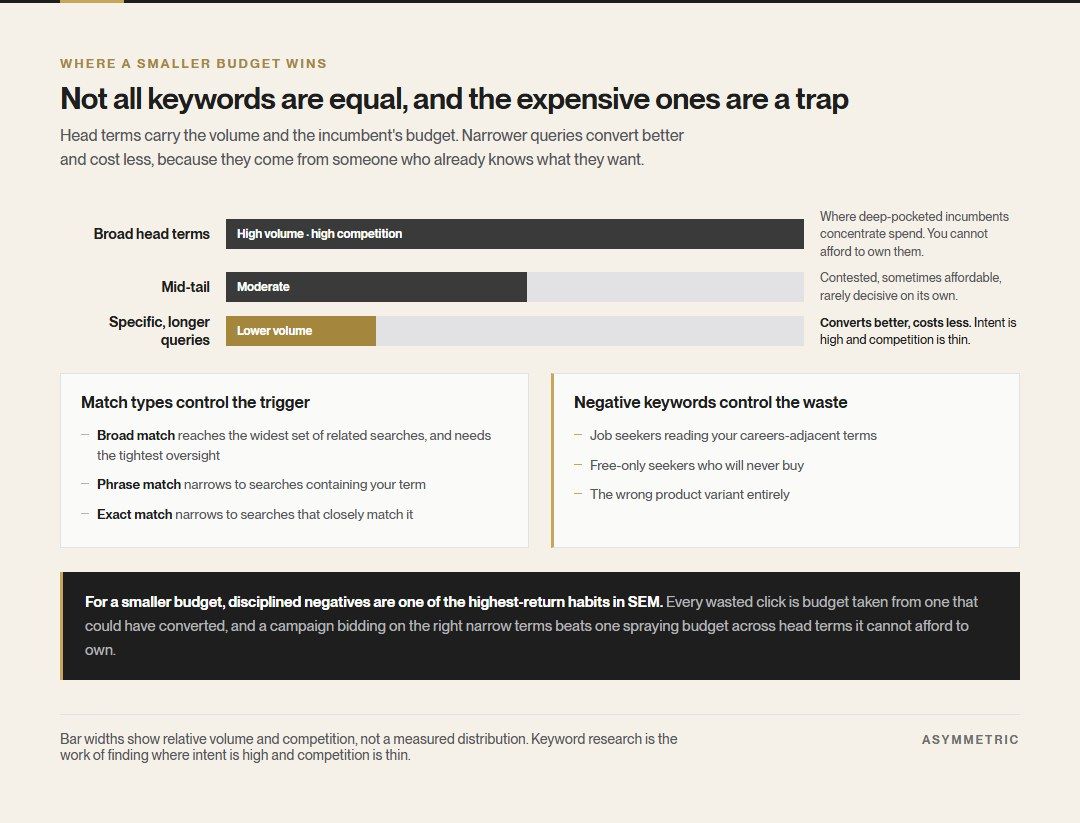
Keywords aren't all-or-nothing. Match types control how closely a search must fit your keyword before your ad shows. Broad match reaches the widest set of related searches and needs the tightest oversight, while phrase and exact match narrow the trigger to searches that closely match your term. Just as important are negative keywords, the terms you tell the engine to ignore. Adding negatives for searches that look related but never convert, such as job seekers, free-only seekers, or the wrong product variant, stops you paying for clicks that can't become customers. For a smaller budget, disciplined negatives are one of the highest-return habits in SEM, because every wasted click is budget taken from one that could have converted.
Campaign types and ad assets
Paid search is more than a single text ad. Search campaigns target keywords directly. Shopping campaigns put product listings with images and prices in front of buyers, which matters for ecommerce. Remarketing follows people who visited but didn't convert, keeping you in front of a warm audience at low cost. Within each, ad assets, once called extensions, add sitelinks, callouts, phone numbers, and other details that make your ad larger and more useful, often lifting click-through at no extra cost per click. Choosing the campaign type that fits the goal, and using assets fully, gets more out of the same budget.
The challenger's SEM play: bid where they're weak
This is where SEM becomes a real equalizer rather than a spending war. A challenger shouldn't line up against a larger competitor on the most expensive head terms, where the incumbent will simply outbid and outlast it. The move is to concentrate budget where the bigger player is weak or absent: the specific segments, the long-tail queries, the buyer problems their generic ads don't speak to, and the competitor-comparison searches their own brand generates. Knowing where a rival is exposed is the job of competitive intelligence, and feeding that read into your keyword strategy is what turns a limited budget into wins the incumbent never notices.
Quality Score and landing pages
Because Quality Score lowers your cost, the cheapest way to improve SEM performance is often not a higher bid but a more relevant experience. The ad should match the search, and the landing page should deliver exactly what the ad promised, quickly and clearly. A tight match among keyword, ad copy, and landing page raises Quality Score, which raises your position and lowers your cost per click at the same time. Sending paid traffic to a generic homepage instead of a focused landing page is one of the most common and expensive SEM mistakes.
A challenger campaign in practice
Picture a regional firm competing against a national brand that dominates the obvious head term. Bidding on that term directly means paying premium prices to lose an auction the national brand is glad to win. Instead, the challenger builds tightly themed campaigns around the specific problems and segments the national ads treat generically, adds a strong list of negative keywords to cut waste, and points each ad at a focused landing page that answers that exact search. It bids on the comparison and alternative searches the incumbent's own brand generates, where intent is high and the incumbent is weak. The budget is small, but it's concentrated where it converts, and the campaign produces customers the national competitor never notices it's losing.
Measuring SEM
SEM is among the most measurable forms of digital marketing there is. Click-through rate tells you whether your ad earns attention, conversion rate tells you whether the click turns into a customer, and cost per click and return on ad spend tell you whether the economics work. A/B testing ad copy and landing pages, then shifting budget toward what converts, is the day-to-day discipline that compounds results over time. The point of the data isn't a dashboard; it's to keep moving money toward the terms and messages that produce customers.
Bidding behind a real position
SEM rewards a sharp offer the same way the rest of marketing does. The campaigns that pay back are the ones attached to a differentiated reason to choose you, aimed at a buyer the incumbent serves poorly, on terms you can afford to win. If that position is clear, SEM is one of the fastest channels a challenger has. If it is not, SEM just spends faster.
Frequently asked questions
What is search engine marketing (SEM)?
SEM is the practice of buying visibility in search engine results through paid ads, so your business appears at the top of the page when someone searches for what you sell. In common usage it refers to paid search advertising, the pay-per-click ads on Google and Bing, as distinct from search engine optimization, which earns organic placement without paying per click.
How does SEM work?
You bid on keywords, and when someone searches a term you target, the search engine runs an auction. Your ad position is set by a combination of your bid and your Quality Score, which measures how relevant your ad and landing page are to the search. A more relevant advertiser can win a higher spot while paying less per click, so precise intent matching, not just a bigger budget, drives results.
What is the difference between SEM and SEO?
SEM buys placement through paid ads and can drive traffic immediately, with costs that continue as long as you run the campaign. SEO earns organic placement over time through content and technical optimization, which is slower to build but compounds and doesn't charge per click. Most businesses use both, with SEM for fast, high-intent reach and SEO for durable long-term visibility.
How much does SEM cost?
There's no fixed price, since you pay per click and the cost of each click depends on the competition for a keyword and your Quality Score. Expensive head terms cost more and favor large budgets, while specific long-tail terms cost less and often convert better. Improving the relevance of your ads and landing pages raises Quality Score, which lowers your cost per click for the same position.
What is an example of search engine marketing?
Bidding on a search term so your ad appears above the unpaid results is search engine marketing. If someone searches for an emergency plumber and you pay to appear at the top of that page, you've bought placement in front of demand that already exists rather than creating it.
What is better, SEO or SEM?
Neither is better in general, they answer different problems. SEM buys placement now and stops when the budget does, which suits a launch or a test. SEO takes months and keeps working, which suits a position you intend to hold. Most challengers run SEM while SEO builds underneath.
About the author

Mark Hope
Founder, President & Chief Strategy Officer, Asymmetric Marketing
Mark Hope is the Founder, President & Chief Strategy Officer of Asymmetric Marketing. His career spans elite military service, senior leadership at two of the largest companies in their categories, and founding several companies of his own. It's the common thread behind how Asymmetric helps smaller companies out-compete bigger ones.
Mark began his career in U.S. Army Special Operations, serving from 1977 to 1988 in the 1st and 3rd Battalions of the 75th Ranger Regiment and as an Operator in 1st Special Forces Operational Detachment–Delta (Delta Force). What that world runs on (careful planning, reading your opponent, and winning from a position of disadvantage) is the foundation of how he helps smaller companies win today.