

June 11, 2021
9 Questions for Effective Marketing Campaigns
Most marketing campaigns fail in the thinking before launch, not in execution. These nine questions, answered honestly before any creative is made, separate an effective campaign from an expensive one.
By Mark Hope, Founder, President & Chief Strategy Officer, Asymmetric Marketing

Most marketing campaigns don't fail in execution. They fail in the thinking that should have happened before any creative was made. A campaign built on clear answers to a few hard questions tends to work, while a campaign that skipped them spends money to discover it had nothing to say. The agency or team that asks these questions first will outperform the one that jumps straight to designing ads, every time. Before you brief a designer or buy a single placement, work through these nine questions. They separate an effective marketing campaign from an expensive one.
Key takeaways
- An effective marketing campaign starts by answering nine questions before any spend, not by jumping to channels and creative.
- The questions define the audience, the goal, the offer, the message, the channel, the measurement, and the budget.
- A campaign aimed at a buyer no one bothered to define is the most common and most expensive failure.
- Strategy comes before tactics: the questions force the strategic decisions a campaign needs to actually convert.
- Measurement is part of the plan, not an afterthought, define how you'll know it worked before you launch.
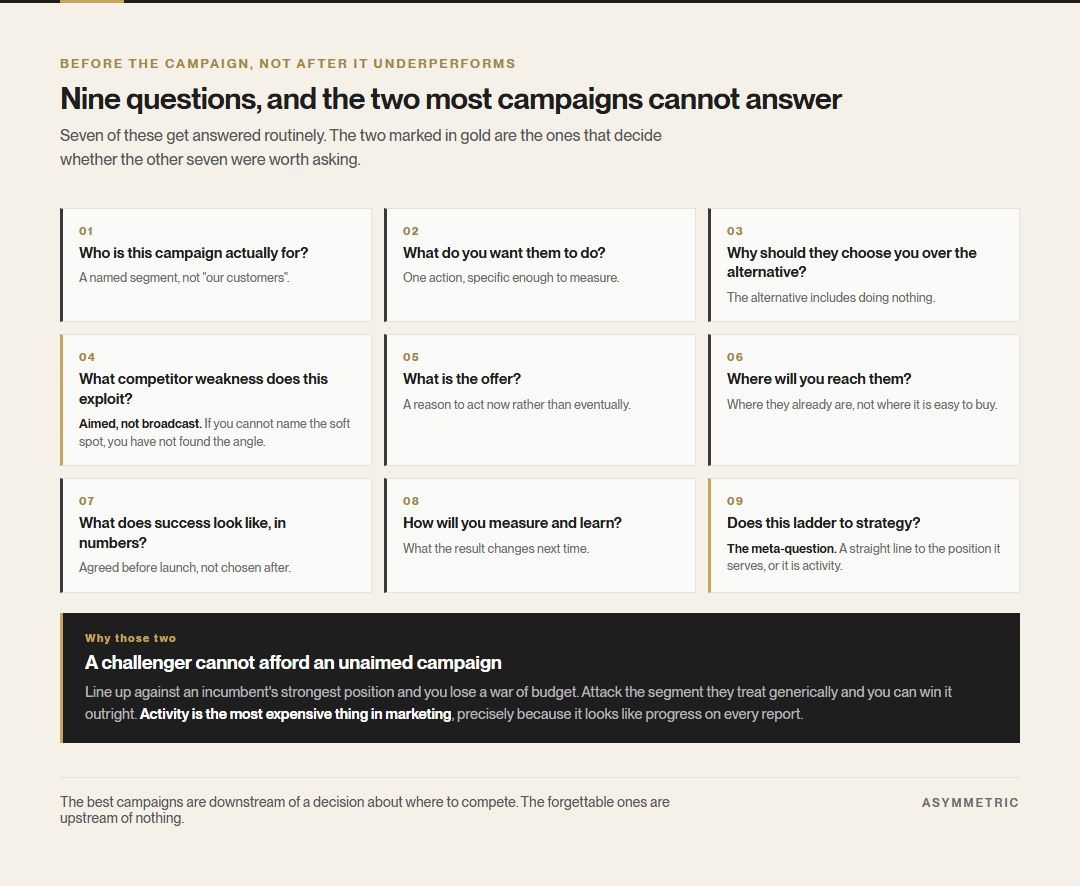
1. Who is this campaign actually for?
"Everyone" is not an audience, and a message built to offend no one persuades no one. The strongest campaigns target a specific segment whose situation and beliefs you understand precisely, because a message written for one defined group lands far harder than one diluted to reach all of them. Before you decide what to say, name the buyer, where they're in their decision, and what they already think about your category. The narrower and more honest that picture, the sharper everything downstream becomes, from the offer to the channel to the words. Most weak campaigns are really just campaigns aimed at a buyer no one bothered to define.
2. What do you want them to do?
A campaign needs one clear, valuable action: book a call, request a quote, buy, subscribe. Campaigns that ask for several things at once usually get none of them, because every additional option adds friction and dilutes the call to act. Decide the single most valuable thing a customer can do, make it the obvious next step, and strip away the competing asks. If your team can't agree on the one action before launch, the audience won't figure it out from the ad.
3. Why should they choose you over the alternative?
Every buyer has options, including the option to do nothing. If your campaign can't state a specific reason to choose you over a named competitor, it's decoration. This is where a real competitor analysis earns its keep: it hands you a reason rooted in where a rival is generic, overpriced, or absent, rather than a vague claim about quality and service that three competitors are making in the same words. A campaign that can't answer this question is competing on the incumbent's terms and hoping volume makes up the difference.
4. What competitor weakness does this exploit?
The most effective campaigns are aimed, not broadcast. They go where a larger competitor is weak, ignored, or asleep, because that's where a smaller player can win attention it could never afford to buy in a head-on fight. A challenger that lines up against an incumbent's strongest position, their core message and their best keywords, loses a war of budget. A challenger that attacks the segment or need the incumbent treats generically can win it outright. If you can't name the soft spot the campaign is aimed at, you haven't yet found your angle.
5. What is the offer?
The offer is the specific value exchange you put in front of the buyer, and it's not the same thing as your product. A clear, compelling offer framed around the customer's problem does more for a campaign than clever creative wrapped around a vague one. Spell out exactly what the customer gets, why it matters to them now, and what makes saying yes easy. Strong campaigns often win on the offer alone, while weak ones try to use production value to disguise the fact that there's no real offer underneath.
6. Where will you reach them?
Channels follow the audience, not the other way around. The question is never which platform is trending but where your specific buyer actually pays attention and is open to hearing from you. Concentrate budget where they are, rather than spreading a limited spend thin across every channel because it feels like you should have a presence everywhere. For a smaller budget, owning one channel where your buyer is genuinely reachable beats a token presence on five where you're ignored.
7. What does success look like, in numbers?
Define success before launch, in terms that matter to the business: leads, qualified conversations, customers, revenue. Vanity metrics such as impressions and reach measure activity, not results, and a campaign judged on them will quietly optimize for being seen rather than for selling. Set the number you need to hit and the cost you're willing to pay to hit it, so that when the results come in you can tell the difference between a campaign that worked and one that merely happened.
8. How will you measure and learn?
Decide in advance how you'll track outcomes and attribute them, so the campaign teaches you something whether it wins or loses. The discipline of watching conversion rate and cost per result, then moving budget toward what converts and away from what does not, is what turns a one-off campaign into compounding knowledge about your market. A campaign you can't measure is a campaign you can't improve, and you'll be left guessing whether to run it again.
9. Does this ladder to strategy, or is it just activity?
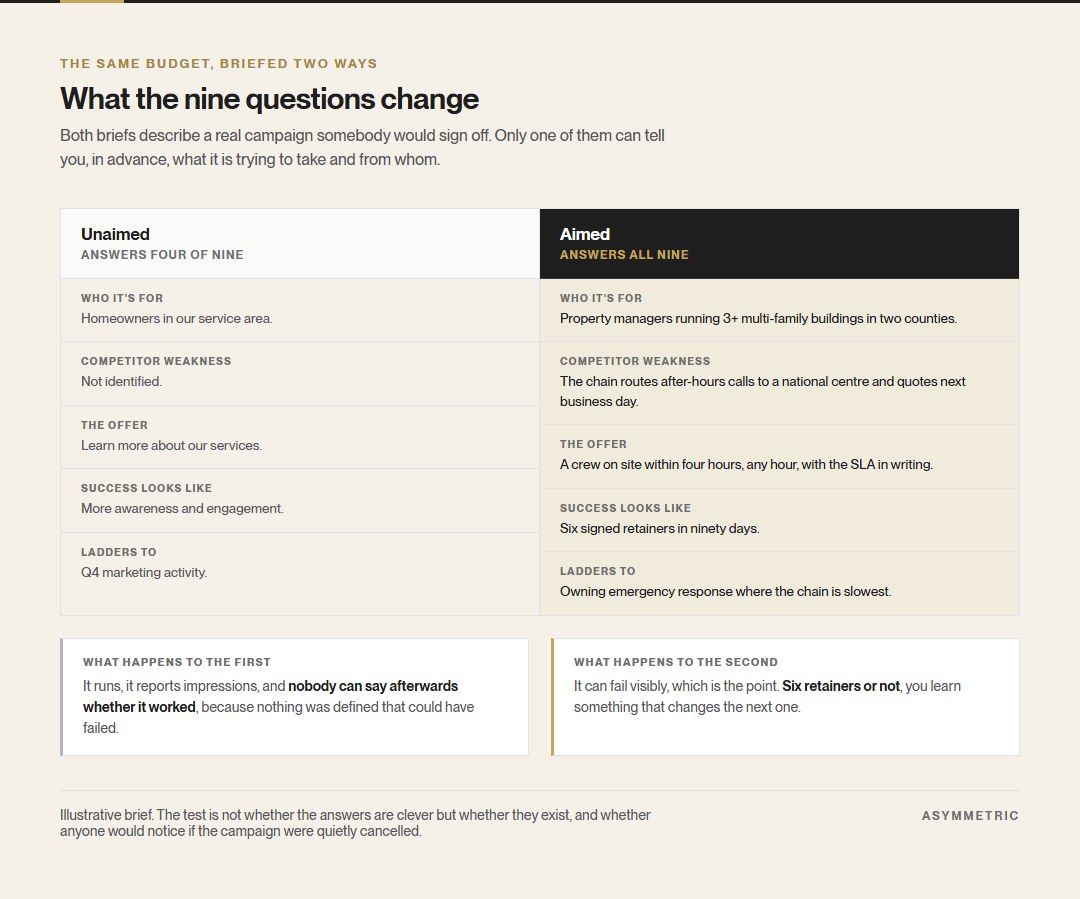
This is the meta-question behind the other eight. A campaign should advance a clear competitive position, not exist because it was someone's turn to run one. If you can't draw a straight line from this campaign to the strategy it serves and the specific customer it's meant to win, it's activity rather than growth, and activity is the most expensive thing in marketing. The best campaigns are downstream of a decision about where to compete. The forgettable ones are upstream of nothing.
Build campaigns that start with the right questions
Frequently asked questions
What makes a marketing campaign effective?
Effectiveness is decided before execution, by clear answers to a few questions: who the campaign is for, what single action it asks, why a customer should choose you over a named competitor, what weakness it exploits, what the offer is, and what success looks like in real numbers like leads and revenue. A campaign built on those answers works; one that skipped them spends to discover it had nothing to say.
What questions should you ask before launching a campaign?
Who is it for, what one action do you want, why choose you over the alternative, what competitor weakness does it exploit, what is the offer, where will you reach the audience, what does success look like in numbers, how will you measure and learn, and does it ladder to a real strategy. Answering these honestly upfront is what separates an effective campaign from an expensive one.
How do you measure marketing campaign success?
Define success before launch in terms that matter to the business: leads, qualified conversations, customers, and revenue, plus efficiency measures like conversion rate and cost per result. Avoid judging campaigns on vanity metrics such as impressions and reach, which measure activity rather than outcomes and push the campaign to optimize for being seen instead of selling.
What is an example of an effective marketing campaign?
An effective campaign is one where every element traces back to a decision someone made on purpose. You know who it's for, what you want them to do, why they'd pick you over the alternative, and what number tells you it worked. A campaign that looks polished but can't answer those isn't effective, it's just expensive.
How do you know if a campaign is worth running before you spend?
Answer the nine questions first. If you can't name the audience, the action, the offer, the competitor weakness you're exploiting, and the number that defines success, the campaign isn't ready. Most wasted spend comes from campaigns that started with a channel or a creative idea instead of those answers.
About the author

Mark Hope
Founder, President & Chief Strategy Officer, Asymmetric Marketing
Mark Hope is the Founder, President & Chief Strategy Officer of Asymmetric Marketing. His career spans elite military service, senior leadership at two of the largest companies in their categories, and founding several companies of his own. It's the common thread behind how Asymmetric helps smaller companies out-compete bigger ones.
Mark began his career in U.S. Army Special Operations, serving from 1977 to 1988 in the 1st and 3rd Battalions of the 75th Ranger Regiment and as an Operator in 1st Special Forces Operational Detachment–Delta (Delta Force). What that world runs on (careful planning, reading your opponent, and winning from a position of disadvantage) is the foundation of how he helps smaller companies win today.