

September 5, 2024
Asymmetric Marketing for Service Operators: How Independents Beat Franchises and Rollups
Asymmetric marketing for independent home & commercial service operators: how a smaller, sharper company beats a franchise or PE-backed rollup without trying to out-spend it.
By Mark Hope, Founder, President & Chief Strategy Officer, Asymmetric Marketing

Asymmetric marketing applies the logic of asymmetric warfare to business: how a smaller competitor beats a larger, better-funded one without fighting on the larger one's terms. For an independent home or commercial service operator, that better-funded competitor now has a name: the national franchise and the private-equity rollup buying up the shops around you and outspending you on every keyword.
It's the opposite of how most marketing advice works, which quietly assumes you can outspend, out-staff, and out-produce the competition. A service operator cannot, and doesn't need to. The whole point is to win on terrain where the rollup's size stops mattering.
Key takeaways
- Asymmetric marketing applies the logic of asymmetric warfare to business: a smaller player beats a larger one by refusing to fight where the giant is strong.
- It's the opposite of outspending, winning by choosing a different battlefield, concentrating force, and moving faster than a large organization can respond.
- Five principles: don't fight where the incumbent is strong, attack weakness, concentrate force, move faster, and compete on something other than spend.
- It's a discipline (where and how to compete) decided before any tactic, not a clever campaign or growth hack.
- It's most powerful for challengers and least useful for the market leader whose advantage genuinely is scale.
Where the idea comes from
The concept borrows directly from military strategy, where the weaker side has always had to win differently. The same logic runs through Sun Tzu's Art of War: avoid strength, attack weakness, and win by choosing the ground before the fight. A small force that meets a large one head-on loses. A small force that picks the time, place, and terms of engagement can win decisively. The modern operational version is John Boyd's OODA loop, the case for winning on tempo by deciding and acting faster than a rival can respond. In a marketplace the giant's resources are real, but they're not infinite, and they're never strong everywhere at once. Asymmetric marketing is the search for where they're not.
Asymmetric vs. symmetric competition
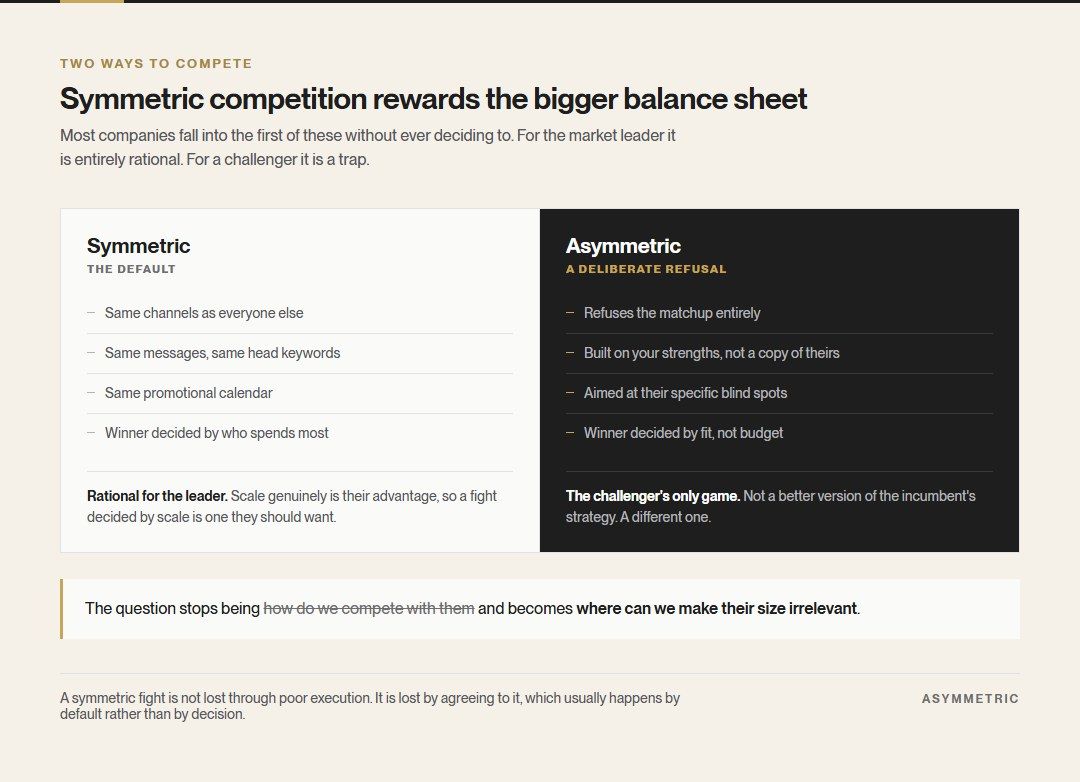
Symmetric competition is the default most companies fall into without deciding to: same channels, same messages, same head keywords, same promotional calendar as everyone else, with the winner decided by who spends the most. For the market leader, that's a rational game, because scale is genuinely their advantage. For the challenger, it's a trap. A symmetric fight rewards the bigger balance sheet, and the challenger doesn't have it. Asymmetric competition refuses the matchup. Instead of a slightly better version of the incumbent's strategy, it runs a different strategy entirely, one built around the challenger's specific strengths and the incumbent's specific blind spots. The question stops being how do we compete with them and becomes where can we make their size irrelevant.
The core principles
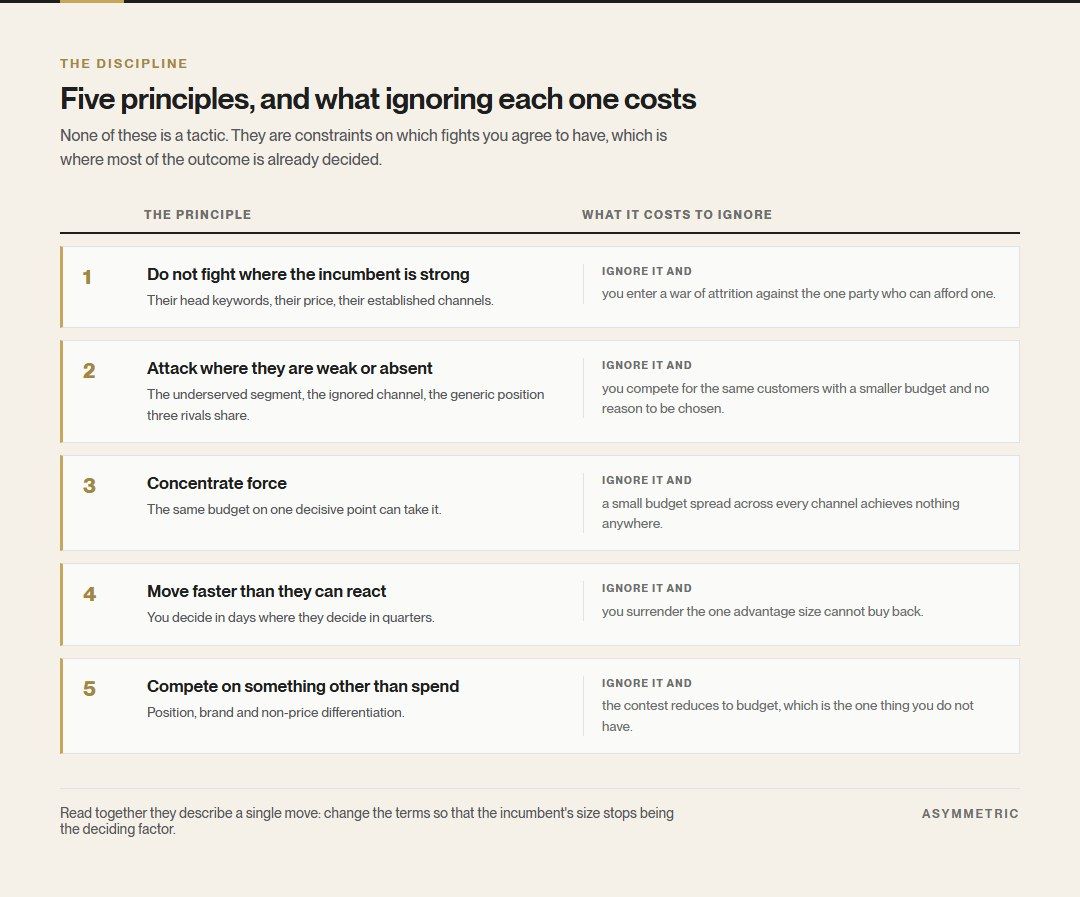
A few principles define the approach:
- Don't fight where the incumbent is strong. Matching a larger competitor on their core terms, their head keywords, their price, their established channels, is a war of attrition you lose.
- Attack where they're weak or absent. The underserved segment, the ignored channel, and the generic position three rivals share are where a challenger wins, which is why it starts with an honest competitor analysis.
- Concentrate force. A small budget spread thin achieves nothing; the same budget concentrated on one decisive point can take it.
- Move faster than they can react. A smaller organization can decide and act in days where a large one takes quarters, and tempo is an advantage size can't buy.
- Compete on something other than spend. Position, brand, and non-price differentiation beat budget when budget is the one thing you don't have.
How to apply it: from opening to move
Asymmetric marketing runs as a sequence, not a slogan. First, build a real read on the competitive field through competitive intelligence, a standing understanding of rival positioning, pricing, and messaging rather than an annual glance at their website. Second, turn that read into a decision with a structured strategy framework: map your genuine strengths against where each competitor is exposed, and find the opening only you can take. Third, concentrate, putting a disproportionate share of resources on that single opening instead of spreading them evenly across every channel. Fourth, pressure-test the move in a business wargame before you commit budget, playing your competitors' likely responses so you find the flaw in a room rather than in the market. The campaigns, channels, and content all follow from that decision. They're downstream of it, never a substitute for it.
What it looks like in practice
The clearest version is structural. We founded Pegasus Sustainability Solutions, later Pegex, in hazardous-waste disposal, where small-quantity generators were badly served by both ends of the market: the national players couldn't serve them economically, and the local operators who would were often a compliance risk. Rather than competing on either incumbent's terms, the move was a three-sided platform matching those generators with vetted providers, an opening neither incumbent type could follow into. The company grew exponentially without the capital a head-to-head fight would have demanded.
It works for service operators too. Venturi Restoration scaled from 17 to 30 branches not by outbidding national competitors on every keyword, but by concentrating capital and response time where their local density made them impossible to beat, then repeating it market by market.
Where it does and doesn't apply
Asymmetric marketing is most powerful for the underdog that has to win on terms other than budget, and least useful for the market leader whose advantage genuinely is scale. It's also not the same as guerrilla marketing. Guerrilla tactics are unconventional executions, the stunt, the clever activation, and they only matter when a real strategy sits underneath them. Asymmetric marketing is that strategy: the discipline of deciding where the fight is winnable. Get the strategy right and the execution often falls out of it. Get it wrong and no amount of cleverness saves you.
It's a discipline, not a tactic
Asymmetric marketing isn't a clever campaign or a growth hack. It's a way of choosing where and how to compete, decided before any tactic. The work begins with an honest read of where a competitor is exposed and where your particular strengths matter most, and it ends in a concentrated move on that opening. The goal is never to do more marketing. It's to do the few things that shift the odds in a fight you weren't supposed to win.
Shift the odds in your favor
If you're an independent operator competing against a franchise or a rollup, and out-spending them isn't an option, finding and taking the asymmetric opening is the whole game.
Frequently asked questions
What is asymmetric marketing?
Applying the logic of asymmetric warfare to business: a smaller competitor beats a larger, better-funded one by refusing to fight where the giant is strong. For a service operator, it's how you beat a franchise or PE rollup without matching their ad budget.
How can an independent operator beat a PE-backed rollup?
Not by outspending them. By concentrating force where their centralized playbook can't follow: the specific ZIP codes, service lines, and commercial relationships a forty-market operator can't tune to. Change the terms and their size stops deciding the fight.
Isn't this just having a smaller budget?
No. It's choosing a different battlefield on purpose. A small budget spread thin achieves nothing; the same budget concentrated on one decisive point can take it. The discipline is deciding where and how to compete before you spend a dollar.
What are the core principles?
Don't fight where the incumbent is strong, attack where they're weak or absent, concentrate force, move faster than they can react, and compete on something other than spend.
Who is asymmetric marketing for?
Challengers: the independent operator who has to win on terms other than budget. It's least useful for the market leader whose advantage genuinely is scale, which is exactly why franchises and rollups hate facing it.
Is it a campaign or a strategy?
A strategy, decided before any tactic. It's a way of choosing where and how to compete, not a clever campaign or growth hack. The tactics follow once the asymmetric opening is found.
About the author

Mark Hope
Founder, President & Chief Strategy Officer, Asymmetric Marketing
Mark Hope is the Founder, President & Chief Strategy Officer of Asymmetric Marketing. His career spans elite military service, senior leadership at two of the largest companies in their categories, and founding several companies of his own. It's the common thread behind how Asymmetric helps smaller companies out-compete bigger ones.
Mark began his career in U.S. Army Special Operations, serving from 1977 to 1988 in the 1st and 3rd Battalions of the 75th Ranger Regiment and as an Operator in 1st Special Forces Operational Detachment–Delta (Delta Force). What that world runs on (careful planning, reading your opponent, and winning from a position of disadvantage) is the foundation of how he helps smaller companies win today.