

November 11, 2025
Competitive Strategy: A Practical Guide to Porter's Five Forces
Porter's Five Forces maps the competitive structure of an industry. Most companies use it to judge whether a market is attractive. The sharper use, for anyone already competing, is to find where the forces are weak for you specifically and a rival is exposed.
By Mark Hope, Founder, President & Chief Strategy Officer, Asymmetric Marketing

Porter's Five Forces is a framework for analyzing the competitive structure of an industry. Developed by Harvard professor Michael Porter, it maps the five forces that determine how much profit an industry allows: competitive rivalry, the threat of new entrants, the bargaining power of buyers, the bargaining power of suppliers, and the threat of substitutes. Read them together and you see why some industries are chronically hard to make money in and others are comfortable.
That's the textbook description, and it's correct. But most companies use Five Forces to answer the wrong question. They use it to decide whether an industry is attractive, as if attractiveness were a fixed property of the market. The more useful question for anyone already competing is narrower and sharper: given these forces, where is the opening for us specifically? The forces aren't just a verdict on the industry. They're a map of where a challenger can find an advantage.
Key takeaways
- Porter's Five Forces maps the structural forces that decide an industry's profitability: competitive rivalry, buyer power, supplier power, the threat of new entrants, and the threat of substitutes.
- It answers whether a market is worth competing in, and where the leverage is, before you commit resources.
- Strong forces compress profits; weak forces leave room, so the five are a map of where a challenger can find an advantage.
- Run it before entering a market, not after, and pair it with a competitor analysis for the specific rivals.
- It's diagnosis, not action: the move comes from deciding where to position against the forces you can't change.
The five forces, briefly
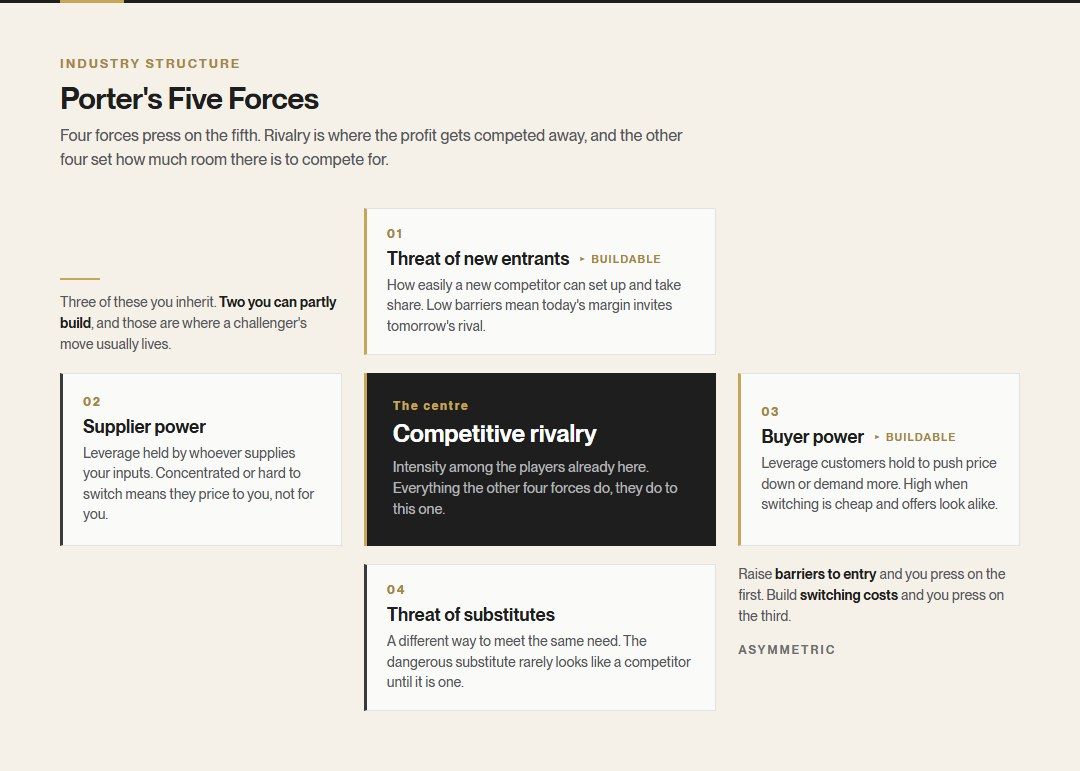
Competitive rivalry. The intensity of competition among existing players. High when rivals are numerous, similar, and fighting on price; lower when firms are genuinely differentiated.
Threat of new entrants. How easily new competitors can enter. Low barriers to entry, such as little capital or no proprietary advantage, mean today's profits invite tomorrow's competition. High barriers protect incumbents.
Bargaining power of buyers. How much leverage customers have to push down price or demand more. Buyers are powerful when they're concentrated, well informed, or face low switching costs.
Bargaining power of suppliers. How much leverage your inputs' providers have. Suppliers are powerful when there are few of them, or when switching to an alternative is costly.
Threat of substitutes. Whether customers can meet the same need a different way. A substitute doesn't have to be a direct competitor; it just has to solve the buyer's problem well enough to cap what you can charge.
What most people get wrong about Five Forces
Two mistakes are common. The first is treating the analysis as a one-time snapshot. Industries shift, switching costs erode, new substitutes appear, and a read that was accurate two years ago can be wrong now. Five Forces is most useful refreshed, not filed. The second mistake is stopping at the verdict. Concluding that an industry has fierce rivalry, powerful buyers, and low entry barriers tells you the industry is tough. It doesn't tell you what to do, and a framework that ends in a description rather than a decision hasn't earned its time.
Is there a sixth force?
People ask this because Porter's original five leave out something that clearly affects profitability: complements. A complement is a product that makes yours more valuable. Games make consoles worth owning, and chargers make electric cars practical.
Andrew Grove argued for adding complementors as a sixth force, and the logic holds. When a complement is scarce or controlled by someone else, your pricing power drops even if all five of Porter's forces look favorable. When complements are abundant, demand for your product rises without you spending anything.
Porter's own answer was that complements aren't a separate force, they're a factor that works through the existing five, mostly through barriers to entry and the threat of substitutes. Both readings are defensible, and the argument matters less than the habit of asking the question.
The practical version for a smaller business: list what has to exist for your product to be worth buying. If any of it is controlled by a company that could raise its price or withdraw it, you have a dependency that the standard five forces won't show you. That's worth writing down whether or not you call it a sixth force.
Five Forces vs SWOT: which to use when
SWOT looks inward at your company. Five Forces looks outward at the industry. That single difference decides which one answers the question you're actually asking.
Five Forces tells you whether a market is worth being in. It describes structure: who captures the profit, and why. It says nothing about whether you specifically can win, because it doesn't know anything about you. Two companies in the same industry get the same Five Forces read.
SWOT tells you what you're good at and where you're exposed, but it has no view on whether being good at that thing pays. A strength in an industry where buyers hold all the power is still a strength that earns nothing.
Run them in that order. Five Forces first, to see where profit sits and which force is weak enough to work against. SWOT second, to judge whether you own anything that lets you attack that opening. Teams that run SWOT alone tend to produce a list of pleasant facts about themselves with no connection to where money is made.
How industry structure shifts over time
A Five Forces analysis describes a moment. Industries move, and the forces that decide profitability move with them, which is why a read from three years ago can quietly stop being true.
Technology moves barriers to entry more than anything else. Software that used to require a team now requires a subscription, and an industry that was protected by capital cost becomes one where anyone can enter. The same shift usually raises buyer power at the same time, because customers gain more options.
Consolidation moves supplier power. Every time two suppliers merge, the remaining ones hold more of the negotiation. Regulation moves several forces at once, sometimes raising barriers in a way that protects incumbents and sometimes dismantling them.
Growth rate matters too, though Porter treats it as a condition rather than a force. Rivalry stays tolerable while a market is growing, because everyone can add customers without taking them from each other. When growth flattens, the same set of competitors starts fighting over a fixed pool and rivalry sharpens fast.
The practical habit is to redo the analysis when something structural changes, not on a calendar. A major entrant, a regulatory change, a shift in how customers buy, or a flattening growth curve are all reasons to look again.
Five Forces in practice: a worked read
Take a challenger weighing entry into a crowded local services market. Competitive rivalry looks brutal at first glance, with many similar providers competing on price. Read the forces more closely, though. The threat of new entrants is high because barriers are low, which is bad news for everyone already fighting on price, but it also means no incumbent has built a real moat to defend. Buyer power is high because customers can easily compare and switch, but mainly in the commoditized middle of the market. A specific segment with a harder problem has far fewer credible providers and much weaker buyer power. Substitutes are limited because the need is real and local. The read doesn't conclude "attractive" or "unattractive." It points to a move: avoid the commoditized middle where rivalry and buyer power are punishing, and enter the underserved segment where the same forces are far gentler. That's the difference between using Five Forces as a verdict and using it as a map.
Signals that tell you a force is strong
The analysis is only as good as the evidence behind each rating, and most weak Five Forces work comes from rating forces by impression. These are the observable signals worth collecting instead.
Buyer power is high when a few customers make up most of your revenue, when switching to a competitor is easy, when buyers can see and compare prices readily, or when they routinely ask for discounts and get them. Watch your own discount rate over time; it's the clearest measure of buyer power you have.
Supplier power is high when you have few alternatives, when the input is a large share of your cost, or when a supplier could plausibly do what you do. Price increases you accept without negotiating are the tell.
Rivalry is high when competitors match each other's promotions within weeks, when growth has flattened, or when the product is hard to tell apart. Threat of entry is high when you can name a new competitor from the last two years. Threat of substitutes is high when customers solve the problem some other way, including doing nothing, which is the substitute most analyses forget.
Where Five Forces falls short
It's worth knowing the limits before you rest a decision on the output. Five Forces was built to explain the profitability of stable industries, and it carries the assumptions of that setting.
It has no sense of timing. The framework tells you where power sits, not how fast anything is moving, so it can rate an industry attractive right up until a fast entrant changes it. Pairing it with something that handles tempo, like reading how quickly a competitor can respond, covers the gap.
It also assumes reasonably clear industry boundaries, which is a poor fit where products span several markets at once. And it treats the industry as the unit of analysis, which can hide the fact that one segment inside a bad industry is very profitable. That segment is often exactly where a challenger should be looking.
None of this makes the framework less useful. It makes it a diagnosis rather than a plan, which is the distinction most teams lose somewhere between the analysis and the slide deck.
The two forces you can actually build: barriers and switching costs
Most of the forces describe conditions you inherit. Two of them you can partly create. Barriers to entry protect you once you're established, since a strong brand, proprietary capability, scale, or a hard-won reputation makes the next entrant's path steeper. Coca-Cola is the textbook case, where a century of brand investment is itself a barrier that no amount of capital quickly overcomes. Switching costs work the same way on the customer side. When leaving you is genuinely costly or inconvenient, buyer power drops and the customers you win tend to stay. So a challenger should read the forces not only to find a soft entry point but to ask which barrier it can build and which switching costs it can create, so that the position it takes is defensible once rivals notice it's working.
The challenger's read: find where a force is weak for you
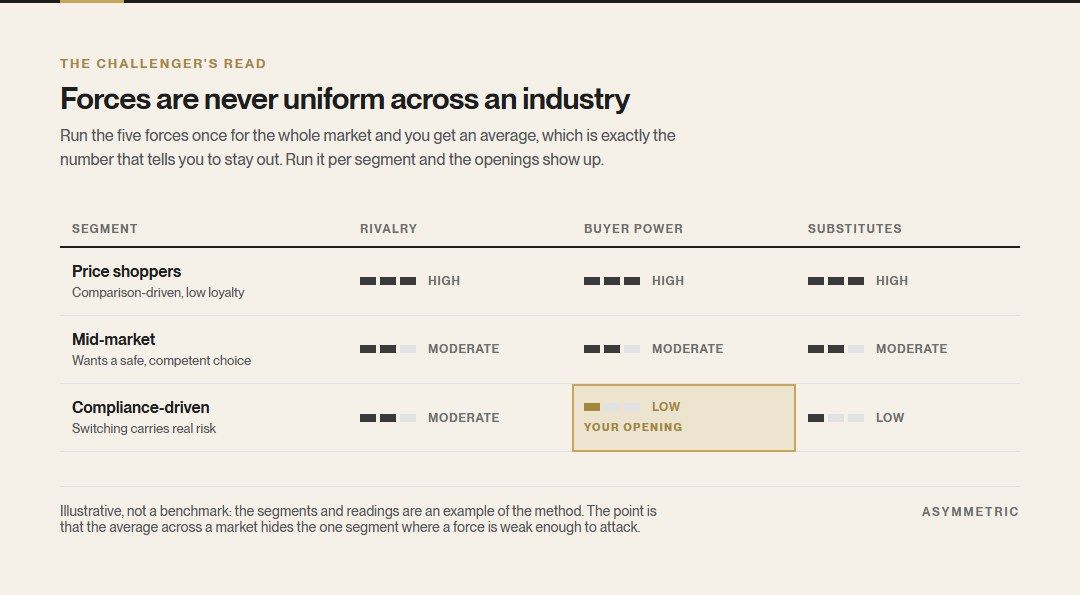
The forces are rarely uniform across an industry. Buyer power is high in one segment and low in another; entry barriers are formidable in the incumbent's core and thin at the edges; a substitute threatens one use case and not another. A challenger uses Five Forces to locate that unevenness. Where is rivalry actually soft because the established players have all converged on the same position and left a segment underserved? Where are switching costs low enough to pry customers loose, or high enough to lock the ones you win? This is the same discipline as a focused competitor analysis: not a description of the whole market, but a search for the specific place where the structure favors you and a rival is exposed.
Five Forces and the rest of the toolkit
Five Forces is one lens, and it pairs with others rather than replacing them. It analyzes the structure of an industry, which is different from analyzing your own position within it. That's why it sits alongside the other strategy frameworks, such as a competitor-mapped SWOT, in a complete read: Five Forces tells you what the industry's economics allow, and a position analysis tells you where you stand inside those economics. The threat of substitutes and buyer power also connect directly to how you compete on price, since both forces cap what the market will pay and push you toward differentiation when price competition is a losing fight.
From the forces to a move
The point of the analysis is a decision: enter here, avoid there, attack this segment, build this barrier, or change the basis of competition so a force that hurts you matters less. The strongest move is often not to fight an unfavorable force head-on but to shift to ground where it's weaker. And because a competitor will respond, the decision is worth pressure-testing before you commit to it, which is exactly what a business wargame does: it runs your move against the rivals who would react to it, so you learn where the forces really bite before you spend.
Read your industry for the opening
If you want a read of your industry's structure that ends in a specific move rather than a verdict on whether the market is attractive, that's the work we do.
Frequently asked questions
What is Porter's Five Forces?
Porter's Five Forces is a framework, developed by Harvard professor Michael Porter, for analyzing the competitive structure of an industry. The five forces are competitive rivalry, the threat of new entrants, the bargaining power of buyers, the bargaining power of suppliers, and the threat of substitutes. Together they explain how much profit an industry tends to allow and where the pressure on a business comes from.
How do you apply Porter's Five Forces to an industry?
Assess each force for your specific industry and segment: how intense rivalry is, how easily new competitors can enter, how much leverage buyers and suppliers have, and whether substitutes can meet the customer's need another way. The forces are rarely uniform across a market, so the useful step is locating where a force is weak enough to give you an opening, then deciding a move rather than stopping at a description.
What are the benefits of using Porter's Five Forces?
It gives a structured view of why an industry is profitable or punishing, and where the competitive pressure actually originates. Used well, it helps a company decide which segments to enter or avoid, where to build barriers, and when to change the basis of competition rather than fight an unfavorable force head-on. Its value depends on ending in a decision and being refreshed as the industry shifts.
What is the bargaining power of buyers?
It's how much leverage customers have to push prices down or demand more for the same price. Buyers are powerful when they're concentrated, well informed, buy in large volumes, or face low switching costs, since they can credibly take their business elsewhere. High buyer power caps what you can charge and usually pushes a business toward stronger differentiation.
What is the difference between SWOT and Porter's Five Forces?
SWOT describes your company. Porter Five Forces describes the industry you're competing in. SWOT tells you what you're good at, and Five Forces tells you whether being good at it will pay. Read the industry first to see where the profit sits and which forces are weak, then use SWOT to judge whether you can get there.
Is Porter's Five Forces still relevant?
It's still the fastest way to read an industry's structure, but it was written for stable industries and says nothing about timing. Treat Porter Five Forces as a snapshot of where power sits rather than a forecast, and pair it with something that handles speed, like how quickly a competitor can respond to you.
About the author

Mark Hope
Founder, President & Chief Strategy Officer, Asymmetric Marketing
Mark Hope is the Founder, President & Chief Strategy Officer of Asymmetric Marketing. His career spans elite military service, senior leadership at two of the largest companies in their categories, and founding several companies of his own. It's the common thread behind how Asymmetric helps smaller companies out-compete bigger ones.
Mark began his career in U.S. Army Special Operations, serving from 1977 to 1988 in the 1st and 3rd Battalions of the 75th Ranger Regiment and as an Operator in 1st Special Forces Operational Detachment–Delta (Delta Force). What that world runs on (careful planning, reading your opponent, and winning from a position of disadvantage) is the foundation of how he helps smaller companies win today.