

September 16, 2024
Wisconsin SEO Services: How to Get Found and Choose a Provider
For a Wisconsin business, SEO is the difference between being found by a ready-to-buy customer and losing them to a competitor who ranked higher. Here's what SEO actually includes, why local SEO matters most, and how to choose a provider worth paying.
By Mark Hope, Founder, President & Chief Strategy Officer, Asymmetric Marketing

For a Wisconsin business, SEO is often the difference between being found by a ready-to-buy customer and losing that customer to a competitor who ranked higher. Search engine optimization is the work of earning visibility in Google's organic results, so that when someone searches for what you sell, your website is what they find. Done well, it produces a steady stream of customers who were already looking, without paying for every click. The catch is that good SEO is specific, technical, and slow, which is exactly why choosing the right approach, or the right partner, matters.
Key takeaways
- SEO services earn organic visibility so ready-to-buy customers find you instead of a competitor who ranked higher.
- Real SEO has four parts: on-page optimization, technical SEO, off-page authority, and, decisively for Wisconsin businesses, local SEO.
- Local SEO, a strong Google Business Profile, reviews, location pages, and the map pack, matters most because customers search locally.
- Choose a provider that ties SEO to leads and revenue, starts with an audit, and is honest about the months-long timeline.
- SEO and paid search work together: paid for immediate visibility, SEO for durable, compounding local presence.
What SEO services actually include
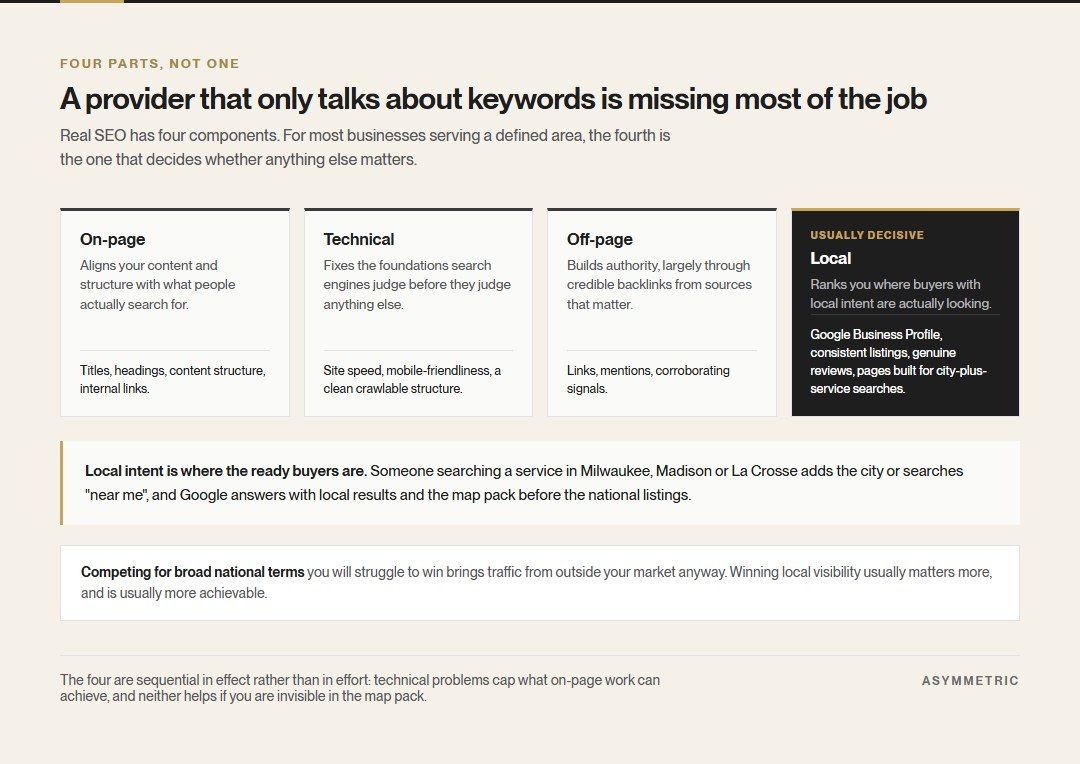
Real SEO is more than stuffing keywords onto a page. It has a few core parts. On-page optimization aligns your content and structure with what people search for. Technical SEO fixes the foundations search engines judge, including site speed, mobile-friendliness, and a clean, crawlable structure. Off-page work builds authority, largely through credible backlinks. And for most Wisconsin businesses, local SEO is decisive: an accurate Google Business Profile, consistent listings, reviews, and pages built to rank in the local map pack for searches like your city plus your service. An SEO provider that only talks about keywords is missing most of the job.
Why local SEO matters most for Wisconsin businesses
Most Wisconsin businesses serve a defined area, and their customers search locally. Someone in Milwaukee, Madison, or La Crosse looking for a service adds the city or searches near me, and Google answers with local results and the map pack before the national listings. Winning that local visibility, through a strong Google Business Profile, genuine reviews, and location pages that actually rank, often matters more than competing for broad national terms you'll struggle to win and that bring traffic from outside your market anyway. Local intent is where the ready buyers are.
How to choose an SEO provider
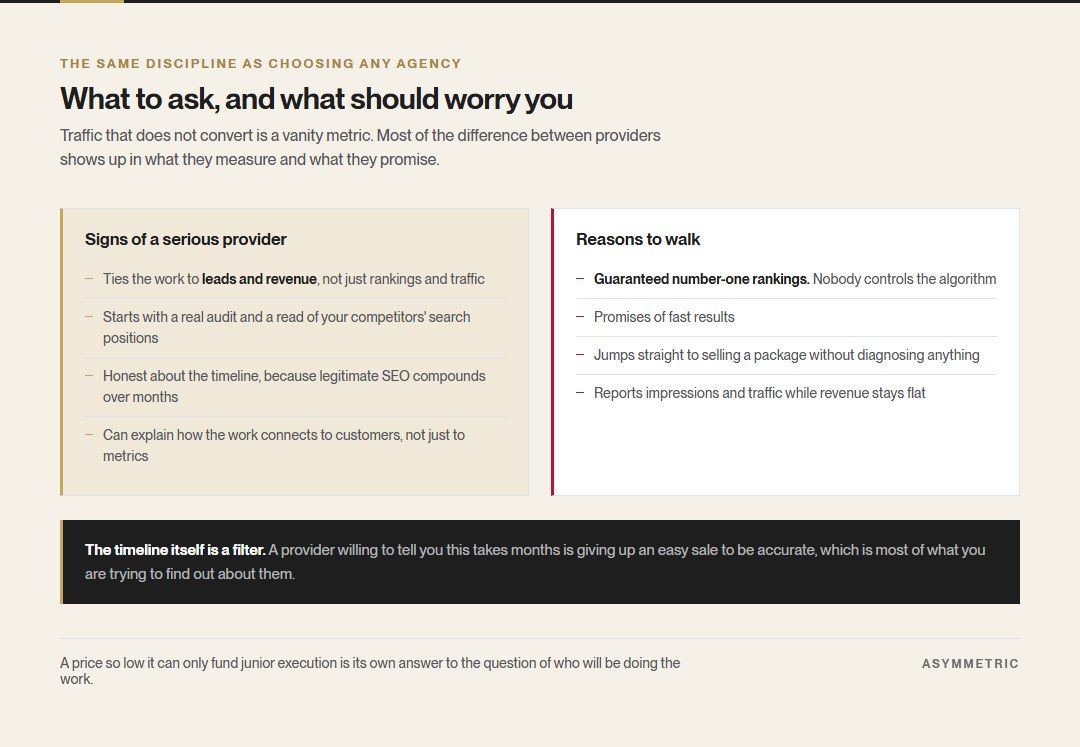
The same discipline that applies to choosing any agency applies here. Look for a provider that ties SEO to leads and revenue, not just rankings and traffic, since traffic that doesn't convert is a vanity metric. Ask whether they start with a real SEO audit and a read of your competitors' search positions, or jump straight to selling a package. Be wary of anyone promising guaranteed number-one rankings or fast results, because legitimate SEO compounds over months and no one controls Google's algorithm. The right provider is honest about the timeline and clear about how the work connects to customers. For the broader agency decision, see our guide to marketing agencies in Wisconsin.
SEO and paid search work together
How long SEO takes, and what should happen along the way
The most common source of disappointment with SEO isn't the result but the timeline nobody agreed on at the start. Legitimate work compounds over months, and knowing what should be visible at each stage makes the wait assessable rather than a matter of faith.
In the first month you should see technical and foundational fixes landing: crawl issues resolved, the Google Business Profile corrected and complete, listings made consistent, and a baseline established that you both agree on. None of this moves rankings yet and all of it is prerequisite.
By roughly the third month there should be movement on the long tail. Specific, lower-competition terms start appearing in Search Console where they previously did not, and impressions rise before clicks do. This is the earliest honest evidence the work is taking.
By six months the more competitive local terms should be moving, and local pack visibility should be measurably better than the baseline. This is also the point at which a programme that's not working becomes obvious, which is why a six-month checkpoint agreed in advance is worth insisting on.
Anyone promising first-page rankings in weeks is describing something other than organic search. The one legitimate exception is a site with serious technical problems, where fixing them can produce fast gains simply by allowing existing content to be seen properly.
Local SEO for a business serving several Wisconsin markets
Serving more than one city complicates local SEO in ways that catch operators out, because the mechanism rewards physical presence rather than service area.
The map pack is driven largely by proximity to the searcher and by verified location. A single location in Madison will struggle to appear in Milwaukee's local results however good the site is, and no amount of content changes that. Understanding this early prevents a lot of wasted effort.
What does work is a genuine location page per market, built around that city's specific needs rather than the same page with the city name swapped. Search engines identify templated location pages easily, and a set of near-identical pages tends to underperform a smaller number of substantial ones.
If you have a real address and staff in a second market, a separate verified profile for it is the highest-return action available. If you do not, a service-area business profile plus one strong location page is the honest ceiling, and it's better to be excellent in one market than mediocre across four.
The judgment worth making explicitly is whether a second market is worth the effort at all. Route density and margin usually argue for going deeper where you already win rather than thinner across a wider map, and that's a business decision that SEO should follow rather than lead.
SEO isn't the only way to show up in search. Paid search ads can put you at the top immediately while your organic rankings build, and the data from paid campaigns shows you which terms are worth optimizing for. Understanding how SEO and SEM differ and work together helps you spend on the right mix rather than treating them as competing line items. For most Wisconsin businesses, the strongest plan uses paid search for immediate visibility and SEO for durable, compounding local presence.
Get found by the customers already searching
Frequently asked questions
What do SEO services include?
Real SEO covers on-page optimization (aligning content and structure with what people search), technical SEO (site speed, mobile-friendliness, a crawlable structure), off-page authority building through credible backlinks, and, for most Wisconsin businesses, local SEO: an accurate Google Business Profile, consistent listings, reviews, and pages built to rank in the local map pack. A provider that only talks about keywords is missing most of the work.
Why is local SEO important for Wisconsin businesses?
Most Wisconsin businesses serve a defined area, and their customers search locally, adding a city name or 'near me.' Google answers those searches with local results and the map pack before national listings, so winning local visibility through a strong Google Business Profile, reviews, and location pages usually matters more than competing for broad national terms that bring traffic from outside your market.
How do I choose an SEO provider?
Pick one that ties SEO to leads and revenue rather than just rankings and traffic, starts with a real audit and a read of your competitors' search positions, and is honest that legitimate SEO compounds over months. Be wary of guaranteed number-one rankings or promises of fast results, since no one controls Google's algorithm and quick gains rarely last.
Should I use SEO or paid search in Wisconsin?
Usually both. Paid search puts you at the top immediately while your organic rankings build, and its data reveals which terms are worth optimizing for. SEO then earns durable, compounding local visibility that doesn't charge per click. The strongest plan uses paid search for speed and SEO for lasting presence rather than treating them as competing budgets.
How long do Wisconsin SEO services take to show results?
Expect six to twelve months for meaningful movement on competitive terms, with earlier signs along the way: pages getting indexed, impressions rising, and rankings improving on longer phrases before the main terms move. If a provider promises rankings in weeks, ask which terms, because it's usually ones nobody searches.
How does local SEO work for a business serving several Wisconsin markets?
You need a real page for each market, not one page with city names swapped in. Each should carry content specific to that location, and your name, address, and phone details need to match everywhere they appear. Duplicated location pages are the most common reason multi-market businesses stall.
About the author

Mark Hope
Founder, President & Chief Strategy Officer, Asymmetric Marketing
Mark Hope is the Founder, President & Chief Strategy Officer of Asymmetric Marketing. His career spans elite military service, senior leadership at two of the largest companies in their categories, and founding several companies of his own. It's the common thread behind how Asymmetric helps smaller companies out-compete bigger ones.
Mark began his career in U.S. Army Special Operations, serving from 1977 to 1988 in the 1st and 3rd Battalions of the 75th Ranger Regiment and as an Operator in 1st Special Forces Operational Detachment–Delta (Delta Force). What that world runs on (careful planning, reading your opponent, and winning from a position of disadvantage) is the foundation of how he helps smaller companies win today.