

August 14, 2025
Why Your Click-Through Rate (CTR) Isn't the Only Metric That Matters
Click-through rate tells you whether your message earns attention, but a high CTR that leads nowhere just buys traffic that never converts. Here's what CTR is, what counts as good, and where it really belongs.
By Mark Hope, Founder, President & Chief Strategy Officer, Asymmetric Marketing

Click-through rate, or CTR, is the percentage of people who click on something after seeing it, whether an ad, a search result, or an email. It's one of the most watched numbers in digital marketing, and for good reason: it tells you whether your message earns attention. But CTR is also one of the most over-trusted metrics, because a high click-through rate that leads nowhere is just an efficient way to pay for traffic that never becomes a customer. CTR is worth understanding, and worth keeping in its place.
Key takeaways
- Click-through rate is clicks divided by impressions, times 100: the share of people who click after seeing your ad, listing, or email.
- There's no universal "good" CTR; it varies widely by channel, format, and intent, so compare against your own benchmarks, not a generic number.
- CTR is a strong top-of-funnel signal and, in paid search, lifts Quality Score, which lowers cost per click.
- A click isn't a customer: a high CTR can still lose money if those clicks don't convert.
- Judge CTR alongside conversion rate, cost per acquisition, and revenue, never on its own.
What CTR is and how to calculate it
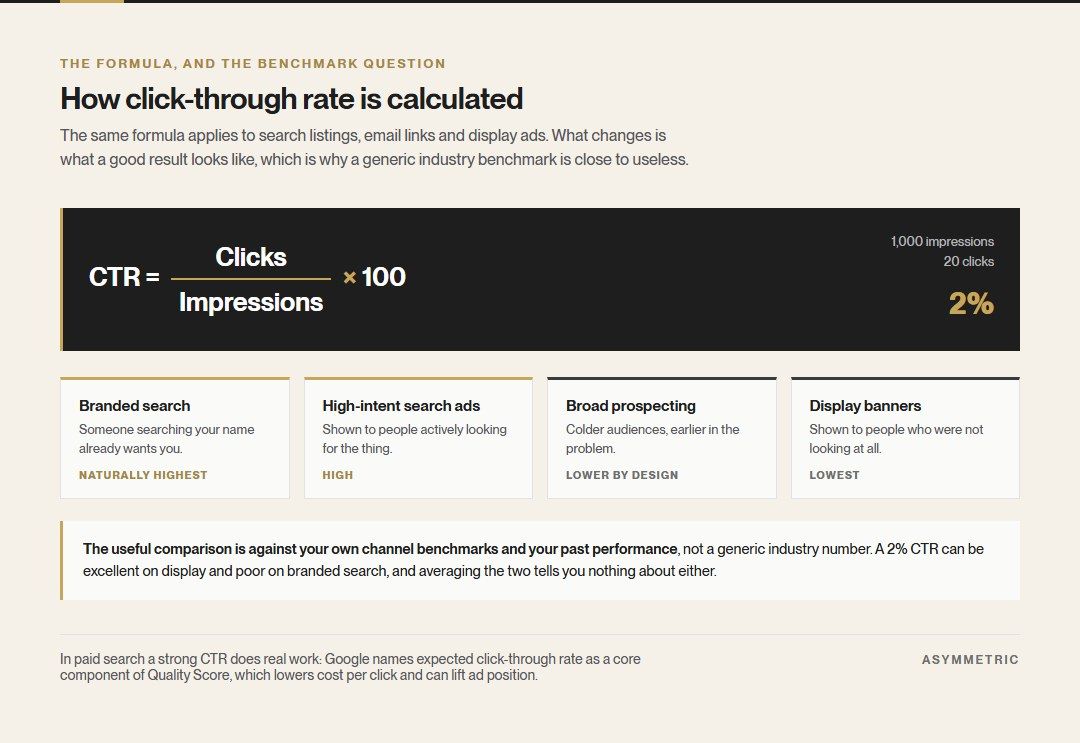
CTR is calculated by dividing the number of clicks by the number of impressions, then multiplying by 100. If an ad is shown 1,000 times and clicked 20 times, its CTR is 2 percent. The same formula applies to search listings, email links, and display ads. Because it measures the share of viewers who act, CTR is a clean signal of how relevant and compelling your message is to the people who see it.
How to calculate click-through rate, with worked examples
The formula is the same everywhere, and the only thing that changes is what counts as an impression. Divide clicks by impressions, multiply by 100, and you have the percentage.
An email sent to 5,000 people that produces 150 clicks has a 3% click-through rate. A search ad shown 12,000 times that earns 360 clicks also has 3%. A landing-page button seen by 800 visitors and clicked 40 times has 5%. The arithmetic never varies.
What varies is the denominator, and that's where comparisons quietly break. Email platforms usually calculate against delivered messages rather than sent, so a list with heavy bounces will report a flattering rate. Search platforms count an impression when your ad renders, which may be below the fold and never actually seen. Organic search impressions in Search Console count when your listing appears anywhere in the results, including position 40 on page four, which is why organic CTR figures look low against paid ones.
Before comparing two numbers, check they're counting the same event. Most surprising CTR comparisons turn out to be a denominator problem rather than a performance one.
What counts as a good CTR
There's no universal good CTR, because it varies enormously by channel, format, and intent. Search ads on high-intent keywords often see much higher rates than display banners, which are shown to people who weren't actively looking. Branded keywords, where someone searches your name, naturally pull strong click-through rates, while broad prospecting reaches colder audiences and earns fewer clicks. The useful comparison is against your own channel benchmarks and your past performance, not a generic industry number.
Reading the impressions side of the ratio
Because CTR is a ratio, it moves for two entirely different reasons, and the direction of the number doesn't tell you which. Clicks can rise. Impressions can fall. A campaign whose rate improved because reach collapsed isn't performing better, and one whose rate dropped while both clicks and revenue grew is usually doing something right.
This is the single most common misreading in reporting. Broadening a campaign's targeting almost always lowers CTR, because the additional impressions come from colder audiences, while total clicks and often total customers go up. Judged on rate alone, a successful expansion looks like a failure.
The habit that prevents it's simple: never look at a rate without the two numbers underneath it. If clicks and impressions are both in the report, the story is usually obvious. If only the percentage is there, you can't tell whether anything happened.
In organic search the same logic explains most alarming drops. Ranking for a broader set of queries raises impressions faster than clicks, so a page gaining visibility can show a falling click-through rate while gaining traffic every week.
Why channel benchmarks differ so much
Published benchmark tables are popular and mostly unhelpful, because the number they report is downstream of intent rather than of quality. It's worth understanding what actually drives the spread instead of memorising someone else's averages.
Intent is the largest factor. Branded search, where someone typed your name, produces the highest rates of anything, because the person was already looking for you. High-intent non-brand search follows. Broad prospecting sits lower by design, and display advertising sits lowest of all, because it interrupts people who weren't looking for anything.
Format and placement come next. A video thumbnail, a text ad and a banner ask for very different levels of commitment, and a placement below the fold is counted as an impression by most platforms whether or not a human eye reached it.
Audience temperature is the third. A retargeting list of people who already visited will always outperform a cold prospecting audience, and comparing the two tells you nothing except that you already knew which was warmer.
The practical consequence is that your own history is the only benchmark worth acting on. A rate that would be excellent on display and poor on branded search is meaningless as a single figure, and the average of the two describes nothing that exists.
Why CTR matters
A strong CTR does real work. In paid search it improves your Quality Score, which lowers your cost per click and can lift your ad position, so relevance is rewarded with cheaper, better placement. Google's own documentation names expected click-through rate as a core component of Quality Score. Across channels, CTR is the fastest signal that a headline, offer, or creative is connecting, which makes it valuable for testing and quickly comparing messages. As a diagnostic for the top of the funnel, it's hard to beat.
Why CTR isn't the only metric that matters
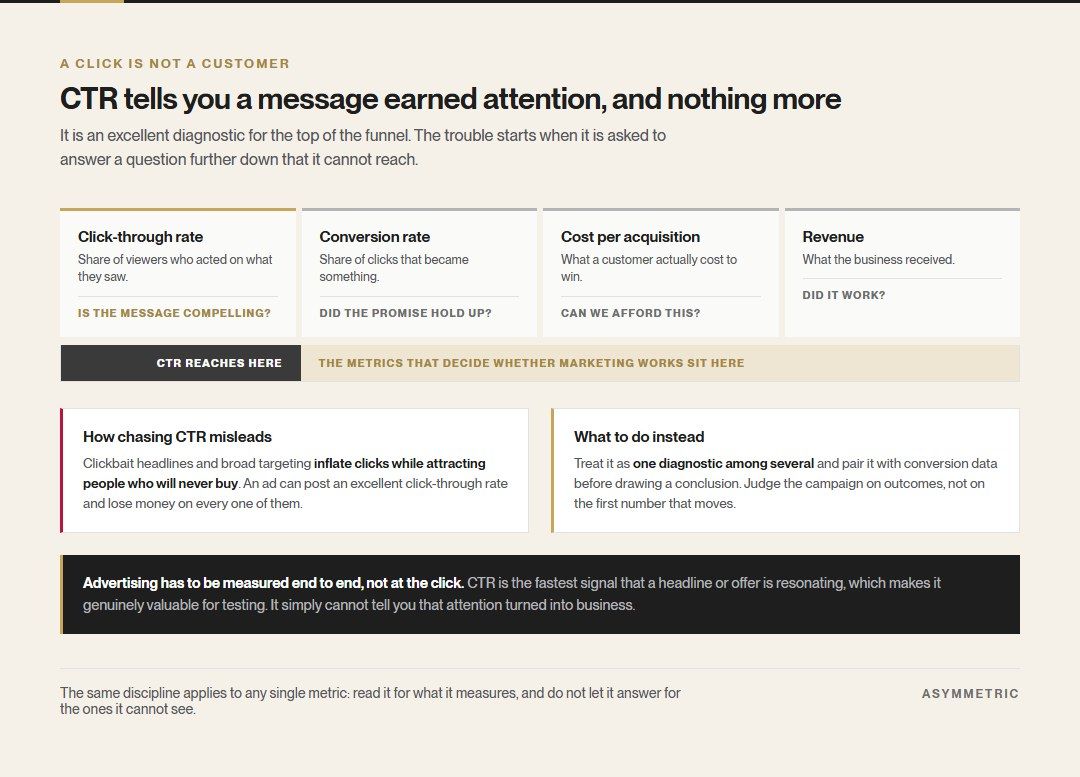
Here's where CTR gets people in trouble. A click isn't a customer. An ad can earn a high click-through rate and still lose money if those clicks don't convert, and chasing CTR alone can actively mislead you, since clickbait headlines and broad targeting can inflate clicks while attracting people who will never buy. The metrics that decide whether marketing works sit further down: conversion rate, cost per acquisition, and ultimately revenue. CTR tells you a message earns attention; it can't tell you that attention turns into business. Treat it as one diagnostic among several, the same discipline behind judging campaigns on outcomes rather than vanity metrics, and pair it with conversion data before drawing conclusions. It's also why advertising has to be measured end to end, not at the click.
Measure what actually grows the business
If your reporting leads with clicks and impressions rather than customers and revenue, the fix is to measure the whole path, not just the first step. That's the work we do.
Frequently asked questions
What is a click-through rate (CTR)?
Click-through rate is the percentage of people who click on something after seeing it, calculated as clicks divided by impressions times 100. It applies to ads, search listings, emails, and display, and measures how relevant and compelling your message is to the people who see it.
What is a good click-through rate?
There's no universal good CTR; it varies widely by channel, format, and intent. High-intent and branded search earn far higher rates than cold display or prospecting. The useful benchmark is your own channel history and comparable campaigns, not a generic industry average.
How do you calculate CTR?
Divide the number of clicks by the number of impressions, then multiply by 100. An ad shown 1,000 times and clicked 20 times has a CTR of 2 percent. The same formula applies to search results, email links, and display ads.
Why isn't CTR the only metric that matters?
Because a click isn't a customer. An ad can earn a high CTR and still lose money if the clicks don't convert, and clickbait can inflate clicks while attracting people who never buy. CTR is a top-of-funnel signal; conversion rate, cost per acquisition, and revenue decide whether marketing actually works.
Does CTR affect Google Ads cost?
Yes. In paid search, expected click-through rate is a core component of Quality Score, and a higher Quality Score lowers your cost per click and can improve ad position. Relevance that earns clicks is rewarded with cheaper, better placement.
How do you calculate click-through rate?
Divide clicks by impressions and multiply by 100. An email sent to 5,000 people that produces 150 clicks has a 3% click-through rate, and a search ad shown 12,000 times that earns 360 clicks also has 3%. The arithmetic never changes; what changes is what each platform counts as an impression. Email tools usually calculate against delivered rather than sent messages, and organic search counts an impression when your listing appears anywhere in the results, including page four, which is why organic rates look low next to paid ones.
Why did my click-through rate drop when traffic went up?
Because it's a ratio, and it moves for two different reasons. Broadening a campaign's targeting adds impressions from colder audiences faster than it adds clicks, so the rate falls while total clicks and often total customers rise. The same happens in organic search when a page starts ranking for a wider set of queries. Never read a rate without the two numbers underneath it: if clicks and impressions are both in the report, the story is usually obvious.
About the author

Mark Hope
Founder, President & Chief Strategy Officer, Asymmetric Marketing
Mark Hope is the Founder, President & Chief Strategy Officer of Asymmetric Marketing. His career spans elite military service, senior leadership at two of the largest companies in their categories, and founding several companies of his own. It's the common thread behind how Asymmetric helps smaller companies out-compete bigger ones.
Mark began his career in U.S. Army Special Operations, serving from 1977 to 1988 in the 1st and 3rd Battalions of the 75th Ranger Regiment and as an Operator in 1st Special Forces Operational Detachment–Delta (Delta Force). What that world runs on (careful planning, reading your opponent, and winning from a position of disadvantage) is the foundation of how he helps smaller companies win today.