

May 13, 2026
Competitive Intelligence: A Complete Guide to Turning a Read on Your Rivals Into an Edge
Most competitive intelligence is gossip with a spreadsheet. Real CI is a standing discipline that finds where rivals are exposed. What it is, where it comes from, the process, the frameworks, and how to turn it into a move.
By Mark Hope, Founder, President & Chief Strategy Officer, Asymmetric Marketing

Most "competitive intelligence" is a browser tab someone opens twice a year: glance at a rival's website, screenshot their pricing, note that they launched something, move on. That's not intelligence. It's gossip with a spreadsheet. Real competitive intelligence is a standing discipline, a continuous, structured practice of gathering and analyzing information about your competitors and your market to inform better decision-making, aimed at the one question the gossip never asks: where are they over-extended, generic, or asleep? This is the full guide to competitive intelligence: what it is, where the information comes from, how the process works, the frameworks and tools that organize it, and how to turn it into a move.
I learned how much that work is worth running marketing at The Coca-Cola Company, where the single most valuable decision I made was moving ten percent of the budget out of media and into market and competitive research. Knowing precisely where a competitor was soft made every remaining dollar work harder than another flight of ads ever could. The companies that win don't out-spend on intelligence; they treat it as the input that decides where the rest of the budget goes.
Key takeaways
- Competitive intelligence (CI) is the continuous, ethical practice of gathering and analyzing public information about competitors, customers, and the market, turned into insight that guides strategy.
- It differs from gossip in two ways: it's continuous rather than occasional, and weakness-seeking rather than feature-cataloguing.
- It runs as a cycle, plan, collect, analyze, disseminate, act, repeated as the market moves, not a one-off report.
- The half most companies skip is reading themselves as honestly as their rivals; intelligence lives in the gap between the two.
- It's only worth doing if it ends in a decision, a positioning, pricing, channel, or market move, ideally pressure-tested before the budget commits.
What competitive intelligence is
Competitive intelligence, often shortened to CI, is the systematic gathering and analysis of information about competitors, customers, and the broader market, turned into insight that guides strategy and decision-making. It's related to but distinct from a few neighboring terms. Business intelligence usually refers to analyzing your own internal data. Market intelligence is the wider read on market trends and customers. Competitive intelligence focuses specifically on rivals and your position against them. Done as an ongoing competitor analysis rather than a one-off, it feeds everything from product development and product positioning to pricing and go-to-market.
Crucially, competitive intelligence is an ethical, legal discipline built on publicly available information and honest research. It's not industrial espionage. The professional field even has its own body, SCIP, the Strategic and Competitive Intelligence Professionals, which publishes a Code of Ethics and sets standards for intelligence analysis without crossing legal or ethical lines.
Intelligence versus gawking
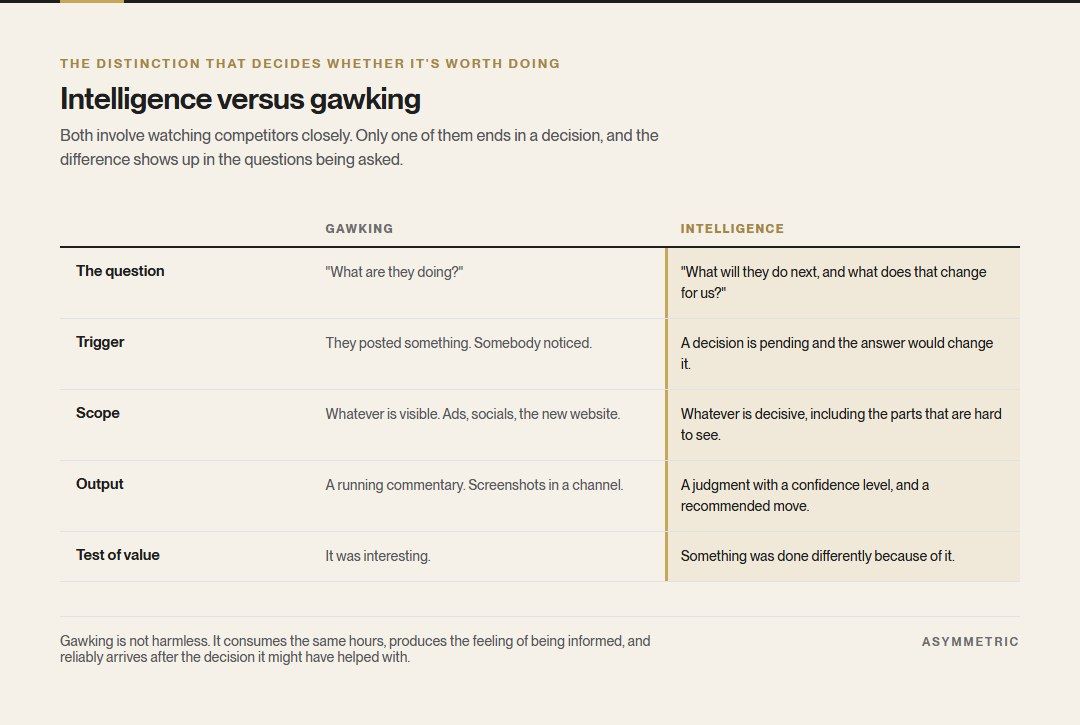
Checking a competitor's website tells you exactly what they want you to see. Intelligence is the standing system that tracks what they don't advertise: where their messaging has gone generic, where their pricing is indefensible, which segments they have quietly stopped defending. The difference is two-fold. It's continuous rather than occasional, because a rival's price change means something only against the pattern of everything before it. And it's weakness-seeking rather than feature-cataloguing, because you're not building a competitor encyclopedia, you're hunting for soft spots you can exploit.
How a competitive intelligence program works: the cycle
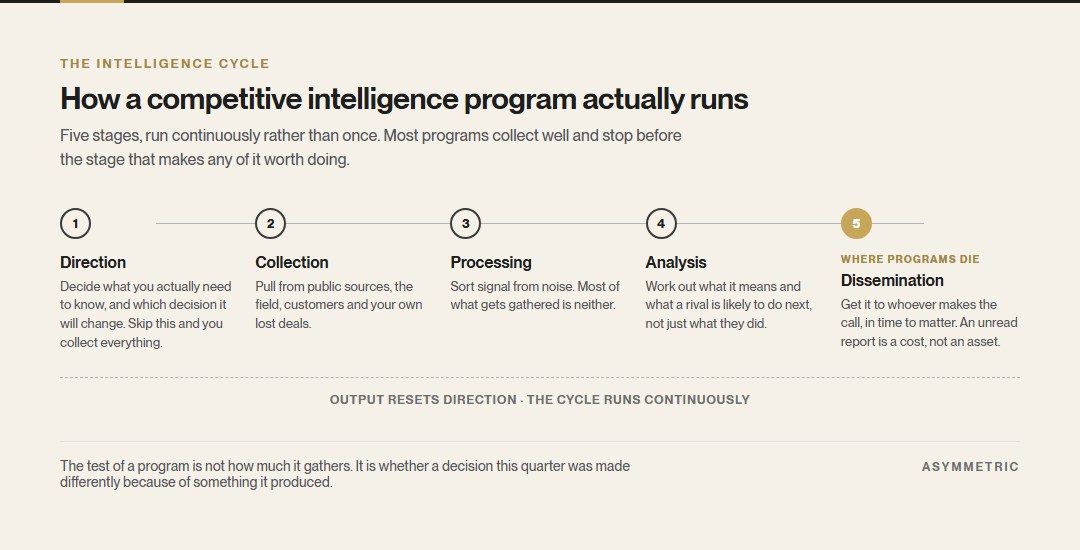
CI is run as a loop, the intelligence cycle, not a single report. It has five stages. Plan: define the decisions the intelligence must inform and the questions worth answering, so collection stays focused. Collect: gather from the public sources below on a standing cadence rather than in a panic before a board meeting. Analyze: turn raw information into insight by reading it through a framework for one thing, where a competitor is exposed. Disseminate: get the insight to the people who act on it, sales, product, and leadership, in a form they will use, such as a battlecard or a short brief. Act: make the decision the intelligence points to, then feed the result back into the next cycle. A CI analyst, where the role exists, owns this loop; in smaller companies it's a discipline a marketing or strategy lead runs. Either way, the value is in the loop turning continuously, not in any one snapshot.
Where competitive intelligence comes from
A useful CI program pulls from many sources, almost all of them public. Competitor websites, pricing pages, and marketing reveal positioning and claims. Analyst reports, press releases, news, and earnings calls show strategy and financial pressure, while ongoing market research fills in what customers and the wider market are doing. Job postings signal where a rival is investing. Patents hint at product development. Social media, customer reviews, and review sites expose how customers actually feel and behave, and customer behavior data, customer feedback, and win/loss interviews from your own sales team are among the richest internal sources of all. Trade shows and conferences surface what competitors are pushing. Increasingly, big data and AI tools help monitor all of this at scale. The art is less in finding information, which is abundant, than in filtering it for the few signals that change a decision.
What to track
A disciplined CI program watches a handful of things rather than everything:
- Positioning: what each rival claims, and where the claim has gone soft, generic, or undifferentiated.
- Pricing: structure, recent moves, and where it's exposed.
- Product and product development: what they're building, the product roadmap behind recent product launches, and the gaps it leaves.
- Market share: how the competitive split is shifting, and which rivals are gaining or losing ground.
- Messaging and channels: where they're loud, and just as importantly, where they're absent.
- Market trends: the shifts that change who is strong, so your read doesn't go stale.
- Weakness and over-extension: the segments, channels, or promises they can't defend well.
The output isn't a database. It's a shortlist of exploitable gaps.
Frameworks and tools for competitive intelligence
Raw information becomes intelligence when a framework organizes it. A competitor-mapped SWOT analysis sorts strengths and weaknesses against your own. Porter's Four Corners model analyzes a competitor's motivations and likely moves, not just their current capabilities. Battlecards, also called battle cards, distill the intelligence into a one-page reference that sales can use against a specific rival in a live deal. Competitive benchmarking measures how you stack up on the dimensions customers care about. And early warning systems flag competitor moves before they become threats. Specialized CI tools and platforms automate much of the monitoring, but the framework, not the tool, is what turns data into a decision.
The half everyone skips: knowing yourself
Most companies can describe their competitors fluently and can't honestly name their own soft spots. Intelligence lives in the gap between those two reads: what the competitor is weak at, versus what you're weak at. When we mapped the competitive market for an energy-analytics firm, the intelligence surfaced an uncomfortable truth about them, not just their rivals. Their technology was genuinely superior, yet they were nearly invisible during the buyer's journey. The CI showed why: a larger public competitor owned mindshare on the core search terms, and a fifty-year-old data incumbent owned the thought-leadership ground. By the time a prospect encountered this firm, competitors' narratives had already defined what a solution should look like. That gap, between a real product strength and a real visibility weakness, is invisible if you study only competitors. You find it by reading them and yourself, honestly, at the same time.
From intelligence to a move
Intelligence that doesn't change a decision is a cost center. The discipline has to end in action, a positioning shift, a channel concentration, a pricing response, a new market opportunity to pursue, a shift in business strategy, or a segment to own, and ideally that move gets pressure-tested before any budget commits. AviaryAI, a Y Combinator-backed company building AI voice agents for credit unions and banks, came to us with the kind of opening only competitive intelligence reveals. When we read the category, the pattern was unmistakable: nearly every competitor was built around inbound call handling. Aviary's strength was outbound, and the CI reframed what that meant. They weren't a late entrant fighting a crowded field head-on; they were the specialist in a lane the whole category had left open. That read turned their positioning from "another AI voice vendor" into the outbound-first option, and Aviary became a client. The way we run CI is built backward from that endpoint: we track positioning, pricing, product, and weakness continuously, read the client as honestly as the competitor, and end each cycle in a decision we often stress-test in a business wargame before the spend is committed.
Put your competitive read to work
If you want a standing read on your competitors that ends in moves instead of slides, one that finds where rivals are over-extended and tells you honestly where you're exposed, that's the work we do.
Frequently asked questions
What is competitive intelligence?
Competitive intelligence (CI) is the systematic, continuous gathering and analysis of public information about competitors, customers, and the market, turned into insight that guides strategy and decision-making. It's an ethical, legal discipline built on publicly available information, not espionage, and its purpose is to find where rivals are exposed so you can compete where you can win.
What is the difference between competitive intelligence and business intelligence?
Business intelligence usually means analyzing your own internal data, such as sales and operations. Market intelligence is the wider read on market trends and customers. Competitive intelligence focuses specifically on rivals and your position against them. The three overlap, but CI is the one aimed at finding a competitor's weakness and your own.
How does the competitive intelligence process work?
As a cycle, not a one-off report: plan the decisions the intelligence must inform, collect from public sources on a standing cadence, analyze the data through a framework to find where a competitor is exposed, disseminate the insight to the people who act on it (often as a battlecard or brief), and act on the decision, then feed the result into the next cycle.
What are the sources and tools for competitive intelligence?
Sources are mostly public: competitor websites and pricing, analyst reports, earnings calls, news, job postings, patents, social media, customer reviews, and your own win/loss interviews. Frameworks like SWOT, Porter's Four Corners, battlecards, and benchmarking organize it, and specialized CI platforms automate the monitoring. The framework, not the tool, is what turns data into a decision.
What is an example of competitive intelligence?
For AviaryAI, an AI voice-agent company, our CI read of the category showed nearly every competitor was built around inbound call handling while Aviary's strength was outbound, an open lane. That reframed their positioning from another voice vendor to the outbound-first specialist. Good CI turns a pattern in public information into a specific, defensible move.
Who runs competitive intelligence in a company?
In large organizations a dedicated CI analyst or team owns the intelligence cycle, gathering, analyzing, and disseminating to sales, product, and leadership. In smaller companies it's a discipline a marketing or strategy lead runs as part of the role. Either way, what matters is that the loop turns continuously and ends in decisions, not that a specific title exists.
About the author

Mark Hope
Founder, President & Chief Strategy Officer, Asymmetric Marketing
Mark Hope is the Founder, President & Chief Strategy Officer of Asymmetric Marketing. His career spans elite military service, senior leadership at two of the largest companies in their categories, and founding several companies of his own. It's the common thread behind how Asymmetric helps smaller companies out-compete bigger ones.
Mark began his career in U.S. Army Special Operations, serving from 1977 to 1988 in the 1st and 3rd Battalions of the 75th Ranger Regiment and as an Operator in 1st Special Forces Operational Detachment–Delta (Delta Force). What that world runs on (careful planning, reading your opponent, and winning from a position of disadvantage) is the foundation of how he helps smaller companies win today.