

June 20, 2024
Growth Marketing Agency: What It Is and Why You Might Need One
A growth marketing agency grows a business across the whole customer journey with data and experimentation, not one-off campaigns. Here's what one does, how it differs from growth hacking, and when you need it.
By Mark Hope, Founder, President & Chief Strategy Officer, Asymmetric Marketing

A growth marketing agency specializes in growing a business across the entire customer journey, from the first time someone hears of you to the moment they buy and come back, using data and experimentation rather than one-off campaigns. The term gets used loosely, and it's often confused with growth hacking and its promise of viral tricks. Real growth marketing is the opposite of a gimmick. It's a disciplined, measurable system for finding what actually moves revenue and doing more of it.
Key takeaways
- A growth marketing agency works the entire funnel, acquisition through retention and revenue, not just top-of-funnel awareness.
- It's judged on business outcomes such as leads, customers, and revenue, rather than impressions or awards.
- Growth marketing is the disciplined cousin of growth hacking: continuous experiments, not one-off viral tricks.
- It pays off most after product-market fit, when you need to scale acquisition efficiently.
- For a challenger, experimentation is how you find the cheap channels and segments a larger competitor ignores.
What a growth marketing agency does
A traditional agency tends to focus on the top of the funnel: awareness, brand, and creative campaigns that get attention. A growth marketing agency works the whole funnel, from acquisition through activation, retention, and revenue. It runs structured experiments across channels, content, and the website, measures what converts, and shifts effort toward what works. The defining habit is that it's judged on business outcomes, leads, customers, and revenue, rather than on impressions or awards. Where a traditional agency delivers a campaign, a growth agency delivers a system for finding and compounding what grows the business. The work spans every level of marketing planning, but its center of gravity is measurable execution.
What a growth marketing engagement actually delivers
The word "growth" covers a lot of ground, so it is worth being concrete about what arrives. Most engagements produce four things. A measurement foundation, because you can't run experiments against numbers you don't trust, which usually means fixing attribution and event tracking before anything else. An experiment backlog, prioritised by expected impact and cost to test rather than by whoever suggested it loudest. A running cadence of tests across the funnel, typically several live at once at different stages. And a decision record: what was tried, what it cost, what happened, and what changed as a result.
What you shouldn't expect is a channel plan handed over in month one. A growth agency that arrives with the answer already written has skipped the part you're paying for. The first weeks are for finding out which of your assumptions survive contact with data, and a good engagement will kill some of yours early.
The unglamorous half matters most. Roughly a third of the work in a typical engagement is instrumentation and analysis rather than campaigns, and it's the part clients are most tempted to cut. Cutting it doesn't save money. It just means the experiments that follow can't be read.
Growth marketing versus growth hacking
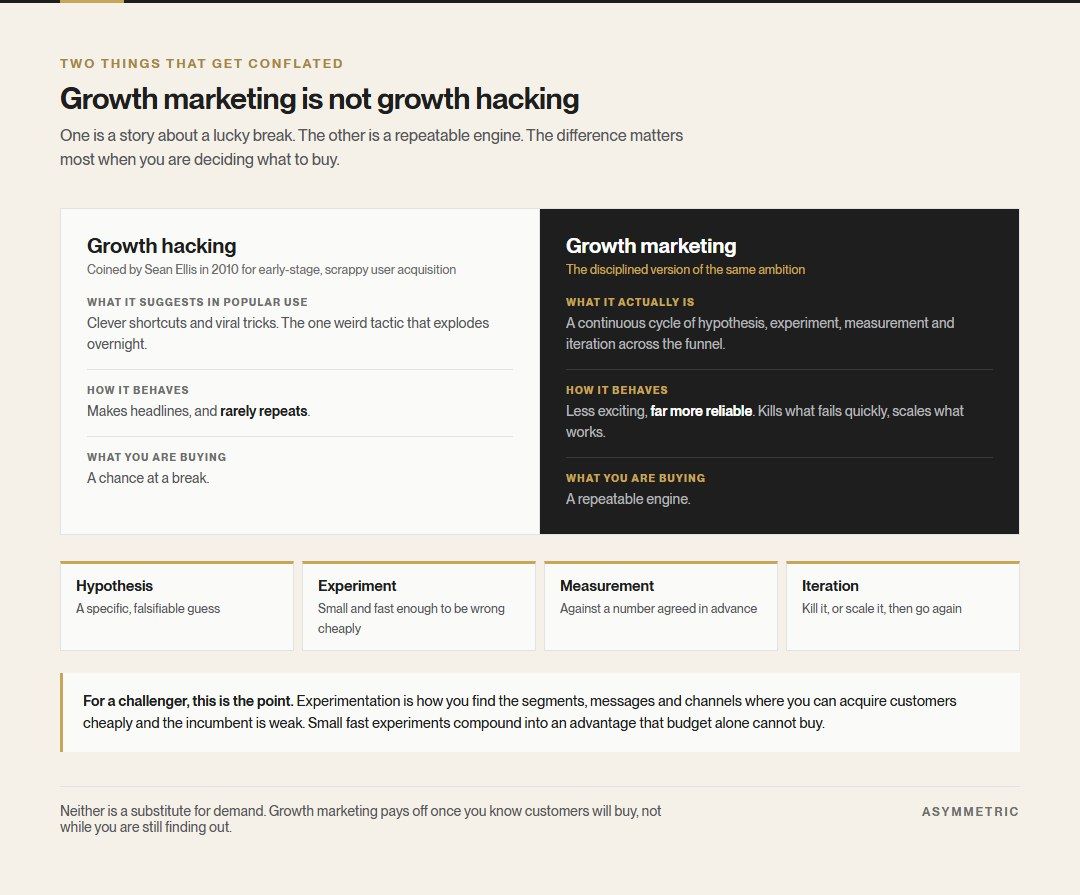
The two get conflated, but they're not the same. The term growth hacking was coined by Sean Ellis in 2010 to describe early-stage, scrappy user acquisition, and in popular use it has come to suggest clever shortcuts and viral tricks, the one weird tactic that explodes overnight. Those stories make headlines and rarely repeat. Growth marketing is the disciplined version: a continuous cycle of hypothesis, experiment, measurement, and iteration across the funnel. It's less exciting and far more reliable, because it builds a repeatable engine rather than chasing a lucky break. A good growth agency runs experiments constantly, kills what fails quickly, and scales what works.
When you need a growth marketing agency
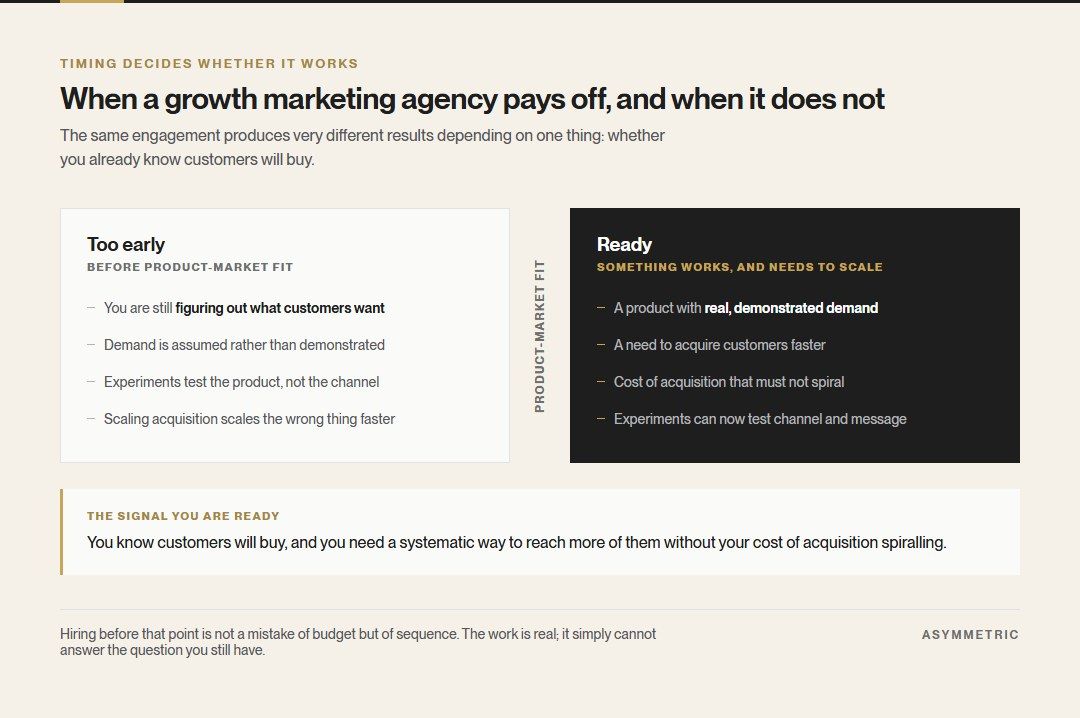
Growth marketing pays off most when you have something that works and need to scale it efficiently, a product with real demand and a need to acquire customers faster and at a lower cost. It's less useful before you've found product-market fit, when the real priority is still figuring out what customers want. The signal that you're ready is simple: you know customers will buy, and you need a systematic way to reach more of them without your cost of acquisition spiraling.
What the first ninety days should look like
The shape of the opening is the clearest signal of whether an engagement will work. Roughly, the first month goes on measurement and diagnosis: auditing what is tracked, establishing a baseline you both agree on, and identifying where the funnel actually leaks rather than where it's assumed to.
The second month is where the first experiments run. Small ones, chosen because they're cheap to be wrong about, aimed at the stage the diagnosis flagged. Expect most of them to fail, because an experiment programme with a high success rate is testing things that were already obvious.
By the third month you should be able to name at least one thing that changed as a result: a channel defunded, a message replaced, a segment prioritised. If ninety days produce activity reports and no decisions, that's the moment to raise it rather than at renewal.
It's also reasonable to ask what happens to the work if you leave. The measurement foundation, the experiment record and the documented learnings should be yours. An agency that treats those as its own asset is holding a hostage rather than building you a capability.
The challenger's version of growth marketing
For a smaller company competing against a larger one, growth marketing is especially powerful, because experimentation is how a challenger finds the openings a bigger competitor can't be bothered to chase. The point isn't to outspend the incumbent on the obvious channels but to test relentlessly until you find the segments, messages, and channels where you can acquire customers cheaply and the incumbent is weak. That is asymmetric marketing run as a measurable engine: small, fast experiments that compound into an advantage budget alone can't buy.
B2B growth marketing is a different problem
A B2B growth marketing agency isn't simply a consumer one pointed at businesses. The mechanics change in three ways that matter, and an agency that has only run consumer growth will usually get all three wrong at first.
The first is the length of the cycle. A B2B purchase can take months and involve four or five people, so the feedback loop that makes growth marketing work is far slower. Experiments that would resolve in a week for a consumer product take a quarter, which means you need leading indicators you trust rather than waiting for closed revenue to tell you whether a test worked.
The second is that the buyer and the user are often different people. The person who signs isn't the person who will live with the decision, and a message that lands with one can actively alienate the other. Growth work in B2B therefore tends to run parallel tracks rather than a single funnel.
The third is volume. B2B markets are small enough that statistical significance is frequently unreachable. A test with forty leads won't give you a clean answer, so the discipline shifts from measuring precisely to reasoning carefully from thin data and being honest about the confidence level. An agency that reports B2B test results with the same certainty it would use on a consumer campaign is telling you something about its rigour.
Grow with a system, not a gimmick
If you have a product that works and need to scale acquisition without your costs running away, building that growth engine is the work we do.
What it costs, and how to judge whether it's worth it
Growth engagements are usually retainers, and the range is wide enough that the number alone tells you very little. What moves it's the same set of things that moves any agency fee: how much work across how many channels, whether senior people do it or hand it to juniors after the pitch, and whether you're buying strategy or only execution.
The useful test isn't the size of the fee but what it's measured against. A growth retainer tied to cost per acquisition and revenue can be assessed on its own terms within a couple of quarters. One tied to campaigns launched and tests run cannot, because those numbers go up whether or not anything improved.
For a smaller company the temptation is to minimise the fee, and it's usually the wrong economy. The expensive line item was never the retainer; it's the acquisition budget spent behind a channel mix nobody validated. Buying the thinking that finds where a larger competitor is weak, then concentrating spend there, returns more than saving a few thousand a month on the people doing the finding.
Frequently asked questions
What is a growth marketing agency?
A growth marketing agency grows a business across the entire customer journey, acquisition through activation, retention, and revenue, using data and structured experimentation rather than one-off campaigns. It's judged on business outcomes like leads, customers, and revenue, not impressions or awards.
What is the difference between growth marketing and growth hacking?
Growth hacking, a term coined by Sean Ellis in 2010, has come to suggest clever shortcuts and viral tricks. Growth marketing is the disciplined version: a continuous cycle of hypothesis, experiment, measurement, and iteration across the funnel. It builds a repeatable engine rather than chasing a lucky break.
When do you need a growth marketing agency?
When you have product-market fit and need to scale acquisition efficiently, a product with real demand and a need to win customers faster at a lower cost. It's less useful before product-market fit, when the priority is still discovering what customers want.
Is growth marketing only for startups?
No. Any company with a working product and a need to scale acquisition efficiently benefits. It's especially powerful for challengers competing against larger rivals, because relentless experimentation surfaces the cheap segments, messages, and channels a bigger competitor ignores.
What does a growth marketing agency actually do day to day?
Most of the work is measurement, experiment design and analysis rather than campaign production. A typical week involves reviewing results from live tests, killing the ones that failed, scaling anything that worked, and preparing the next round. Campaigns are the visible output, but they're the instrument rather than the product. If an agency's weekly update is a list of assets shipped with no reference to what was learned, it's running a production schedule rather than a growth programme.
What is the difference between a growth marketing agency and a B2B growth marketing agency?
The discipline is the same and the constraints are not. B2B cycles run for months and involve several decision-makers, so feedback arrives far more slowly and you have to rely on leading indicators rather than closed revenue. B2B volumes are also small enough that most tests never reach statistical significance, which means reasoning carefully from thin data instead of measuring precisely. An agency that reports B2B results with consumer-grade certainty is overstating what its numbers can support.
How much does a growth marketing agency cost?
Growth work is usually a monthly retainer, and the range is wide enough that the number on its own is close to meaningless. What moves it's scope, whether senior people do the work or hand it to juniors after the pitch, and whether you're buying strategy or only execution. The more useful question is what the fee is measured against: a retainer tied to cost per acquisition and revenue can be judged within a couple of quarters, while one tied to tests run and campaigns launched can't be judged at all.
How long before a growth marketing agency shows results?
Expect roughly ninety days before the work produces a decision you wouldn't otherwise have made. The first month usually goes on measurement and diagnosis, the second on the first round of experiments, and by the third you should be able to name something concrete that changed: a channel defunded, a message replaced, a segment prioritised. Anyone promising meaningful results in the first few weeks is either inheriting unusually clean data or describing activity rather than outcomes.
About the author

Mark Hope
Founder, President & Chief Strategy Officer, Asymmetric Marketing
Mark Hope is the Founder, President & Chief Strategy Officer of Asymmetric Marketing. His career spans elite military service, senior leadership at two of the largest companies in their categories, and founding several companies of his own. It's the common thread behind how Asymmetric helps smaller companies out-compete bigger ones.
Mark began his career in U.S. Army Special Operations, serving from 1977 to 1988 in the 1st and 3rd Battalions of the 75th Ranger Regiment and as an Operator in 1st Special Forces Operational Detachment–Delta (Delta Force). What that world runs on (careful planning, reading your opponent, and winning from a position of disadvantage) is the foundation of how he helps smaller companies win today.