

September 4, 2024
Top Marketing Agencies in Wisconsin: A Guide to Choosing the Right One
Wisconsin's marketing agencies all look alike on paper. The useful way to compare them isn't by service menu but by how they think. Here's what separates an agency that grows your business from one that just stays busy.
By Mark Hope, Founder, President & Chief Strategy Officer, Asymmetric Marketing

Wisconsin has no shortage of marketing agencies, from Milwaukee and Madison to La Crosse and the Fox Valley. On paper they look alike: full-service firms promising growth, leads, and a strong brand. For a business owner trying to choose, the similarity is the problem. The useful way to compare them isn't by service menu but by how they think, because the difference between an agency that grows your business and one that simply stays busy comes down to strategy.
Key takeaways
- Wisconsin's marketing agencies look alike on paper, so compare them by how they think, not by their service menu.
- The same services, web, SEO, paid, social, content, produce wildly different results depending on the strategy behind them.
- The best Wisconsin marketing agencies lead with strategy, measure outcomes like leads and revenue, staff senior people, and hold a point of view.
- The right fit depends on your situation: an underdog needs an agency that out-positions rather than outspends.
- Judge the thinking, ask where your business can actually win against competitors and listen for a specific answer.
Look past the service list
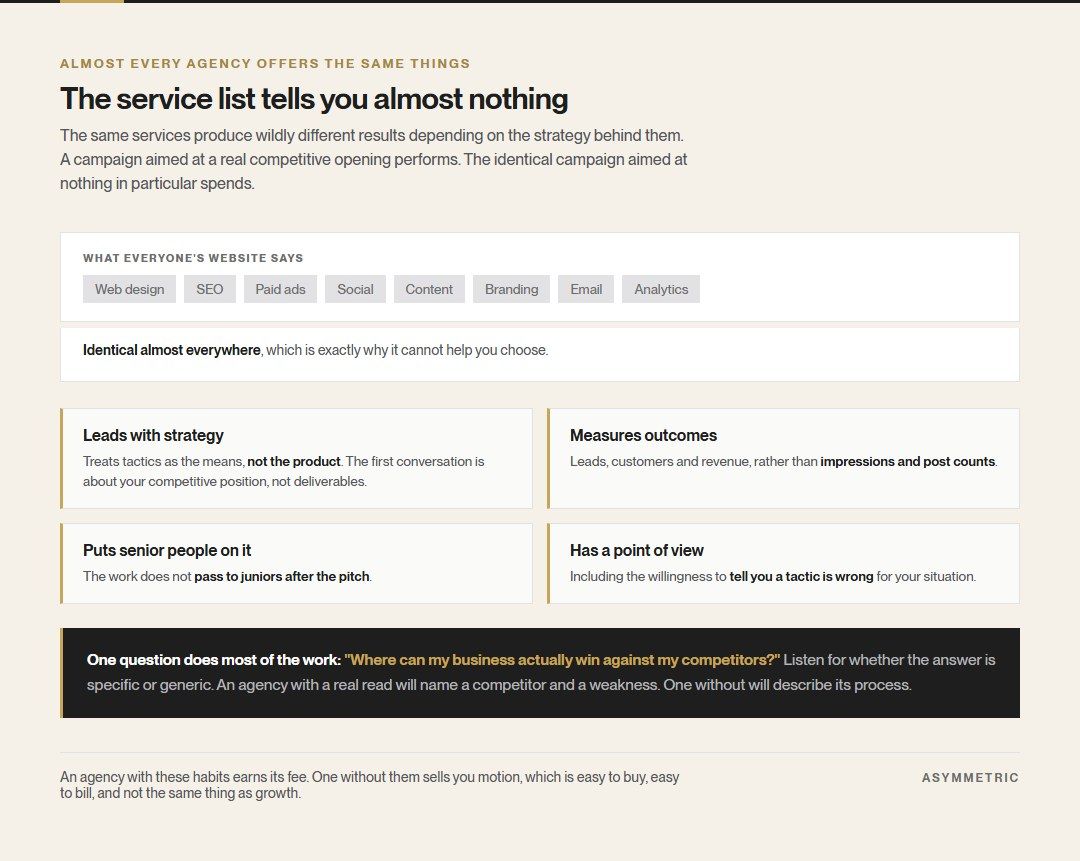
Almost every agency offers the same things: web design, SEO, paid ads, social, content, branding. The list tells you little, because the same services produce wildly different results depending on the strategy behind them. A campaign aimed at a real competitive opening performs; the identical campaign aimed at nothing in particular spends. So judge the thinking, not the menu. Ask an agency where your business can actually win against its competitors and listen for whether the answer is specific or generic.
What separates the best Wisconsin agencies
The strongest agencies share a few traits regardless of city. They lead with strategy and treat tactics as the means, not the product. They measure themselves on outcomes such as leads, customers, and revenue rather than on activity such as impressions and posts. They put experienced people on the work instead of handing it to juniors after the pitch. And they have a point of view, including the willingness to tell you a tactic is wrong for your situation. An agency with those habits earns its fee. One without them sells you motion.
The right fit depends on your situation
What to ask on the first call
Most agency selection processes are decided by how the first conversation feels, which is a poor instrument. A handful of questions turn it into something you can compare across firms.
Ask where your business can win against a named competitor. Not what they would do for you, but where the opening is. An agency that has looked will name a rival and a specific weakness. One that hasn't will describe its process, its team, or its awards.
Ask who does the work in month three. The people in the room during a pitch are frequently not the people who show up afterwards, and this is the single largest hidden variable in what you're buying. A direct answer is a good sign regardless of what it is; a vague one is the answer.
Ask what they would tell you not to do. Any agency can add services. The willingness to say a tactic is wrong for your situation, in a meeting where they're trying to win your business, is close to the only reliable signal of a genuine point of view.
Ask how they would know it was working, and listen for whether the answer is measured in customers or in activity. If success is defined as posts published and impressions delivered, that's what you'll get, and it will be delivered reliably.
Does a Wisconsin agency need to be local?
Proximity matters less than it used to and more than nothing, and the useful question is which parts of the work actually benefit from it.
Local knowledge helps most when your competition is local. Understanding the Madison, Milwaukee or Green Bay market, who the established players are, and what buyers in the region respond to is genuine knowledge that takes time to acquire and doesn't transfer from a national playbook. For a business competing inside a defined service area, that's worth something real.
It matters least for the technical craft. Paid search, analytics, and content production aren't geographically dependent, and a firm's competence at them has nothing to do with where it sits.
Where it matters unpredictably is in the working relationship. Some engagements benefit enormously from occasional in-person sessions, particularly strategy work where you need several people in a room arguing. Others run perfectly well entirely remote.
The honest summary is that being local is a tiebreaker rather than a requirement. A local agency with no competitive insight is worse than a distant one that has read your market properly, and the read is the thing to test for.
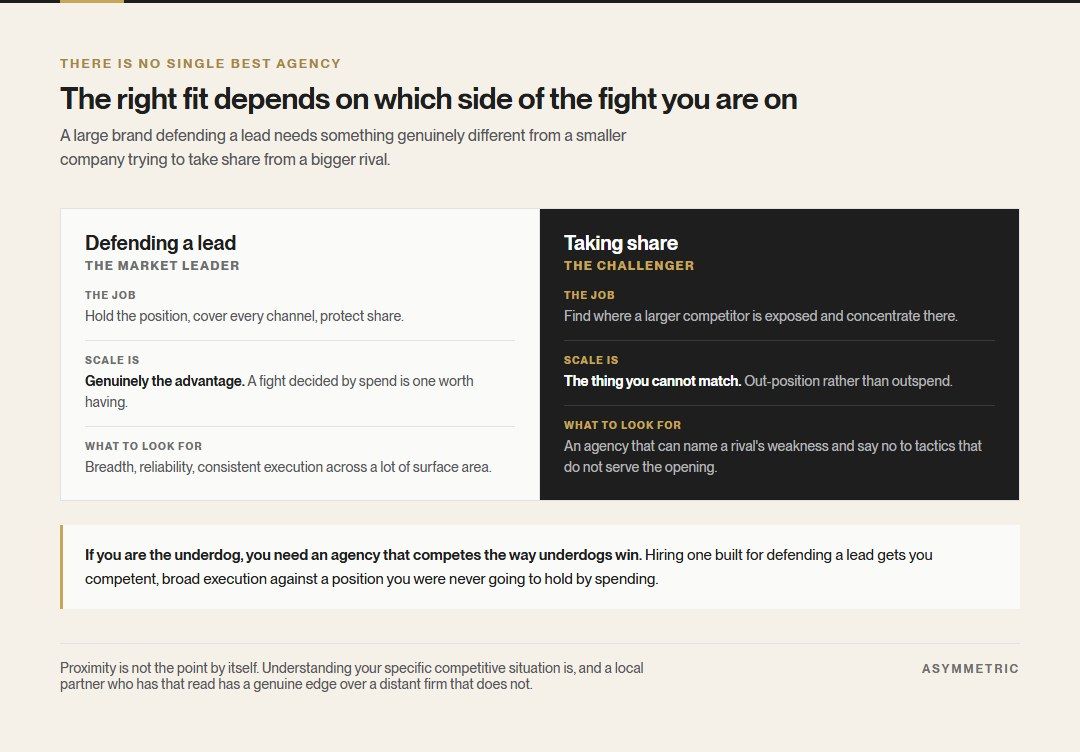
A large brand defending its lead needs something different from a smaller company trying to take share from a bigger rival. If you're the underdog, you need an agency that competes the way underdogs win, by out-positioning rather than outspending and by finding where a larger competitor is exposed. For choosing in a specific city, see our guide to a marketing agency in Madison, and for search specifically, SEO services in Wisconsin.
Talk to a Wisconsin agency built for challengers
Frequently asked questions
How do I choose the right marketing agency in Wisconsin?
Compare agencies by how they think, not by their service menu, since nearly all of them offer the same services. Ask where your business can win against its competitors and judge whether the answer is specific. The best fit leads with strategy, measures itself on leads and revenue rather than activity, and puts experienced people on your account.
What makes the best Wisconsin marketing agencies different?
They lead with strategy and treat tactics as the means rather than the product, they measure outcomes like customers and revenue instead of impressions, they staff the work with experienced people, and they hold a point of view, including telling you when a tactic is wrong for your situation. Those habits separate an agency that grows your business from one that just stays busy.
Does the right agency depend on my business?
Yes. A large brand defending its position needs something different from a smaller company trying to take share from a bigger rival. If you're the underdog, look for an agency that competes the way underdogs win, by out-positioning rather than outspending and finding where a larger competitor is exposed.
Do marketing agencies in Wisconsin need to be local to work with your business?
Not for most of the work. What matters is whether they understand your market and your buyer. Being local helps when the work depends on being on the ground, like events or relationships with regional media, and matters much less for search, paid media, or content.
What should you ask a marketing agency on the first call?
Ask what they'd measure and when they'd expect it to move. Ask who does the work, not who's on the call. Ask for an example where results took longer than planned and what they changed. Vague answers to those are the clearest signal you'll get before signing anything.
About the author

Mark Hope
Founder, President & Chief Strategy Officer, Asymmetric Marketing
Mark Hope is the Founder, President & Chief Strategy Officer of Asymmetric Marketing. His career spans elite military service, senior leadership at two of the largest companies in their categories, and founding several companies of his own. It's the common thread behind how Asymmetric helps smaller companies out-compete bigger ones.
Mark began his career in U.S. Army Special Operations, serving from 1977 to 1988 in the 1st and 3rd Battalions of the 75th Ranger Regiment and as an Operator in 1st Special Forces Operational Detachment–Delta (Delta Force). What that world runs on (careful planning, reading your opponent, and winning from a position of disadvantage) is the foundation of how he helps smaller companies win today.