
Asymmetric Marketing – Levels of Marketing Planning

In the competitive landscape of small businesses, effective business planning cannot be emphasized enough.

At Asymmetric Marketing, we leverage insights from strategies and historical perspectives to offer an approach that connects business tactics with military strategy.

Small businesses can outperform their rivals and progress by aligning their marketing strategy with business goals and consistently updating them to reflect market dynamics.

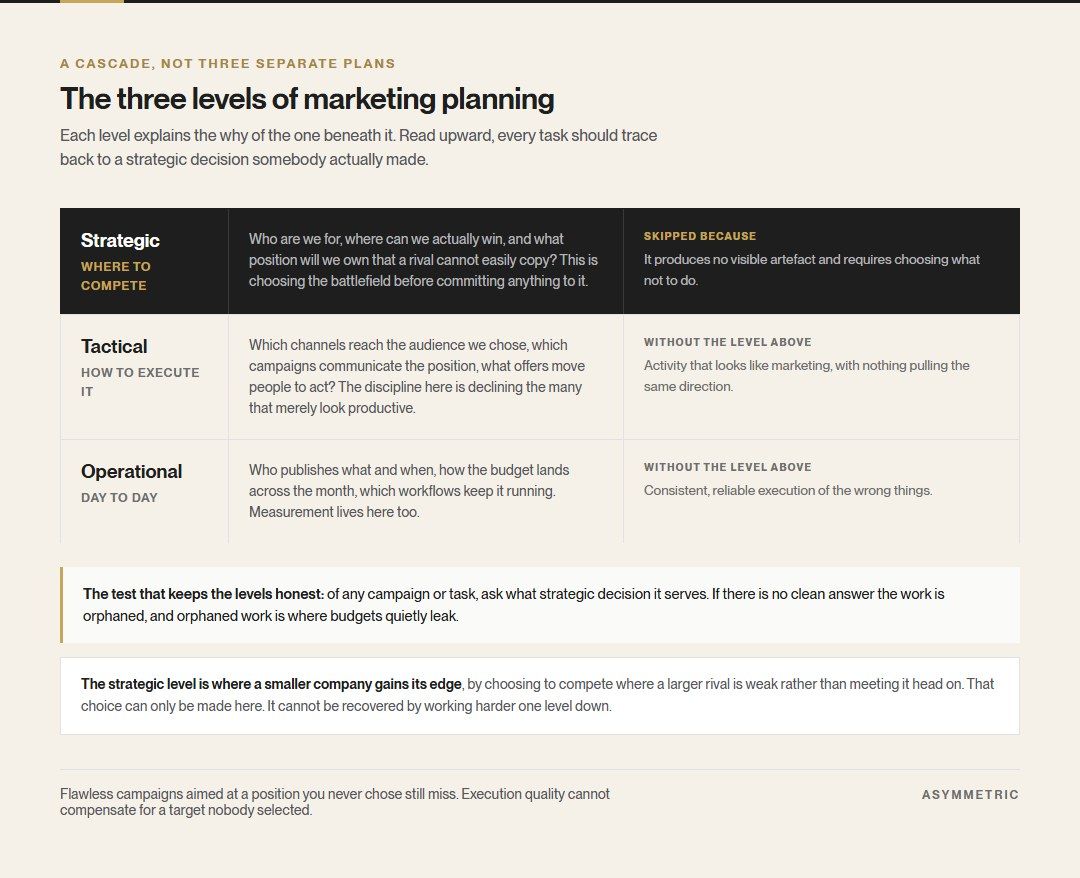
This piece explores the core business planning principles using the Asymmetric Marketing Framework as a guide, focusing on three levels: Strategic, Operational, and Tactical.

Understanding Marketing Plans

An effective marketing plan is a comprehensive document that systematically guides work from research and goal-setting through execution and measurement. It serves as a roadmap for the marketing team, guiding their efforts and ensuring alignment with the company’s overall business objectives. Typically, a marketing plan includes several key components, and the marketing planning process usually starts by auditing the current state, researching the market, defining the audience, setting goals, building the plan, and evaluating results. It also clarifies who the plan is for, since a marketing plan identifies the target market and aligns with the company's business goals and broader business goals.

  • Executive Summary: A brief marketing plan overview highlighting the main goals and strategies.
  • Situation Analysis: An assessment of the current market conditions, including a SWOT analysis, a marketing audit, and competitor analysis to understand the current state.
  • Marketing Objectives: The marketing team aims to achieve clear, measurable goals.
  • Target Market: A detailed description of the target audience, including demographics, psychographics, buying behavior, and Buyer Personas that capture pain points, motivations, and purchasing triggers.
  • Marketing Mix: Strategies built around the four pillars of Product, Price, Place, and Promotion, along with a clear value proposition or Unique Selling Proposition that explains why a customer should choose the product or service over a competitor’s.
  • Budget: An outline of the marketing budget, including budget allocation across marketing activities and campaigns.
  • Timeline: A schedule of marketing activities and campaigns.

By having a well-structured marketing plan, businesses can ensure that their marketing efforts are focused, efficient, and aligned with their broader business objectives, following a clear step-by-step marketing planning guide that connects strategy with execution.

Strategic Marketing Strategy Planning

The Strategic Level is the pinnacle and abstract tier in business planning.

Described as “the planning and execution of competition among business rivals,” strategic planning is crucial for attaining goals set by stakeholders such as owners, shareholders, and board members.

At this level, a strategic marketing plan functions as a comprehensive marketing strategy that aligns long-term marketing goals with broader business goals, providing an overarching framework through market trend analysis and target market identification. Business planning here also entails deploying resources—capital, technology, financial assets, and information—against competitors, while accounting for the business model and how the company creates value, to gain dominance or weaken their spirit. It also demands adaptation and agility to address consumer trends, marketing trends, and industry insights as the market landscape shifts, forming a crucial part of the strategic marketing planning process.

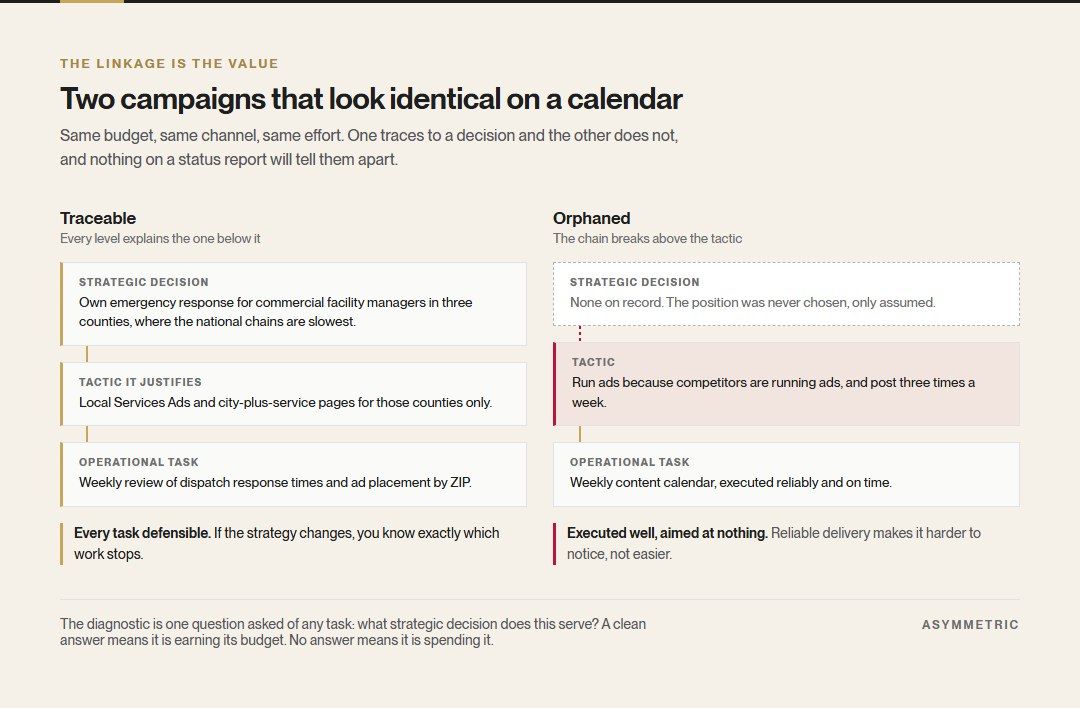
One of the principles in business planning involves distinguishing between strategy and tactics. Strategy sets out the objectives and creates unified direction across departments, while tactics detail the approaches to achieve these objectives. Strategic planning focuses on long-term, large-scale plans that may encompass aspects, whereas tactics involve smaller-scale actions carried out over shorter periods.

Successful marketing strategies, backed by market research and data analysis, are essential for reaching objectives, and answering nine essential questions for effective marketing campaigns helps ensure those strategies are clearly defined. To sustain a competitive edge, businesses should conduct market research to understand customer needs, the competitive landscape, opportunities and threats, and review competitor positioning, including historical market share or growth trends, to identify gaps in the market.

iStock-134955466-700x467.jpg

Marketing Plan vs. Business Plan

While a marketing plan is a subset of a business plan, it plays a distinct and crucial role within effective business planning and strategy development. A business plan provides a comprehensive overview of the company’s operations, covering finance, operations, management, and more. In contrast, a good marketing plan defines the audience, market segmentation, positioning, and a messaging framework for the market, zeroing in on the strategy and tactics needed to achieve the business’s goals.

A marketing plan is essential for businesses to differentiate themselves in the market, raise their profile, and drive revenue growth. Competitor research should assess direct and indirect rivals to spot market gaps, establish baseline messaging, and sharpen positioning, often starting with a structured competitor site analysis. It focuses on attracting and retaining customers, building brand awareness, and ultimately supporting the company’s business objectives. Businesses can clearly define their target market through segmentation decisions and brand messaging, use SWOT analysis to assess internal and external factors, and turn strategy into action through advertising strategies and marketing channels to ensure their marketing efforts are targeted and effective.

Operational Marketing Objectives and Goals

At the level also known as “Operational Art,” the connection between specifics and strategic aims in business planning is established, while tactical marketing plans focus on short-term marketing activities that support larger strategic aims. Military doctrine defines Art as “the approach taken by commanders and staff—supported by their expertise, knowledge, experience, creativity, and judgment—in crafting strategies, campaigns, and operations.”

In business planning, the Asymmetric Framework applies this doctrine to assess business goals, methods, and resources for strategizing and executing operations that contribute to achieving objectives. The marketing department plays a role at this level by ensuring its goals and strategies align with corporate aims, with marketing leaders overseeing execution and tracking, including campaign management, and management providing sufficient resources. Setting a marketing budget involves directing financial and human inputs through resource allocation, including media budget decisions tied to the highest expected ROI, guided by effective marketing budget strategies.

Operational Art incorporates four components: time, space, resources, and objectives, which are examined in detail at the operational level, often informed by competitive intelligence services that clarify market conditions and rival capabilities. These elements are intricately interwoven to develop an efficient approach to business strategy.

Operational-level strategies connect the deployment of resources to overarching goals encompassing aspects of time and space compared to tactical planning. This level of strategizing often involves a range of marketing initiatives that align efforts with strategic goals, adding complexity and nuance to the process, and operational execution works best when all teams share a unified direction behind the same company objectives.

iStock-1280034233-700x467.jpg

Marketing Tactics at Play

Tactical Planning focuses on the blend of science and art required to organize a business entity and strategically utilize assets and resources to outperform market competitors.

The marketing team executes strategies, evaluates performance metrics, and implements marketing campaigns that support the company’s strategic vision, often through data-driven growth marketing strategies that emphasize continuous testing and optimization. Tactical execution may combine digital marketing strategies with traditional tactics, depending on the audience and timing. Drawing parallels from tactics, these maneuvers may include setting up obstacles and defenses, maneuvering units strategically, and leveraging terrain advantages for success.

In business terms, this translates into employing tactics like misdirection, timing decisions carefully, and maneuvering skillfully to counteract competitors’ strengths. Tactics may also differ when a business is using product launch plans to introduce new offerings versus market entry plans for expansion into a new region.

Tactical choices prioritize gains, while strategic decisions center on long-term value creation.

Marketing efforts must focus on measuring customer engagement across key marketing channels, incorporating insights from market research, and aligning with audience needs and business objectives to achieve goals, with digital tactics often providing faster measurable feedback.

Regarding marketing planning basics, competition in business involves the interaction of organizations striving to meet their goals while hindering each other’s progress. Leaders must rely on creativity and strategic thinking to outmaneuver competitors. Establishing marketing objectives is vital as they direct strategies and actions toward meeting business targets and support customer retention.

iStock-1471368520-700x467.jpg

Key aspects of business planning include key performance indicators;

  1. Emphasis on Planning by Leaders: Business planning commences with leadership. Leaders should prioritize planning and ensure its integration into business operations.
  2. Continuous Nature of Planning: Business planning is a process rather than a one-time occurrence. Regular updates and revisions are crucial for adapting to changing market dynamics.
  3. Importance of Timeliness in Planning: Timing plays a role in business planning. Plans should be executed at the time of impact.
  4. Embrace Simplicity in Plans: Keeping plans is essential in business planning. Complex plans are challenging to execute and more prone to failure.
  5. Foster Flexibility in Plans: Flexibility enables businesses to adjust to challenges or opportunities swiftly.
  6. Crafting Ambitious Strategies: Embracing boldness in devising business strategies can result in benefits. Thoughtfully taking risks often yields outcomes over time.

These core principles bring structure to a process commonly viewed as creative, establish a link between idea generation and practical implementation, and help measure success, echoing timeless Art of War business strategy principles about planning and adaptation.

The marketing mix, encompassing product offerings, pricing tactics, distribution channels, and promotional efforts, shapes marketing strategies and depends on a well-defined marketing budget and ROI framework. The extent to which each core element is utilized varies depending on the business's circumstances.

Grasping and implementing a defined business planning and operational framework is essential for achieving effectiveness and efficiency in execution.

The business planning process, incorporating elements such as SWOT analysis, mission statements, and assessments, is fundamental for making decisions. By adhering to these guiding principles, you can cultivate an approach to surpassing your competitors.

Evaluating and Improving Marketing Planning

Evaluating and improving marketing plan performance is crucial to ensure effectiveness and alignment with the company’s business objectives, using well-chosen B2B marketing KPIs to track progress. This process involves tracking key performance indicators (KPIs) such as website traffic, social media engagement, lead generation, conversion rate, customer acquisition cost, return on investment, and the percentage of website visitors who become customers to measure the success of marketing efforts.

Regularly reviewing and adjusting the marketing plan allows businesses to stay agile and responsive to market changes. By analyzing performance data in tools like google analytics, companies can identify what’s working and what’s not, making informed decisions to optimize their marketing strategy for better results. Regular reporting should use automated dashboards and scheduled reviews to compare channels, campaigns, and tactics by the highest return on investment. This also helps control marketing spend and improve future budget allocation. This continuous improvement process helps ensure marketing activities align with business objectives and drive the desired outcomes.

Marketing Plan Templates and Tools

Marketing plan templates and tools can help businesses create and manage their marketing plans more efficiently, supporting both strategic planning and implementation plan development, especially when paired with ongoing insights from the Asymmetric Marketing blog. These resources provide a structured approach to marketing planning, ensuring that all essential elements are included. Digital marketing plans specifically use digital channels and technologies to engage target audiences through a range of online tactics and strategies, often delivered by a full-service digital marketing agency that can coordinate SEO, PPC, email, and social media. Some popular marketing plan templates and tools include:

  • HubSpot’s Marketing Plan Template: A comprehensive template covering all marketing plan aspects, from situation analysis to budget planning.
  • Planful’s Marketing Plan Builder: A tool that helps businesses create detailed marketing plans with customizable templates.
  • Hinge Marketing’s Marketing Planning Process: A step-by-step guide to developing a strategic marketing plan, including marketing automation for recurring tasks such as email marketing or scheduling across social media platforms.

Using these templates and tools, businesses can streamline the marketing planning process and ensure that their plans are thorough, well-organized, and aligned with their business objectives, including digital efforts like search engine marketing.

Examples of Successful Marketing Strategies

Successful marketing strategies often involve a combination of online and offline tactics tailored to the target audience and business objectives. For example, Oatly uses a mission-led approach, focusing on sustainability and social responsibility to resonate with its target audience. Its value proposition is what makes that positioning stick with customers, and a Unique Selling Proposition defines the exact reason why a customer should choose one product or service over a competitor's. This strategy differentiates Oatly in the market and builds a loyal customer base.

Another example is HubSpot, which uses search engine optimization (SEO) and content marketing as part of a broader digital marketing approach to attract new users to its site and demonstrates how SEO lead generation strategies can consistently fill the funnel. By understanding their target audience, using data-driven marketing strategies, and applying messaging frameworks outlines primary brand promises, tone of voice, and key messages tailored to each buyer persona, HubSpot drives traffic and generates leads.

These examples illustrate how businesses can create effective marketing plans by understanding their target market, setting clear marketing objectives, and using a mix of tactics to achieve their goals, including product launch plans designed to successfully introduce new products or services to the market through comprehensive marketing strategies that create awareness and drive sales, especially when guided by an Asymmetric Marketing Engine framework that aligns journey stages, funnel, and flywheel. Companies can develop marketing strategies around a clear value proposition for each product or service to drive results and support their overall business objectives.

iStock-1472033620-700x467.jpg

Frequently Asked Questions about Business Planning

What is business planning, and why is it important?

Business planning involves creating a roadmap for your business’s future, outlining goals, strategies, and actions needed to succeed. This process consists of tracking key performance indicators (KPIs) such as website traffic, social media engagement, and lead generation to measure the success of marketing efforts, including those outlined in a social media marketing plan. It’s important because it helps you set clear objectives, allocate resources efficiently, and navigate challenges, ensuring your business remains competitive and grows sustainably.

How does the Asymmetric Marketing Framework apply to business planning?

The Asymmetric Marketing Framework adapts military doctrine to the business environment, offering a unique approach to planning. It breaks down business planning into three levels: Strategic, Operational, and Tactical. Each level helps businesses align their marketing efforts with broader objectives, ensuring a cohesive and effective plan.

What is the difference between strategic and tactical planning in business?

Strategic planning focuses on long-term goals and the overall direction of the business, while tactical planning deals with the specific actions and short-term activities needed to achieve those goals. Strategic planning sets the vision, and tactical planning implements the steps to realize that vision.

Why is continuous planning important in business?

Continuous planning allows businesses to adapt to market changes, respond to new opportunities, and address emerging challenges. Regularly revisiting and updating your business plan ensures that your strategies remain relevant and practical.

What are the critical elements of effective business planning?

Effective business planning includes setting smart objectives, maintaining flexibility, keeping plans simple, focusing on timing, and being bold in your strategies. These elements help ensure alignment with overall business goals, facilitate performance measurement, improve planning accuracy, and help your business successfully navigate the competitive landscape.

How can small businesses benefit from an asymmetric approach to marketing planning?

An asymmetric approach leverages creativity, innovation, and unconventional strategies to gain a competitive advantage. Small businesses can find unique ways to outmaneuver larger competitors, maximize limited resources, and turn challenges into opportunities.

How does marketing play a role in business planning?

Marketing is integral to business planning because it helps align your product offerings, pricing strategies, and promotional activities with your business objectives. A well-executed marketing plan can drive growth, increase brand awareness, and support loyalty programs as a strategic tool to retain high-priority customers and strengthen long-term customer relationships.

What tools can help in creating an effective business plan?

Tools such as SWOT analysis, mission statements, financial forecasting software, and project management platforms can assist in creating a comprehensive business plan. These tools help you assess your business’s strengths and weaknesses, define your goals, and track progress.

cropped-logo-drk-sqrd_500x500-150x150.png

Ready to Learn More About Marketing Planning?

Whether you're just starting or looking to expand, we're here to help you navigate the complex world of business planning.

Contact us for personalized advice or to learn how we can support your business's planning needs, including implementing a tailored Asymmetric Marketing strategy to compete against larger rivals.

Contact us: Click Here
Explore our Madison web design services
Schedule a consultation: Scheduling Page

Mark Hope
Partner, Asymmetric Marketing
📧 mark.hope@asymmetric.pro
📞 (608) 410-4450

Mark Hope - Asymmetric

About the author

Mark A. Hope is the co-founder and Partner at Asymmetric Marketing, an innovative agency dedicated to creating high-performance sales and marketing systems, campaigns, processes, and strategies tailored for small businesses. With extensive experience spanning various industries, Asymmetric Marketing excels in delivering customized solutions that drive growth and success. If you’re looking to implement the strategies discussed in this article or need expert guidance on enhancing your marketing efforts, Mark is here to help. Contact him at 608-410-4450 or via email at mark.hope@asymmetric.pro.

Leave a Comment

Your email address will not be published. Required fields are marked *

Scroll to Top