

June 4, 2026
Category Creation: Win by Making a Category You Own
The surest way to win a category is to create one. Category creation is the challenger strategy of defining a new market you own instead of competing in a crowded one. What it is, why it works, and how to do it.
By Mark Hope, Founder, President & Chief Strategy Officer, Asymmetric Marketing

The hardest way to grow is to be the seventh-best option in an established category. The most powerful is to define a new one and be the only option in it. Category creation, also called category design, is the strategy of framing a new market, naming the problem and the solution, so that you own the category rather than fight for a share of someone else's. It's the ultimate asymmetric move: instead of competing where a larger rival is strong, you change the game so their strength no longer applies.
Key takeaways
- Category creation (category design) is defining and owning a new market category rather than competing for share in an existing one.
- It's an asymmetric move: you change the terms of competition so an incumbent's scale advantage no longer applies.
- The category creator usually captures the majority of the category's value, because it defines the criteria buyers use to judge everyone.
- It works by naming a problem the old category ignored and positioning your solution as the answer to it.
- It's high-reward and demanding: you must educate the market on a problem before you can sell the solution.
What category creation is
Category creation is the work of bringing a new market category into being, defining a problem the existing categories don't name, and positioning your product as the solution to it. Rather than entering a crowded market and arguing you're better, the category creator reframes the conversation: this is a new kind of problem, and here's the new kind of solution. Done well, the company and the category become synonymous, and competitors are forced to define themselves against your terms.
Why category creation is the ultimate asymmetric move
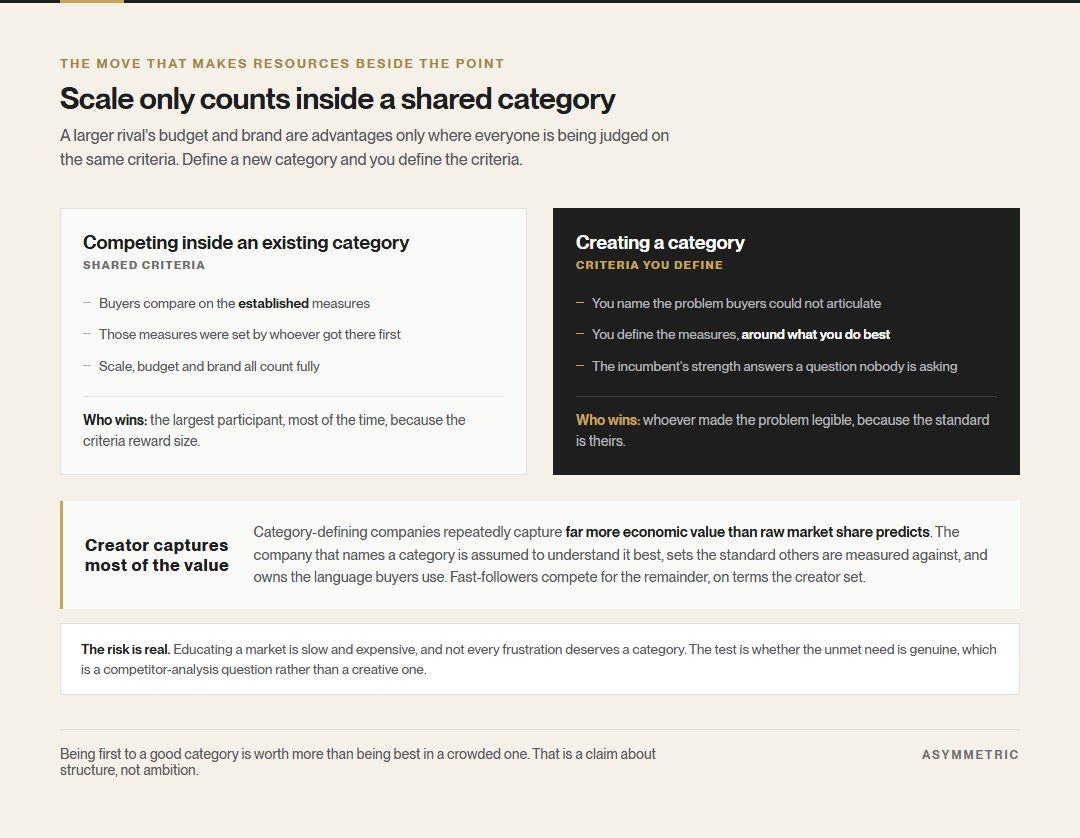
A bigger competitor's advantage, scale, budget, brand, only matters inside a shared category where everyone is judged on the same criteria. Category creation removes that battlefield. When you define a new category, you also define the criteria buyers use to evaluate it, and you naturally define them around what you do best. The incumbent's strength becomes irrelevant because the customer is no longer asking the question that strength answered. This is why category creation sits at the heart of asymmetric marketing: it's the move that makes a larger rival's resources beside the point.
Why the category creator wins the most
Research on category-defining companies keeps finding the same pattern: the creator of a category captures the lion's share of its economic value, far more than its raw market share would predict. The reason is structural. The company that names the category is assumed to understand it best, sets the standard buyers measure others against, and owns the language customers use to describe the problem. Fast-followers compete for the remainder on terms the creator set. Being first to a good category is worth more than being best in a crowded one.
How category creation works
How to tell whether you have a category or just a feature
The failure mode of category creation is naming something that's really a product difference and then spending years explaining it. A few tests separate the two before the money goes in.
The first is whether the problem exists without you. If customers describe the frustration in their own words, unprompted, before they have heard your framing, there's a category there. If the problem only becomes legible once you explain it, you have a feature and an education bill.
The second is whether existing categories genuinely fail the buyer. A new category has to be somewhere the current options don't just underperform but structurally can't serve, because a competitor who can simply add the capability will, and then your category is a feature list again.
The third is whether anyone would change budget lines for it. Categories that stick usually create or move a line item, because that's what it means for a market to accept that something new exists. If the purchase would come out of an existing budget and be compared against existing options, you're competing inside the old category regardless of what you call it.
The fourth is whether you can survive the education period. Making a problem legible takes years and money, and the first movers frequently teach the market for a competitor who arrives later with a bigger budget. Being right about the category isn't the same as being the one who profits from it.
The cheaper version: a subcategory you can hold
Full category creation is expensive and slow, which makes it a poor fit for most companies that read about it. There's a smaller move with much of the benefit.
Rather than naming a new category, define a specific segment inside an existing one and become the obvious answer for it. The buyer still knows what they're shopping for, so you avoid the education cost entirely, but the criteria they use to choose narrow to the ones you meet best.
This works because it borrows the mechanism that makes category creation powerful. The advantage of naming a category is that you define the criteria; the advantage of owning a segment is that you define which criteria matter for that buyer. The second is far easier to achieve and considerably harder for a large competitor to answer, because serving your segment properly would mean specialising away from the mass market that's their entire advantage.
The practical version is a positioning statement narrow enough to exclude most of the market. If it doesn't make somebody a bad fit, it's not narrow enough to be an advantage.
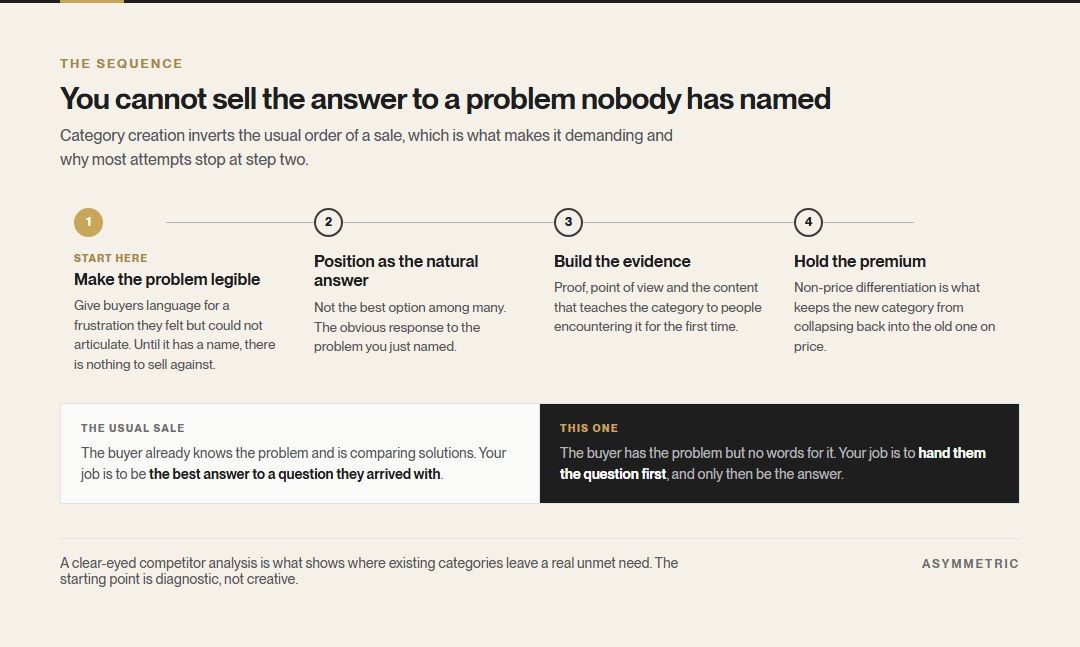
It's demanding because it inverts the usual sale. You can't sell a solution to a problem the market hasn't yet named, so the first job is to make the problem legible, to give buyers language for a frustration they felt but couldn't articulate. Then you position your product as the natural answer and build the evidence, the point of view, and the content that teach the category. A clear-eyed competitor analysis shows where the existing categories leave a real, unmet need, and non-price differentiation is what lets the new category command a premium rather than collapse into the old one. The risk is real: educating a market is slow and expensive, and not every problem deserves a category. But when the unmet need is genuine, no other strategy returns as much.
The Most Common Category Creation Mistakes
Category creation marketing fails most often not because the idea is wrong, but because execution drifts back to conventional positioning under pressure. Here are the traps to avoid:
- Naming the product, not the category. “AI-powered workflow automation” is a product description. “The Invisible Ops Layer” is a category frame. One invites comparison. The other invites curiosity.
- Abandoning education too early. Category creation takes 18-36 months to gain traction. Most companies pivot to demand-gen tactics the moment pipeline slows, undermining the long game they just started.
- Letting competitors define the category for you. If you don’t name and frame your category aggressively, a competitor or analyst will-and you’ll spend years trying to reclaim a narrative you should have owned from day one.
- Building the category around features. Features get copied. Problems don’t. Category creation must be rooted in a durable problem and a distinct point of view, not in a capability that can be replicated in a competitor’s Q3 roadmap.
Category Creation vs. Brand Positioning: Understanding the Difference
Brand positioning answers the question: “Why should I choose you over them?” Category creation answers a different question: “Why does this category exist, and why now?” The former is competitive. The latter is architectural.
Great category creation always includes great positioning-but positioning without category creation leaves you in a zero-sum game. You can win market share while the category commoditizes beneath you. The asymmetric play is to improve the game board entirely.
Think of it this way: Apple’s “Think Different” was positioning. The iPhone was a category creation. The positioning made you feel something. The category creation changed what was possible.
Create the category, don't fight for the scraps
If you're losing a share war in a crowded category, the way out may be to define a new one you can own. Finding whether that category exists, and framing it, is the work we do.
Frequently asked questions
What is category creation?
Category creation, also called category design, is the strategy of defining and owning a new market category rather than competing for share in an existing one. The creator names a problem the old categories ignore and positions its product as the solution, so the company and the category become associated and competitors must define themselves against its terms.
Why is category creation an asymmetric strategy?
Because a larger competitor's advantages, scale, budget, brand, only matter inside a shared category judged on common criteria. Creating a category removes that battlefield: you define the criteria buyers use, naturally around your strengths, so the incumbent's strength becomes irrelevant because customers are no longer asking the question it answered.
Does the category creator really win the most?
Studies of category-defining companies repeatedly find the creator captures a disproportionate share of the category's economic value, more than market share alone would predict. The company that names a category is assumed to understand it best, sets the standard others are measured against, and owns the language customers use, so fast-followers compete for the remainder on the creator's terms.
How do you create a new category?
Start by making the problem legible, giving buyers language for a frustration they felt but couldn't name, since you can't sell a solution to an unnamed problem. Then position your product as the natural answer and build the point of view, evidence, and content that teach the category. It requires a genuine unmet need and patience, because educating a market is slow.
What types of companies benefit most from category creation marketing?
Category creation marketing is most effective for companies that: (1) have a product with a genuinely novel mechanism not well-served by existing category language; (2) are entering a market where the incumbent category is declining, commoditizing, or mistrusted; or (3) have the organizational patience and content resources to sustain an 18-36 month market education cycle. It's particularly powerful for B2B SaaS, emerging consumer brands, and companies operating at the intersection of industry disruption.
How long does it take for category creation marketing to generate ROI?
Category creation marketing typically requires 18 to 36 months before measurable revenue impact is clear. Early indicators include growth in branded search for category keywords, media coverage of the category name, analyst adoption of the category frame, and an increase in inbound prospects who arrive pre-educated. Revenue metrics such as pipeline growth and reduced sales cycle length follow-often 12 to 24 months after the category gains linguistic traction in the market.
Can small or early-stage brands create a new category?
Yes-and in many cases, early-stage brands are better positioned for category creation than incumbents, because they have no legacy positioning to protect and no existing customer base that fears disruption. The constraint for small brands is usually distribution, not credibility. A focused content strategy, strategic media relationships, and consistent thought leadership can compensate for limited budget. The key is committing fully to the category narrative from the beginning rather than hedging between category creation and conventional competitive messaging.
About the author

Mark Hope
Founder, President & Chief Strategy Officer, Asymmetric Marketing
Mark Hope is the Founder, President & Chief Strategy Officer of Asymmetric Marketing. His career spans elite military service, senior leadership at two of the largest companies in their categories, and founding several companies of his own. It's the common thread behind how Asymmetric helps smaller companies out-compete bigger ones.
Mark began his career in U.S. Army Special Operations, serving from 1977 to 1988 in the 1st and 3rd Battalions of the 75th Ranger Regiment and as an Operator in 1st Special Forces Operational Detachment–Delta (Delta Force). What that world runs on (careful planning, reading your opponent, and winning from a position of disadvantage) is the foundation of how he helps smaller companies win today.