

May 24, 2022
Chance Favors the Prepared Mind: Why Preparation Isn't the Same as Planning
Planning is thinking about what might happen; preparation is having what you need to act when it does. The difference, the business load-out that wins, and how foresight and preparation manufacture luck.
By Mark Hope, Founder, President & Chief Strategy Officer, Asymmetric Marketing

"Luck favors the prepared" is the kind of line that ends up on a motivational poster, true enough to nod at, vague enough to ignore. But Louis Pasteur, who said it, wasn't being inspirational. He was describing a method. Opportunities are unpredictable: you can't know which experiment, market shift, or competitor stumble will open a door. So the edge isn't forecasting the door. It's being positioned to walk through it the instant it opens, while slower rivals are still reacting. That's not luck. It's manufactured luck, preparation converted into advantage at the moment of opportunity.
But "be prepared" is itself a platitude until you separate it from the thing people constantly confuse it with: planning. Understanding planning vs preparation, why they're different disciplines and how they fit together, is what turns a slogan into a strategy.
Key takeaways
- Planning is thinking about what might happen; preparation is having what you need to act when it does. They're different disciplines, and confusing them is why much "readiness" is theater.
- The load-out problem: carry exactly what the plan specifies and one delay finishes you; carry everything you might need and you're too heavy to move. Preparation is the judgment in between.
- Most companies provision for the plan, not for the plan's failure modes, the business equivalent of packing three days of supplies because the plan says resupply comes on day three.
- Business preparation is a set of deliberate load-out choices: cash reserve, a backup supplier, slack capacity, and preserved optionality, each at a cost you chose.
- Preparation is the readiness half of strategy; its partner is foresight, which decides what is worth preparing for.
Planning vs preparation: they're not the same discipline
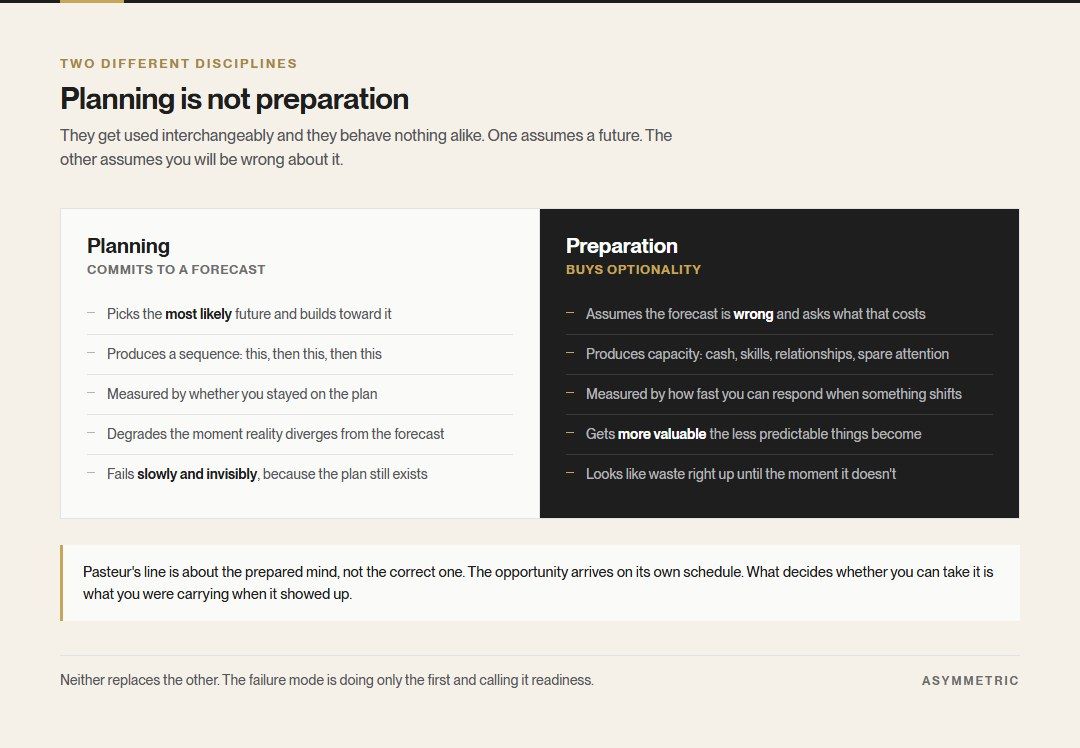
Here's a distinction I learned that wasn't academic. Planning is thinking about what might happen. Preparation is having the things you need to act when it does. They're not the same discipline, and mistaking one for the other is why so much "readiness" is theater. A company can have an immaculate strategic plan and be utterly unprepared, because the plan lives in a document and preparation lives in what you actually carry.
Picture being inserted into hostile territory on a plan that says you'll be resupplied by air in three days. The naive load-out is three days of food, water, and ammunition, exactly what the plan calls for. But contingency planning indicates that resupply might slip by several days: weather, battlefield conditions, things outside your control. So you adjust the load to carry more than planned.
And here's the part that turns this from a slogan into a strategy: you can't carry everything you might need under every condition. Load for every imaginable contingency, and you're too heavy to move, which gets you killed as surely as running out of supplies. Carry exactly what the plan specifies, and a single delay finishes you. Preparation is the judgment in between: making smart, cost-effective choices about what to bring, given the plan and its most likely ways of failing. Planning identifies the contingency. Preparation is what you choose to carry because of it.
The business load-out
The translation is direct, and most companies get it wrong in the same way the green soldier does, they provision for the plan, not for the plan's failure modes.
A startup that plans for its funding round to close on schedule, and holds exactly that much runway, is carrying three days of food. The prepared one carries reserve for the round that slips, because rounds slip, but not so much dead capital that it can't move or invest while it waits. The same logic governs every readiness decision a business makes. Each is a load-out choice, and carrying too little of the right thing, or too much of the wrong thing, both lose.
What to actually prepare: the load-out checklist
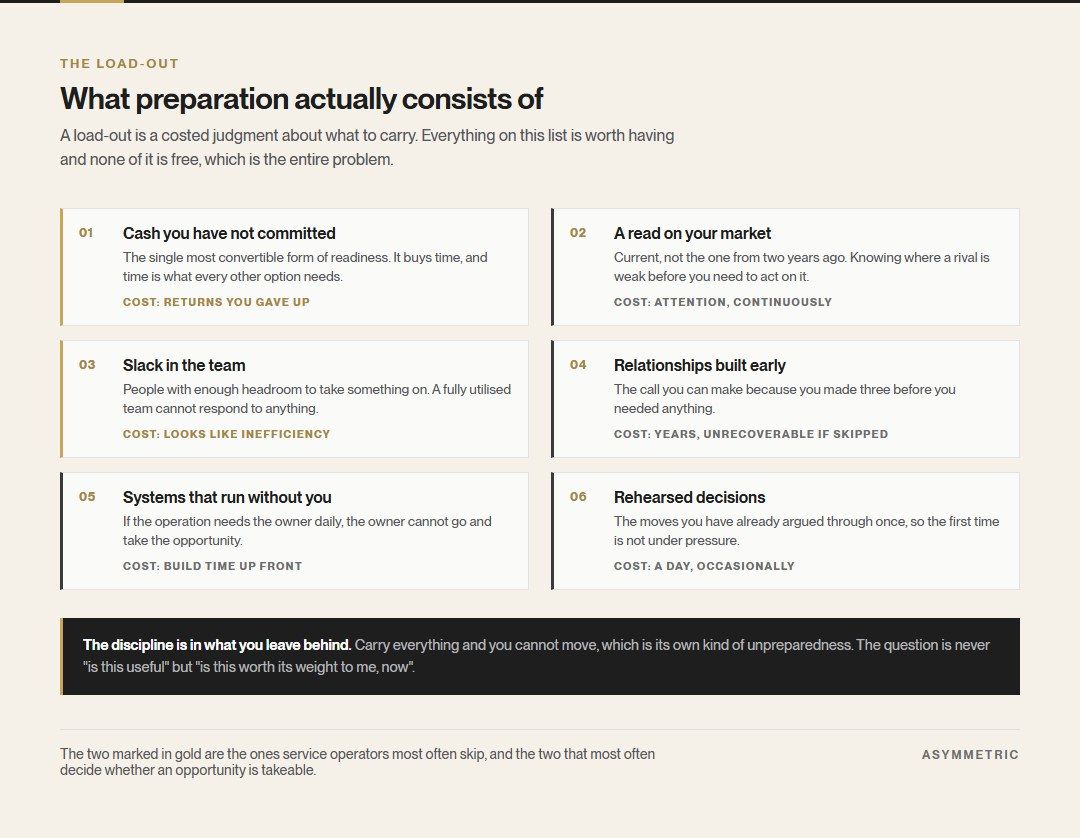
Preparation becomes concrete when you name the specific things a business carries against its plan's failure modes:
- Cash reserve: runway beyond the plan, sized to the most likely delay (a funding round that slips, a slow quarter), not to every doomsday scenario.
- A redundant supplier or channel: a vetted second source behind the primary one, so a single point of failure can't stop you.
- Slack capacity: enough headroom to absorb a demand spike you can't time, without carrying so much fixed cost that it sinks you while you wait.
- Preserved optionality: decisions kept reversible and doors kept open, so a shift in the market finds you able to move rather than committed to the wrong path.
- Capability and speed: the team, tooling, and decision rights in place before the moment, so you can act the day the opening appears instead of scrambling to build the ability to act.
Preparation, done right, is provisioning for the contingencies you actually identified, deliberately, at a cost you chose, without overloading for the ones you didn't.
How much preparation is too much
The discipline cuts both ways, and over-preparation is a real failure mode, not a virtue. Capital held in reserve is capital not invested in growth; redundancy carried for a risk that never materializes is dead weight; optionality preserved forever is a decision never made. The green soldier who loads for every contingency can't move. The skill is calibration: prepare deliberately for the failure modes your foresight says are likely and survivable-only-if-ready, and consciously accept the risk on the rest. Preparation is a budget, not a maximum.
Where this fits: foresight's partner
This is the readiness half of an asymmetric strategy, and it has a natural partner. Strategic foresight is the discipline of identifying what might happen, the futures and contingencies worth taking seriously. Preparation is what you carry because of it. Foresight without preparation is a smart forecast you can't act on; preparation without foresight is a heavy pack full of the wrong supplies. Together, they're why the prepared challenger looks lucky: when the opening appears, it has already chosen to carry exactly what it takes to move, and to everyone who didn't, that readiness looks like fortune. The place both get tested together is a business wargame, where you rehearse the contingencies and confirm you're actually provisioned for them.
Readiness is a strategy, not a slogan
The work isn't predicting the opportunity. It's making the load-out decisions, capability, reserve, optionality, and speed, that let you seize it when it comes. That's buildable, and it's the work.
Frequently asked questions
What is the difference between planning and preparation?
Planning is thinking about what might happen; preparation is having the things you need to act when it does. They're different disciplines. A company can have an immaculate plan and be utterly unprepared, because the plan lives in a document while preparation lives in what you actually carry, cash reserve, backup suppliers, slack capacity, and preserved optionality.
What does 'chance favors the prepared mind' mean?
Coined by Louis Pasteur, it means opportunities are unpredictable, so the edge isn't forecasting which door opens but being positioned to walk through it the instant it does, while slower rivals are still reacting. It's manufactured luck: preparation converted into advantage at the moment of opportunity, not chance.
How do you prepare a business for uncertainty?
Make deliberate load-out choices against your plan's most likely failure modes: a cash reserve sized to the delays that actually happen, a redundant supplier or channel, slack capacity for a demand spike you can't time, preserved optionality, and the capability and speed to act the day an opening appears. Prepare for the contingencies your foresight says are likely, at a cost you chose, without overloading for the rest.
Can a business be over-prepared?
Yes. Over-preparation is a real failure mode: capital in reserve is capital not invested, redundancy for a risk that never arrives is dead weight, and optionality preserved forever is a decision never made. The green soldier who loads for every contingency can't move. Preparation is a budget, not a maximum, calibrated to the failure modes that are both likely and survivable only if you're ready.
How do foresight and preparation work together?
Strategic foresight identifies what might happen; preparation is what you carry because of it. Foresight without preparation is a smart forecast you can't act on; preparation without foresight is a heavy pack full of the wrong supplies. Together they're why a prepared challenger looks lucky: when the anticipated opening appears, the means to seize it's already in place.
About the author

Mark Hope
Founder, President & Chief Strategy Officer, Asymmetric Marketing
Mark Hope is the Founder, President & Chief Strategy Officer of Asymmetric Marketing. His career spans elite military service, senior leadership at two of the largest companies in their categories, and founding several companies of his own. It's the common thread behind how Asymmetric helps smaller companies out-compete bigger ones.
Mark began his career in U.S. Army Special Operations, serving from 1977 to 1988 in the 1st and 3rd Battalions of the 75th Ranger Regiment and as an Operator in 1st Special Forces Operational Detachment–Delta (Delta Force). What that world runs on (careful planning, reading your opponent, and winning from a position of disadvantage) is the foundation of how he helps smaller companies win today.