

May 22, 2026
Marketing Attribution Models: A Practical Guide
Attribution decides which marketing gets credit, and every model lies differently. The main attribution models, what each over- and under-credits, and how to choose one that informs decisions instead of distorting them.
By Mark Hope, Founder, President & Chief Strategy Officer, Asymmetric Marketing

Marketing attribution is how you decide which touchpoints get credit for a conversion, and it quietly governs where your budget goes next. Get it wrong and you defund the channels that actually work because a flawed model handed the credit elsewhere. The uncomfortable truth is that every attribution model is wrong in a different way; the skill is knowing how each lies so you can read it without being misled.
Key takeaways
- Marketing attribution assigns credit for a conversion across the touchpoints that led to it, which determines where the next budget goes.
- The main models are first-touch, last-touch, linear, time-decay, position-based (U-shaped), and data-driven.
- Every model distorts: last-touch over-credits the closer, first-touch over-credits the opener, and even splits ignore that touches differ in weight.
- No model is "true"; pick the one whose bias least distorts the decision you are trying to make.
- Attribution is a decision aid, not an accounting truth; pair it with incident tests (holdouts, geo experiments) to check what really drives sales.
What marketing attribution is
Attribution is the practice of distributing credit for a conversion across the marketing touchpoints a customer encountered on the way, an ad, an email, an organic search, a retargeting impression. Because most purchases involve several touches, attribution answers the question that decides budgets: which of these actually drove the sale? The answer is never perfectly knowable, which is why there are competing models rather than one correct one.
The main attribution models
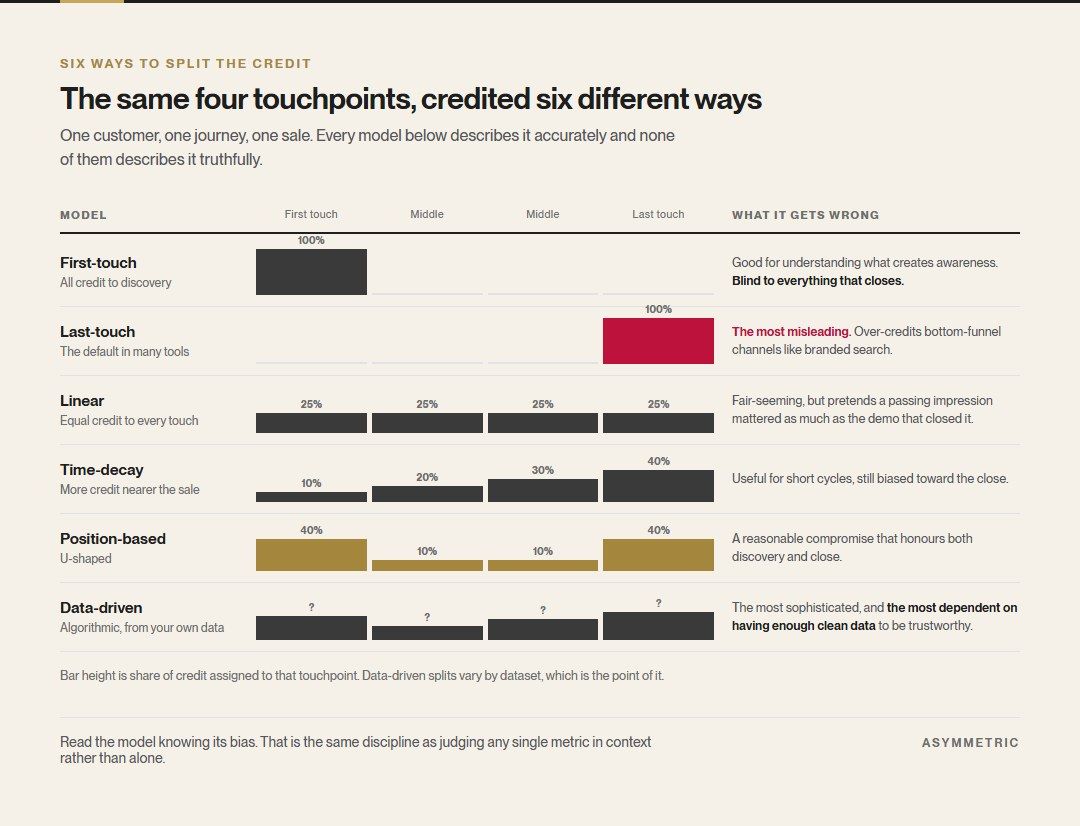
Each model splits the credit differently:
- First-touch: all credit to the first interaction. Good for understanding what creates awareness, blind to everything that closes.
- Last-touch: all credit to the final interaction before conversion. The default in many tools, and the most misleading, since it over-credits bottom-funnel channels like branded search.
- Linear: equal credit to every touch. Fair-seeming, but it pretends a passing impression mattered as much as the demo that closed the deal.
- Time-decay: more credit to touches closer to conversion. Useful for short cycles, still biased toward the close.
- Position-based (U-shaped): heavy credit to the first and last touch, less to the middle. A reasonable compromise that honors both discovery and close.
- Data-driven: an algorithm assigns credit based on patterns in your own conversion data. The most sophisticated, and the most dependent on having enough clean data to be trustworthy.
Why every model misleads
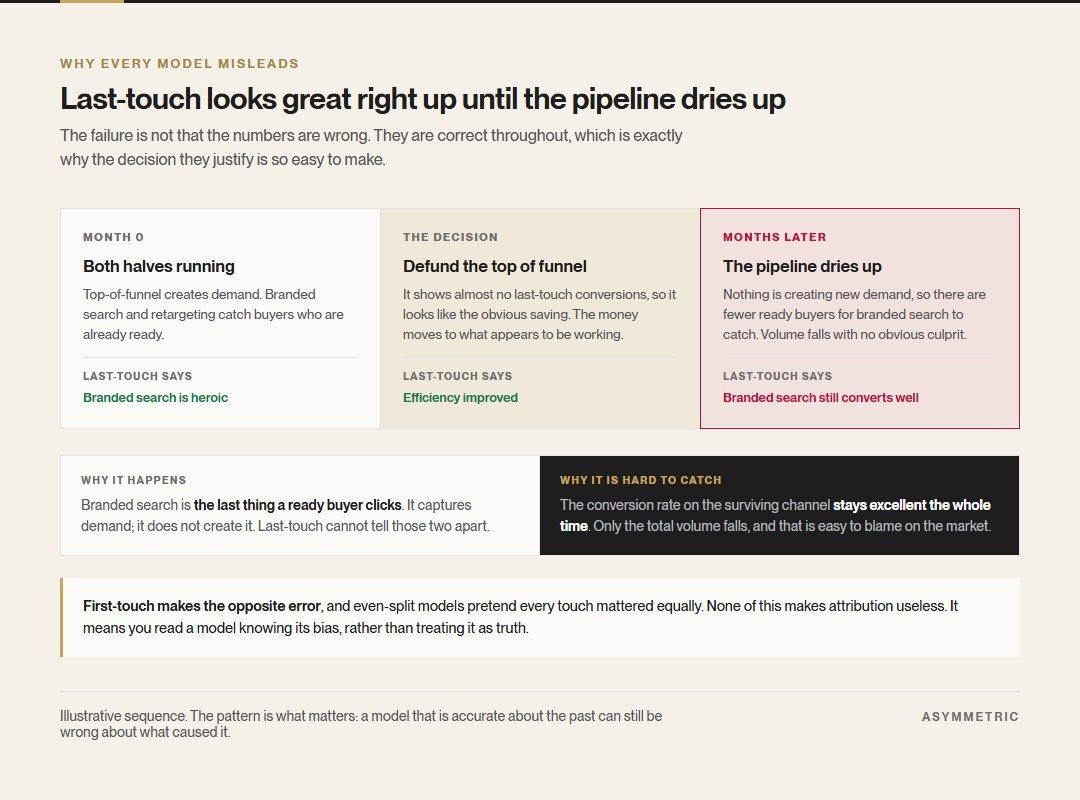
The trap is treating any model as truth. Last-touch makes retargeting and branded search look heroic because they're simply the last thing a ready buyer clicked; defund the top-of-funnel that created the demand and last-touch will keep looking great right up until the pipeline dries up. First-touch makes the opposite error. Even-split models pretend touches are equal when they're not. None of this means attribution is useless; it means you read the model knowing its bias, the same discipline behind judging any single metric, like click-through rate, in context rather than alone.
How to choose a model
Choose by the decision you're making, not by sophistication. To understand what creates demand, look at first-touch. To optimize the close, last-touch or time-decay. For a balanced budget view, position-based. For a mature account with lots of clean data, data-driven. Better still, don't rely on attribution alone: run incrementality tests, holdouts and geo experiments that turn a channel off and measure what actually changes, to check the model against reality. Attribution tells a plausible story; an incrementality test tells you whether it's true.
The point is the decision, not the dashboard
Attribution exists to inform one thing: where the next dollar should go. Read against profit and pressure-tested with experiments, it concentrates budget on what genuinely moves revenue, the same outcome-first thinking that should govern the whole marketing budget. A beautiful attribution dashboard that nobody acts on is just expensive decoration.
Measure what actually drives the sale
What to do when attribution can't see the channel
Every model shares one blind spot: it can only credit touches it observed. A conversation at a trade show, a recommendation in a private group, a podcast someone listened to in the car, and increasingly an answer an AI assistant gave without a click, all influence purchases and none of them appear in the data.
This matters more for smaller companies than for large ones, because the channels that work best when you're outspent are frequently the least trackable. Word of mouth and reputation don't carry a query string.
The practical answer isn't a better model. It's to stop relying on the model alone. Ask new customers how they came to you, in their own words, at the point of purchase rather than in a survey later. The answers won't reconcile with your analytics, and the gap between the two is itself the finding: it tells you roughly how much of your demand is being created somewhere you can't instrument.
The other half is holdout testing. Turn a channel off in one region or segment for a defined period and watch what happens to total demand rather than to that channel's attributed conversions. It's blunt, it costs real money, and it answers the question no attribution model can: whether the channel was creating demand or just collecting it.
Common Challenges in Marketing Attribution
The complexity of consumer journeys complicates tracking and measuring the effectiveness of all marketing channels. Different attribution models can yield varying results, causing confusion about which channel effectively drives conversions. Attribution models often struggle to account for the interdependencies among various marketing touchpoints.
The increasing focus on consumer privacy, such as the lack of third-party cookies and increased privacy regulations, exacerbates challenges in attribution. Using a hybrid approach that combines attribution with qualitative data and machine learning models can help adapt to privacy regulations.
Traditional attribution models can overlook key interactions, especially outside digital environments, neglecting offline interactions key for understanding overall marketing effectiveness. Difficulties arise when tracking offline touchpoints, complicating the attribution of conversions.
How to Measure Marketing Attribution Effectively

Collecting marketing interaction data is the first step in creating trustworthy attribution reports. AI enhances measurement and attribution by linking consumer interactions with ads to online and offline behaviors. When deciding the time period for marketing attribution analysis, consider business type, seasonality, and sales cycle length.
A visual analytics dashboard helps identify patterns and clarify the average sales cycle timeline in marketing attribution. Different attribution models in platforms like HubSpot help analyze the buyer journey. After choosing an attribution model, the next step is to analyze the obtained data. Integration tools like HubSpot and Google Analytics help link information to specific contacts, improving attribution analysis.
Analyzing attribution data helps understand the value of interactions in relation to marketing efforts. Common challenges include combining offline and online data. Advanced tools help organizations without in-house data science capabilities implement effective attribution.
Using Attribution Data to Optimize Campaigns
Attribution model insights can enhance customer experience by pinpointing key interaction points within the buyer’s journey. Attribution reporting improves marketing efforts by enabling marketers to respond more effectively to customer needs. AI-generated audience insights enable more precise targeting and enhance personalization in marketing campaigns.
Machine learning algorithms suggest creative optimizations to improve marketing content engagement. AI integration allows marketers to make real-time adjustments to campaigns based on data analysis. AI uses predictive analytics based on past data to identify optimal times and locations for ad placements.
Understanding customer interactions helps align offerings to customer preferences, improving future product development.
Choosing a model you'll actually act on
The model matters less than the decision it's supposed to inform, so start from the decision. If you're deciding whether to keep funding top-of-funnel work, last-touch is the one model guaranteed to answer wrongly. If you're deciding which bottom-funnel channel to scale, first-touch is equally useless.
For most companies below enterprise scale, position-based attribution is the sensible default. It credits both the touch that created the demand and the one that closed it, which is roughly the shape of reality, and it doesn't require the data volume that data-driven models need to be trustworthy.
Data-driven attribution is genuinely better when it works and quietly worse when it does not. It needs enough conversions for the algorithm to find real patterns rather than noise, and below that threshold it produces confident numbers built on very little. If your monthly conversion count is in the dozens rather than the hundreds, the sophistication is decorative.
Whichever you choose, write down its bias next to the dashboard. A team that knows the model over-credits the close will read a strong branded-search number correctly. A team that doesn't will defund the thing feeding it.
If your reporting credits the wrong channels and your budget follows, fixing the measurement so spend flows to what works is the work we do.
Frequently asked questions
What is marketing attribution?
Marketing attribution is the practice of assigning credit for a conversion across the touchpoints a customer encountered on the way to it, such as ads, email, organic search, and retargeting. Because most purchases involve several touches, attribution answers the budget-deciding question of which marketing actually drove the sale.
What are the main attribution models?
First-touch (all credit to the first interaction), last-touch (all to the final one), linear (equal credit to every touch), time-decay (more credit nearer conversion), position-based or U-shaped (heavy credit to first and last), and data-driven (an algorithm assigns credit from your own conversion data). Each splits credit differently and carries a different bias.
Which attribution model is best?
None is universally best; choose by the decision you're making. Use first-touch to understand demand creation, last-touch or time-decay to optimize the close, position-based for a balanced budget view, and data-driven for a mature account with clean data. Better still, validate the model with incrementality tests rather than trusting it as truth.
Why is last-touch attribution misleading?
Because it credits whatever a ready buyer clicked last, usually bottom-funnel channels like branded search or retargeting, while ignoring the top-of-funnel marketing that created the demand. Optimize to last-touch and you can defund what actually drives pipeline, and the model keeps looking great until the pipeline dries up.
What is incrementality testing?
Incrementality testing measures what truly changes when you turn a channel or campaign off, using holdouts or geo experiments. Unlike attribution, which tells a plausible story about credit, an incrementality test tells you whether a channel actually caused incremental sales. The two together are far more reliable than attribution alone.
About the author

Mark Hope
Founder, President & Chief Strategy Officer, Asymmetric Marketing
Mark Hope is the Founder, President & Chief Strategy Officer of Asymmetric Marketing. His career spans elite military service, senior leadership at two of the largest companies in their categories, and founding several companies of his own. It's the common thread behind how Asymmetric helps smaller companies out-compete bigger ones.
Mark began his career in U.S. Army Special Operations, serving from 1977 to 1988 in the 1st and 3rd Battalions of the 75th Ranger Regiment and as an Operator in 1st Special Forces Operational Detachment–Delta (Delta Force). What that world runs on (careful planning, reading your opponent, and winning from a position of disadvantage) is the foundation of how he helps smaller companies win today.