
Marketing Tactics Small Brands Use to Compete

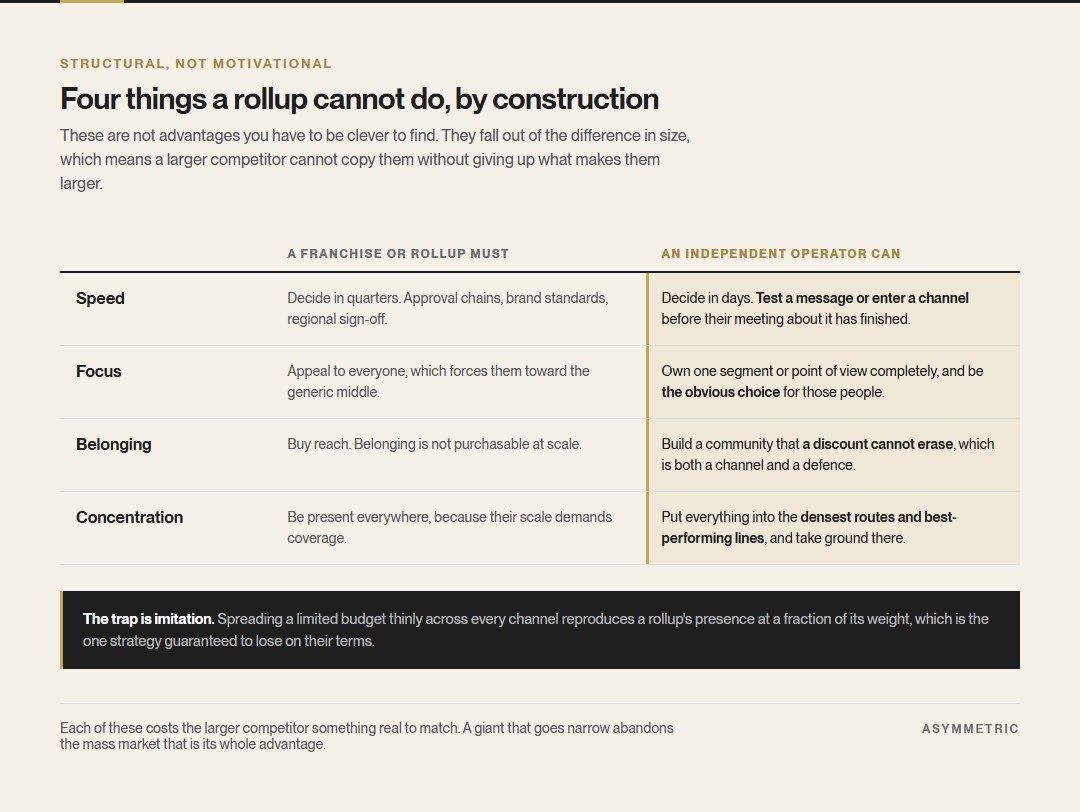
Small brands have never had more ways to compete with larger businesses—and win. While big companies often struggle with slow decision-making and bloated marketing teams, small businesses can move fast, connect directly with customers, and build loyal audiences in niche markets. Small brands differentiate themselves from big businesses by leveraging agility, personalized service, and authentic relationships that larger competitors often can't match.

However, there are common challenges that underdogs face when going up against big businesses, such as limited marketing budgets, scale disadvantages, and the need to maximize every resource. Overcoming these obstacles requires creativity, emotional messaging, and a willingness to adapt quickly.

If you’re looking for a few ways to level the playing field, you’re in the right place. There’s something universally appealing about a good underdog story—consumers are naturally drawn to underdogs who overcome the odds and challenge industry giants. This guide does just that: it breaks down the exact marketing tactics that underdog brands are using in 2026 to close the gap with market leaders.

Key Takeaways

  • Small brands consistently beat larger competitors by leaning on differentiation, sharp niche focus, and modern digital channels—not by trying to outspend them.
  • Successful underdog brands leverage memorable brand experiences, loyalty programs, and positive customer reviews to compete and gain market share despite strong competition from larger, established companies.
  • Building a memorable brand experience is crucial for small businesses to stand out in a competitive market.
  • Loyalty programs effectively encourage repeat business among existing customers.
  • Positive customer reviews are crucial for building credibility and trust among potential customers.
  • Retaining existing customers is five times cheaper than acquiring new ones.
  • Asymmetric Marketing specializes in helping small and mid-sized businesses deploy these tactics (SEO, content, paid media, automation) to level the playing field against big brands.
  • Most tactics described can start showing early signs of impact within 60–120 days when executed consistently with data-driven adjustments.
  • The winning strategy is not to outspend big players but to outsmart them through positioning, precise targeting, and memorable customer experience.
  • This article ends with a practical FAQ section answering common questions like “how do I start?” and “what if my budget is tiny?”

Why Small Brands Can Still Win in 2026

In 2026, small brands face algorithm changes, rising ad costs, and increasingly saturated markets. Yet many are not just surviving—they’re growing and taking share from larger competitors. The key lies in using the right marketing tactics with the right mindset.

Consider the DTC brands that grew from 2020–2025 using TikTok, Shopify, and email automation to carve out niches against giants like Amazon and Walmart. A handmade skincare brand, for example, grew organic sales by 151.7% over just five months through focused SEO and site restructuring. These wins weren’t about budget—they were about focus and execution. Unlike big businesses, small brands can adapt quickly, making changes and capitalizing on opportunities while larger companies are still navigating layers of decision-making.

Technology has democratized sophisticated marketing. AI tools, marketing automation platforms, and self-serve ad platforms have lowered barriers that once reserved advanced tactics for Fortune 500 brands. Small businesses can leverage technology to handle routine tasks efficiently, freeing up more time to focus on building personalized customer relationships and making strategic decisions. They can also adapt to trends and customer feedback almost overnight, unlike larger corporations that move slowly due to complex hierarchies. According to recent research, over 90% of SMBs now say AI tools help cut costs or workload, and more than 76% of companies globally use some form of marketing automation. Investing in analytics and digital document workflows can further enhance speed and professionalism for small businesses. Small brands can also use data-driven decision-making to make smarter moves—without needing to hire dedicated data scientists.

At Asymmetric Marketing, we see this daily as a B2B digital agency working with small and mid-sized challengers. Our focus is on measurable growth—leads, revenue, retention—not vanity metrics. The brands that win don’t try to match big companies dollar for dollar. They find their asymmetric marketing advantage and exploit it relentlessly.

Messy path turns into straight arrows hitting target.

Clarify Your Asymmetric Advantage and Brand Position

Small brands win by being different, not bigger. This is the foundation for every tactic in this article. Before investing in channels or campaigns, you need to understand what makes your brand meaningfully distinct from larger competitors.

Defining a clear positioning statement means answering three questions: who you serve, what problem you solve, and why your solution is meaningfully different from the category leader. This is not about being slightly better—it’s about being different in a way that matters to your target audience.

Storytelling is a powerful marketing tactic small brands use to compete. Sharing your brand’s humble beginnings can foster relatability and trust, making your business more authentic and endearing to your audience. Many small brands leverage the underdog story—highlighting how they overcame significant challenges and disrupted dominant market players—to emotionally connect with customers and portray themselves as innovative and resilient. However, not every brand will benefit from an underdog narrative; some established brands or those with a different industry role may need to consider alternative positioning strategies.

Consider a local eco-friendly cleaning brand competing with Procter & Gamble. They can’t match P&G’s distribution or ad spend, but they can emphasize non-toxic ingredients, transparent sourcing, biodegradable packaging, and local delivery. A boutique consulting firm might specialize exclusively in creative agencies, speaking directly to the aesthetic, financial, and cultural concerns of creative founders—something large firms often gloss over.

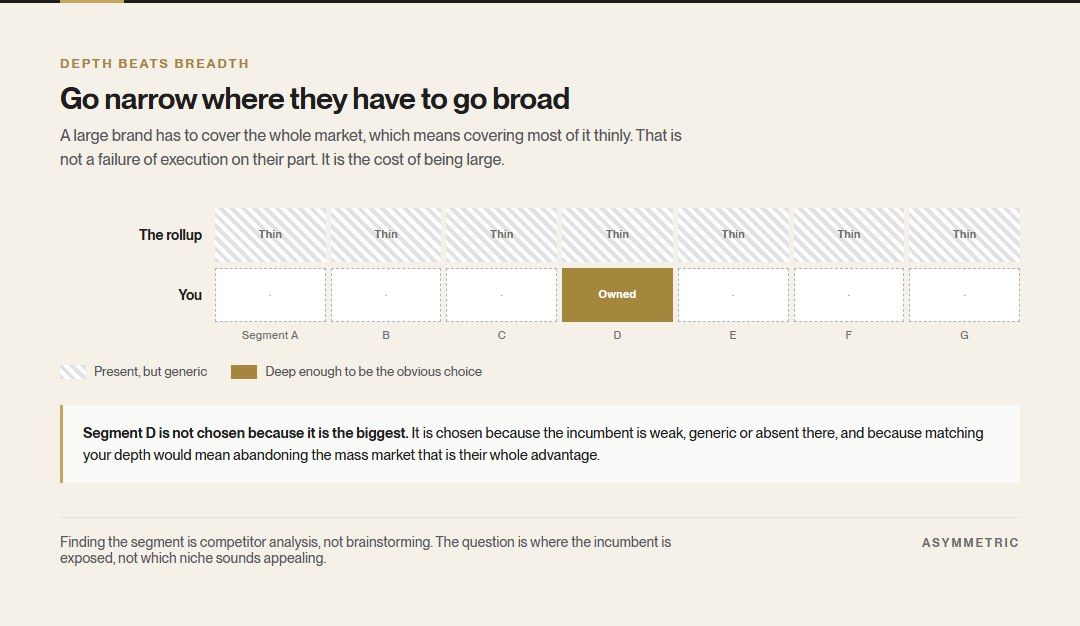
Classic strategic concepts apply here: becoming a “category of one” where you’re the only brand people think of for a specific problem, or “owning a narrow niche,” so your marketing efforts are concentrated, and your differentiation is visible. The goal is not to compete in a broad category but to define a space where you can dominate.

To sharpen your positioning, answer these questions honestly: First, who is your best, highest-margin, happiest customer in terms of demographics, psychographics, and behaviors? Second, what exact problem does your product or service solve for them that they care deeply about? Third, how is your solution different in a way that matters—quality, speed, service, values, convenience? Fourth, what is your brand voice and promise that supports that difference? Creating a clear brand voice and identity is essential for small businesses to stand out in a competitive market.

Niche focus leading to audience engagement icon

Own a Sharp Niche Instead of the Whole Market

Most successful small brands between 2018–2025—specialty coffee roasters, niche SaaS tools, boutique agencies—won by going narrow and deep rather than broad. They didn’t try to serve everyone. They became indispensable to someone.

There are several ways to niche effectively. You can niche by audience, focusing on a specific professional vertical like contractors, teachers, or therapists. You can niche by use-case, building tools or services for a particular workflow like “project management for agencies” rather than generic project management. You can niche by geography, serving a specific region with messaging tied to local identity, seasonality, or distribution advantages. Acting as local businesses allows small brands to build strong community support, offer personalized service, and leverage local market knowledge to differentiate from larger competitors. Focusing on local SEO is crucial for improving visibility and attracting nearby customers, while optimizing your Google Business Profile further enhances your presence in local searches. Or you can niche by values, positioning as climate-positive, fair trade, BIPOC-founded, or ethically sourced. For brands selling physical products, sustainable packaging design and environmentally friendly practices demonstrate social responsibility and can strengthen your brand’s relevance.

Woodworker crafting in a tool-filled workshop

For more tactical deep dives across SEO, paid media, and positioning, small brands can tap into the Asymmetric Blog’s digital marketing guides as an ongoing learning resource.

Consider these realistic brand archetypes. An audience-niche example: a SaaS product built only for independent creative agencies, not “all small businesses.” A use-case niche: software for managing recurring billing in freelance photography businesses. A geography niche: a landscaping company serving only the Pacific Northwest, speaking explicitly to local climate, plant types, and seasonality. A values niche: a clothing brand using only recycled fabrics with carbon-neutral shipping and full transparency.

Before committing budget to a niche, validate demand. Use Google Trends to see interest over time for niche-specific queries. Browse Reddit communities and niche forums to read the pains and language of your audience. Conduct interviews or surveys with prospective customers. Run keyword research to check demand volume and competitiveness. Estimate your addressable market versus customer acquisition cost to ensure sustainability.

Leverage Content and SEO to Punch Above Your Weight

Search behavior in 2024–2026 has fragmented across Google, Bing, YouTube, and even TikTok search. This fragmentation favors small brands that target specific, high-intent queries rather than expensive broad terms. You can capture demand without TV-level budgets. Key tactics for small brands include dominating local SEO, building strong community relationships, and utilizing cost-effective digital marketing tools.

At Asymmetric Marketing, we typically start with small clients with a focused SEO and content roadmap targeting long-tail keywords, using frameworks like the Asymmetric Marketing Engine to map efforts to each stage of the journey. Instead of competing for “consultant,” we might target “B2B industrial IoT consultant in Ohio.” Instead of “CRM software,” we might go after “CRM for solo freelance designers.” This is where small businesses gain a genuine competitive advantage. Building a clear brand voice is essential for underdog brands to stand out in competitive markets.

The core tactics to prioritize include keyword research for underserved questions, publishing in-depth guides and comparison pages, optimizing key landing pages, and building topical authority through content clusters. Tools like Ahrefs, Semrush, and Google Search Console help identify opportunities and track progress.

The comparison page strategy is particularly powerful for underdog brands. A great example is a SaaS startup in 2023–2024 that grew trial signups significantly by ranking for “[category] alternatives” pages—capturing searchers who were actively evaluating the market leader but open to options. These pages address consumer research directly and often convert at higher rates than generic content.

Timelines for SEO are realistic when understood correctly. In months 0–3, focus on technical fixes, site speed, keyword research, and initial content creation. Months 3–6 typically show improved rankings for low-competition keywords and meaningful traffic increases. Months 6–12 often bring positive ROI, significant lead volume, and compounding authority. Benchmarks for small businesses in 2025 show SEO delivering a median ROI of approximately 312%, outperforming paid advertising for sustained growth.

Use Paid Media with Sniper-Like Precision

Magnifying glass targets person icon on wood discs.

Small brands cannot afford broad, unfocused PPC or paid social campaigns. You must target like snipers, not shotguns. Every dollar wasted on low-intent traffic is a dollar that could have converted a ready buyer.

Prioritize high-intent channels first. Google Search Ads targeting “near me,” “hire,” and “buy” queries capture people actively looking to purchase. Retargeting on Meta or LinkedIn keeps warm leads and website visitors in front of your brand after they’ve shown initial interest. These channels should be your foundation before expanding to awareness campaigns.

For small brands in early 2026, starting tests with monthly paid media budgets of $1,500–$5,000 is realistic, depending on ticket size and margins. Focus on 1–2 core campaigns rather than spreading thin across 20 platforms. Use those initial investments to gather data, not to “scale” prematurely.

Common underdog tactics include bidding on competitor brand terms, creating “compare vs. [big brand]” ad campaigns, and pushing limited-time offers to accelerate decision-making. These approaches leverage the existing awareness larger brands have built while positioning you as a viable—often superior—alternative. Leveraging the underdog effect, small brands can make their paid campaigns more effective, as consumers are psychologically inclined to support challengers and root for brands perceived as underdogs in the market.

At Asymmetric Marketing, we structure campaigns with tight ad groups, specific landing pages matched to each message, and conversion tracking through GA4 and CRM integration, all as part of our data-driven growth marketing services. The goal is to close the feedback loop, so every click teaches you something about what works. Data from recent studies shows that companies earning $1–9M in revenue generate approximately 18.1% of revenue from paid ads—making it a meaningful lever for small business growth when executed well.

Turn Social Media Into an Unfair Visibility Advantage

Algorithm-driven feeds on TikTok, Instagram Reels, YouTube Shorts, and LinkedIn have allowed small brands to achieve viral reach without TV ads. Between 2021 and 2025, we’ve seen small skincare brands, local restaurants, and B2B founders build massive audiences through consistent, authentic content that resonates with consumers and fosters emotional connections.

Choose 1–2 primary platforms based on where your audience actually spends time. Consumer brands typically benefit most from TikTok and Instagram. B2B brands often find better returns on LinkedIn and YouTube. Trying to be everywhere dilutes your effort and produces mediocre results.

Woman packaging product for online video

The tactics that work best for underdog brands include founder-led content that shows personality and personal connection, behind-the-scenes videos that build trust, user-generated content that provides social proof, and honest “build in public” posts that create genuine relationships with your audience. Infusing joy and humor into social content can help build a loyal audience and a loyal following, as consumers are drawn to brands that make them feel good and stand out from the crowd. Some underdog brands even use humor or satire to poke fun at the status quo, engaging their audience and differentiating themselves from industry giants. Research shows that posts with user-generated content can achieve double the engagement of polished brand content, and small brands often see 3.4× the engagement of large brands when they prioritize authenticity over production value. Building a memorable brand experience through storytelling and emotional connection also helps small businesses retain customers and foster long-term loyalty.

Video content deserves special attention—it generates approximately 5× more engagement than static posts for small businesses. Reels, Shorts, and TikTok videos have exceptional reach and can introduce your brand to new audiences organically.

A practical posting cadence for consumer brands is 3–5 posts per week. B2B brands might do 2–3 in-depth posts weekly, plus lighter content. At Asymmetric Marketing, we help clients plan content calendars and creative themes so that social media becomes a sustainable system rather than a frantic scramble.

Design a Brand Experience That Feels Human and Premium

Small brands can’t always win on price. But they can win on memorability and emotional connection at every touchpoint. Sharing stories of overcoming challenges not only highlights resilience and perseverance but also creates emotional connections that distinguish your brand from larger competitors. This is where customer interactions become your competitive advantage.

Consistent branding across your website, packaging, email, and customer support builds trust and perceived value. Your tone of voice, colors, photography style, and messaging should feel cohesive whether someone is browsing your homepage, unboxing a product, or emailing your support team. This consistency is how you build a loyal customer base over time.

Offering a responsive, thoughtful customer service experience creates fans and builds loyalty. Customers want companies to listen to their concerns and needs, and small businesses have a unique opportunity to excel here by providing attentive, personalized service. Personalized service is one of the most significant ways small businesses can compete with larger rivals.

Concrete ideas that create memorable experiences include handwritten thank-you notes in first orders (especially effective for the first 50–100 customers), post-purchase check-in emails within 7 days asking how everything arrived, or onboarding calls for B2B clients within 48 hours of contract signing. These touches cost little but create lasting impressions.

In 2026, certain visual and UX elements are non-negotiable for small brands. Fast-loading mobile sites (under 3 seconds) are essential—Google’s Core Web Vitals and user patience demand it, and many local businesses benefit from partnering with a Madison-based custom web design team that understands both UX and SEO. Clear product pages with transparent pricing, shipping, and return information reduce friction. Simple checkout processes minimize abandonment. Personalized post-purchase email sequences with usage tips, cross-sells, and educational content deepen customer relationships. For those with physical locations, creating an appealing environment within retail stores—through thoughtful design, cleanliness, and atmosphere—can attract and retain customers.

Consider a small e-commerce apparel brand writing personal thank-you notes with packaging designed to reflect the founder’s values—recycled materials, minimal plastic, a clear message about why the brand exists. Or a B2B service provider doing personalized onboarding calls with a brief walkthrough and homework to align expectations. These are not expensive tactics. They’re intentional ones.

Automate Smartly So a Small Team Can Look Big

Marketing automation and AI allow a small team of 3–5 people to operate with the sophistication of a 25-person department. The key is using automation tools to handle repetitive, predictable tasks so humans can focus on high-value creative and strategic work.

Key areas to automate include welcome and nurture email flows triggered by sign-up or purchase behavior, cart or lead form abandonment follow-ups that recover lost conversions, lead scoring based on website behavior and engagement, and basic FAQ handling via chatbot to reduce support load.

Automate Smartly So a Small Team Can Look Big

Tools popular in 2024–2026 include HubSpot for CRM and marketing automation, Klaviyo for e-commerce email, ActiveCampaign for mid-market automation, and Make or Zapier for workflow connections between platforms. AI tools like ChatGPT and Jasper assist with content drafting and ideation. At Asymmetric Marketing, we help businesses choose and implement the right stack for their specific needs and budget, aligning it with the Asymmetric Marketing Engine framework to support each stage from awareness through advocacy.

The data strongly support automation investment. Automation tools have been shown to boost qualified leads by approximately 451% compared to non-users. Email automation delivers roughly 320% more revenue than manual campaigns. Small businesses using AI and automation report saving 40+ minutes per week while working more efficiently.

The goal is not to feel robotic. Automation should free humans to spend more time on high-value personal outreach, creative work, and building genuine relationships. When done right, customers never notice the automation—they just notice that you’re responsive, helpful, and consistent.

Building a Strong Team to Support Growth

For underdog brands, building a strong team is one of the most powerful ways to create a sustainable competitive advantage. Unlike large corporations, small businesses can foster a close-knit culture where every team member is invested in the company’s mission and customer success. When your team shares your values and vision, they’re more likely to go the extra mile in every customer interaction—turning first-time buyers into a loyal customer base.

Start by hiring people who are passionate about your brand’s story and committed to delivering exceptional customer experiences. Look for candidates who thrive in dynamic environments and are eager to contribute ideas, not just follow instructions. A small, agile team can often outmaneuver larger competitors by being more responsive and innovative.

Customer relationship management (CRM) is also essential for growth. By implementing the right digital tools, you can track every customer touchpoint, personalize communications, and ensure no opportunity slips through the cracks. Incorporating competitive intelligence services alongside CRM data deepens your understanding of the market, so your team can prioritize the right opportunities. Automation tools can handle routine follow-ups and data entry, freeing your team to focus on high-value customer interactions and creative problem-solving.

Ultimately, a strong team supported by smart tools enables small businesses to punch above their weight—delivering the kind of personal service and attention that big brands struggle to match. This is how you build genuine relationships and a loyal customer base that fuels long-term growth.

Negotiating with Suppliers for Better Margins

Negotiating with suppliers is a critical skill for small businesses looking to strengthen their competitive advantage. For underdog brands, every percentage point in margin matters—and smart negotiation can be the difference between thriving and merely surviving in a competitive market.

Start by building strong, transparent relationships with your suppliers. When you’re seen as a reliable partner, suppliers are more likely to offer favorable terms or exclusive deals. Conduct thorough consumer research to understand your market and identify where you can add value—whether it’s through unique packaging, faster turnaround, or more flexible order quantities.

Don’t be afraid to highlight your unique value proposition when negotiating. Explain how your business stands out from larger competitors and how a partnership can benefit both sides. Sometimes, being a nimble, innovative small business is an asset—suppliers may be willing to support your growth if they see long-term potential.

Leverage digital tools and automation to streamline your supply chain management. With real-time inventory tracking and automated reorder points, you can negotiate from a position of strength, backed by data. If the terms aren’t right, be prepared to walk away—sometimes the best deal is the one you don’t make.

By approaching supplier negotiations strategically, small businesses can secure better margins, improve customer loyalty through reliable fulfillment, and reinforce their competitive advantage in the marketplace.

Avoiding Common Pitfalls That Undermine Small Brands

Person stepping on aged wooden bridge with greenery.

Even the most promising underdog brands can stumble if they fall into common traps. One of the biggest mistakes small businesses make is trying to compete with big brands on price alone. Instead, focus on building strong customer relationships and delivering a unique value proposition that resonates with your target audience. This approach not only sets you apart but also helps create a loyal customer base that values what you offer.

Another pitfall is neglecting the power of digital tools and automation. Streamlining your operations with the right tools frees up time for meaningful customer interactions and allows you to deliver a superior customer experience. Tools like Google Analytics can provide valuable insights into consumer behavior, helping you make data-driven decisions that improve loyalty and retention.

Avoid spreading yourself too thin by trying to appeal to everyone. Instead, develop a clear brand voice and focus your efforts on the audience most likely to become loyal advocates. Consistency in messaging and experience builds trust and strengthens your brand in a competitive market.

By steering clear of these pitfalls and prioritizing customer relationships, small businesses can build a strong foundation for growth. Use digital tools to track progress, refine your strategy, and ensure every customer interaction reinforces your brand’s promise. This is how underdog brands compete—and win—against even the biggest players.

Measure Ruthlessly and Double Down on What Works

Measurement is a key underdog weapon. Small brands can’t afford to waste and need to quickly cut losing tactics while scaling what works. This requires a system, not just occasional check-ins.

Core metrics to track across channels include cost per lead or acquisition (CPA/CPL) by channel, customer lifetime value (LTV), conversion rate by traffic source (organic, paid, social, referral, direct), and payback period on marketing spend (how long it takes to recoup acquisition costs).

A simple monthly rhythm makes measurement actionable. Set aside 60 minutes monthly to review dashboards across GA4, ad platforms, and your CRM. During that review, decide what to scale, what to pause, and what to test next month. Document your hypotheses and results, so you build institutional knowledge over time.

Here’s one concise example: A small e-commerce brand discovers through measurement that email (including automated flows) drives 30% of revenue while consuming only 5% of ad spend. Based on this insight, they reallocate part of their paid budget toward improving email capture, increasing flow frequency, and optimizing sequences. Result: overall CAC drops and revenue rises.

At Asymmetric Marketing, we build reporting frameworks for clients so they understand which tactics are truly leveling the playing field, tying results back to integrated digital marketing services across SEO, PPC, email, and social. Attribution is complex—multi-touch, cross-device, ad plus SEO plus social interplay—but having clear data is better than flying blind.

When to Partner with a Growth-Focused Agency Like Asymmetric Marketing

Many founders run DIY marketing until they hit a plateau in leads or revenue. This typically happens between $500K and $5M in annual revenue, when the complexity of channels exceeds what a generalist can manage effectively.

Clear signs it’s time to bring in an agency include inconsistent lead flow across months, an overextended internal generalist handling too many channels poorly, rising ad costs with flat or declining results, stalled SEO visibility despite effort, or missed opportunities due to lack of time, strategy, or specialized expertise.

What makes Asymmetric Marketing different from generic agencies is our focus on small and mid-sized challengers who need an integrated strategy across SEO, PPC, content, and automation. As a growth marketing agency dedicated to leveling the playing field for smaller businesses, our decision-making is rooted in analytics and competitive intelligence. We understand budget constraints and prioritize tactics that deliver early wins while building toward long-term growth.

A typical engagement looks like this at a high level: discovery and competitive intelligence to understand your market position, a 90-day growth roadmap prioritizing channels and tactics, implementation sprints with weekly or bi-weekly deliverables, and ongoing optimization based on performance data.

The right way to view agency partnership is as a way to compress learning curves and avoid expensive trial-and-error—not just to “outsource tasks.” When you partner with specialists, you gain access to tools, talent, and economies of scale that would take years to build internally.

Question and idea speech bubbles on colorful background.

FAQs on Marketing Tactics Small Brands Use to Compete

How long does it realistically take for the marketing tactics small brands use to compete to show results?

Pay-per-click and paid social campaigns can show directional results within 30 days—you’ll see clicks, traffic, and potentially leads or sales quickly. SEO and content marketing often take 3–6 months to materially move organic traffic and leads, though some low-competition keywords can rank faster.

Compounding effects typically appear around months 6–12 when tactics are consistent and data-driven adjustments are made monthly. This is when SEO authority builds, email lists grow, and your brand becomes known in your niche.

Set expectations for at least a 6-month horizon. Avoid judging channels solely on the first few weeks of performance. At Asymmetric Marketing, we usually structure engagements around 90-day milestones to balance quick wins with sustainable long-term growth.

What if my monthly marketing budget is under $2,000?

With very small budgets, focus your resources ruthlessly. Prioritize a fast, credible website that clearly communicates your unique value proposition. Choose one main social platform where your target audience spends time and build consistency there. Set up basic email automation for welcome sequences and abandoned cart or lead recovery.

Avoid spreading spend thin across many ad platforms. If the budget permits some paid advertising, test only one channel with very tight targeting. Low-budget success often comes from organic tactics: community building, strategic partnerships, PR outreach to niche publications, and leveraging customer feedback for testimonials and word-of-mouth.

At Asymmetric Marketing, we help design phased strategies that grow in sophistication as the budget increases. Starting small and smart beats starting big and scattered.

How can a small B2B brand compete with major players that dominate trade shows and industry media?

B2B challengers can win by becoming the most helpful voice in a narrow problem space. Publish thought leadership content, host webinars, and build a LinkedIn presence that positions you as an expert rather than just a vendor.

Specific tactics include publishing comparison pages like “[Big Vendor] vs. [Your Brand],” creating detailed case studies with ROI data, and developing calculators or tools targeted at specific verticals. These assets capture consumer research at the moment buyers are evaluating options.

Targeted LinkedIn outreach and account-based marketing for key accounts often outperform broad, expensive sponsorships. At Asymmetric Marketing, we frequently help B2B clients map out decision-maker journeys and align content, ads, and email sequences to each stage of the buying process.

How do I know which tactics to prioritize first for my specific small brand?

Start with a quick audit of where leads and revenue are currently coming from—website, referrals, local search, social, or other channels. Look for areas that are “almost working” where small improvements could yield meaningful gains. If you’re getting traffic but not conversions, the issue might be landing pages, not traffic generation.

Choose 2–3 core channels that best match your audience and sales cycle rather than copying a competitor’s full marketing mix. At Asymmetric Marketing, we typically conduct a 2–3 week diagnostic to identify the highest-ROI sequence of tactics for each client.

Document your hypotheses (“We think LinkedIn will outperform Facebook because our B2B buyers spend time there”) and test them in 60–90 day cycles. Let data guide your decisions rather than gut feelings or industry trends that may not apply to your niche.

Can small brands really build a brand as strong as big companies without massive ad spend?

Absolutely. “Brand” is the sum of consistent experiences and messages over time, not just logo visibility on billboards. Many brands built strong reputations from 2015 to 2025 primarily through word-of-mouth, content, and community in niches like DTC apparel, SaaS, and local food. They didn’t outspend—they out-connected.

Small brands create outsized brand impact by being extremely consistent in a narrow story and over-delivering for early customers. Every positive customer interaction, every helpful piece of content, every genuine relationship builds brand equity that compounds over time. Underdogs can build strong brands by leveraging their unique advantages—such as agility, authenticity, and emotional storytelling—to differentiate themselves and form deeper connections with their audiences.

Strategic marketing with Asymmetric Marketing focuses precisely on amplifying these strengths rather than trying to mimic Fortune 500 media plans. For founders who want to go deeper on these concepts, Mark Hope’s articles on asymmetric strategy and growth offer additional practical perspectives. The goal is not to look big—it’s to be memorable and trusted in the spaces that matter most to your customers.

The playing field has never been more level for small brands willing to move fast, focus relentlessly, and use the right marketing tactics. You don’t need massive budgets or armies of marketers. You need clarity on what makes you different, precision in where you invest, and consistency in how you show up.

If you’re ready to compete smarter against larger competitors, reach out to Asymmetric Marketing for a growth consultation. We’ll help you identify your highest-leverage opportunities and build a roadmap that turns your underdog status into a lasting competitive advantage.

Red circle and arrow logo design

Ready to turn your underdog status into a competitive advantage?

The marketing tactics small brands use to compete aren't about matching the big guys dollar-for-dollar—they are about outsmarting them through agility and precision. Let Asymmetric Marketing help you implement these high-leverage strategies to gain a dominant edge in your niche.

Here’s how to get started:

  • Explore more: Read latest articles on the specific marketing tactics small brands use to compete and how to apply the Asymmetric Marketing Engine to your business.

  • Get expert advice: Schedule a free consultation to learn how our data-driven growth marketing can address your specific business challenges.

  • Stay updated: Subscribe to our newsletter for more tips on applying strategic thinking and automation to stay ahead of larger competitors.

Contact Us Today

Mark Hope Partner,
Asymmetric Marketing
📧 mark.hope@asymmetric.pro
📞 (608) 410-4450

Mark Hope - Asymmetric

About the author

Mark A. Hope is the co-founder and Partner at Asymmetric Marketing, an innovative agency dedicated to creating high-performance sales and marketing systems, campaigns, processes, and strategies tailored for small businesses. With extensive experience spanning various industries, Asymmetric Marketing excels in delivering customized solutions that drive growth and success. If you’re looking to implement the strategies discussed in this article or need expert guidance on enhancing your marketing efforts, Mark is here to help. Contact him at 608-410-4450 or via email at mark.hope@asymmetric.pro.

Leave a Comment

Your email address will not be published. Required fields are marked *

Scroll to Top