

May 24, 2026
In-House vs Agency Marketing: How to Decide
Should you build marketing in-house or hire an agency? The real trade-off is fixed cost and control versus variable cost and ready expertise. When each wins, why the answer is usually a hybrid, and how a challenger should decide.
By Mark Hope, Founder, President & Chief Strategy Officer, Asymmetric Marketing

Build a marketing team or hire an agency? The debate usually gets argued on cost, which is the wrong axis. The real trade-off is between a fixed investment in capability you own and control, and a variable cost that buys expertise and flexibility on day one. Framed that way, the right answer depends on your stage, your budget, and how fast you need to move, and for many companies it's not either-or.
Key takeaways
- The real choice is fixed cost and control (in-house) versus variable cost and ready expertise (agency), not simply cheap versus expensive.
- In-house wins when marketing is core, ongoing, and benefits from deep product and customer knowledge.
- An agency wins when you need senior expertise immediately, breadth across channels, or flexibility you can't justify as full-time hires.
- Building a senior in-house team is itself a large fixed investment, salaries, benefits, and ramp, committed before any results.
- The common best answer is a hybrid: a lean in-house core for knowledge and coordination, an agency for strategy and specialized execution.
The real trade-off
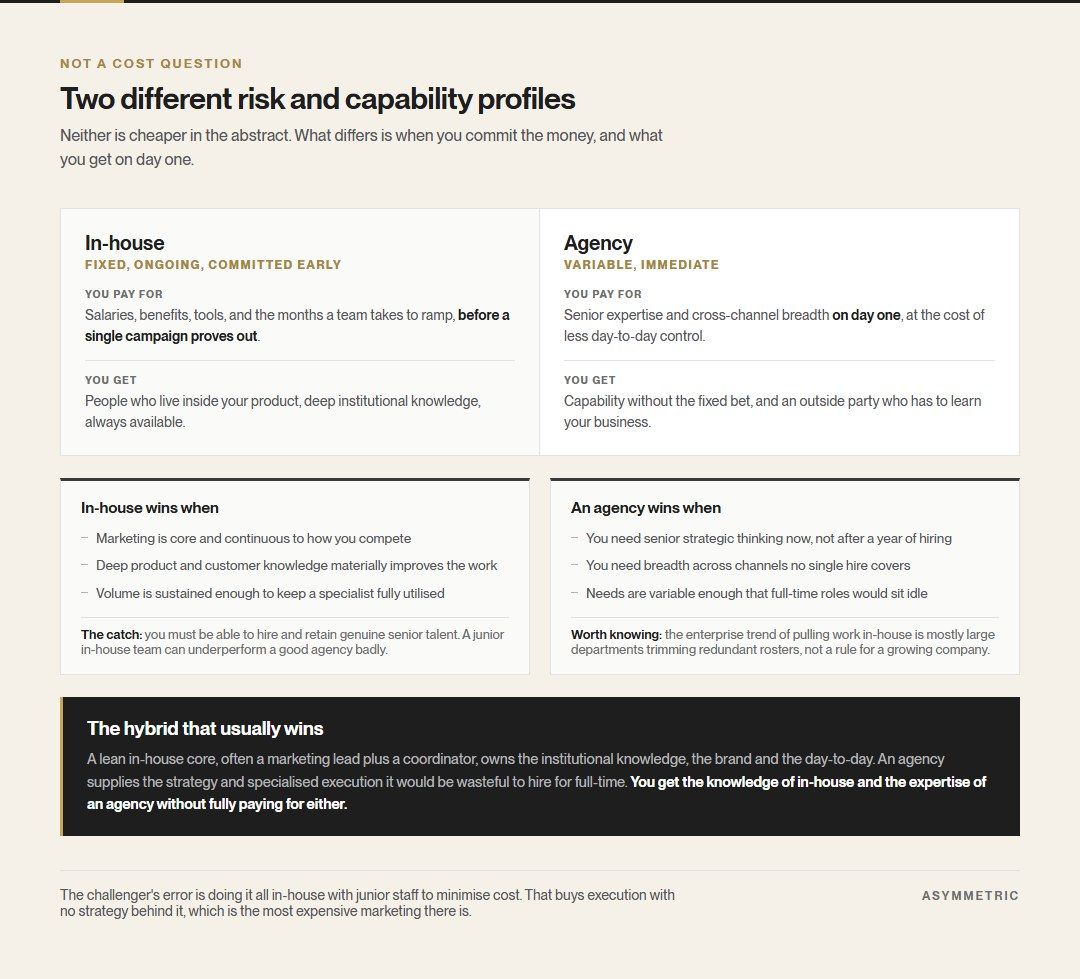
Hiring in-house means a fixed, ongoing investment, salaries, benefits, tools, and the months it takes a team to ramp, committed before a single campaign proves out. In return you get people who live inside your product, build deep institutional knowledge, and are always available. Hiring an agency converts that fixed cost into a variable one and brings senior expertise and cross-channel breadth on day one, at the cost of less day-to-day control and an outside party learning your business. Neither is cheaper in the abstract; they're different risk and capability profiles.
When in-house wins
Build in-house when marketing is a core, continuous function central to how you compete, when deep product and customer knowledge materially improves the work, and when you have enough sustained volume to keep a specialist fully utilized. A mature company with steady demand and a clear strategy often gets more from owning the capability than renting it. The catch is that you must be able to hire and retain genuine senior talent, which is expensive and hard, and a junior in-house team can underperform a good agency badly.
When an agency wins
Hire an agency when you need senior strategic thinking immediately rather than after a year of hiring, when you need breadth across channels no single hire covers, or when your needs are variable enough that full-time roles would sit idle. For a mid-market or growing company, standing up a senior team from scratch is a substantial fixed bet placed before results exist to justify it; an agency makes that capability variable and immediate. The trend of enterprises pulling work in-house is real but mostly a story about large departments trimming redundant rosters, not a rule for a growing company.
The hybrid that usually wins
For most companies the answer isn't either-or. A lean in-house core, often a marketing lead plus a coordinator, owns the institutional knowledge, the brand, and the day-to-day, while an agency supplies the strategy and the specialized execution that would be wasteful to hire for full-time. The in-house team keeps the agency close to the business; the agency brings the senior thinking and breadth. Done well, you get the knowledge of in-house and the expertise of an agency without fully paying for either alone.
What the hybrid looks like in practice
The hybrid is easy to recommend and easy to get wrong, usually by leaving the boundary undefined and discovering it during the first disagreement. A version that works divides on decision rights rather than on task lists.
The in-house side owns the things that depend on knowing the business: the brand and how it sounds, the customer relationships, the commercial context an outsider can't absorb quickly, and the final say on what gets committed to. It also owns the calendar, because the person who has to live with the schedule should set it.
The agency side owns the things that depend on seeing many businesses: where you can compete and win, what the competitive picture actually looks like, and specialised execution that would be wasteful to hire for full-time. It should also own the uncomfortable opinion, since an internal hire has career reasons to soften one.
The friction point is almost always approvals. If every piece of work routes through one internal person who also has a day job, the arrangement stalls regardless of how good either side is. Agreeing in advance what the agency can ship without review is the single change that most often rescues a hybrid.
A lean core is usually one marketing lead plus a coordinator. Below that, nobody has time to direct an agency and you get an expensive vendor. Well above it and you're paying twice for the same capability.
The challenger's calculus
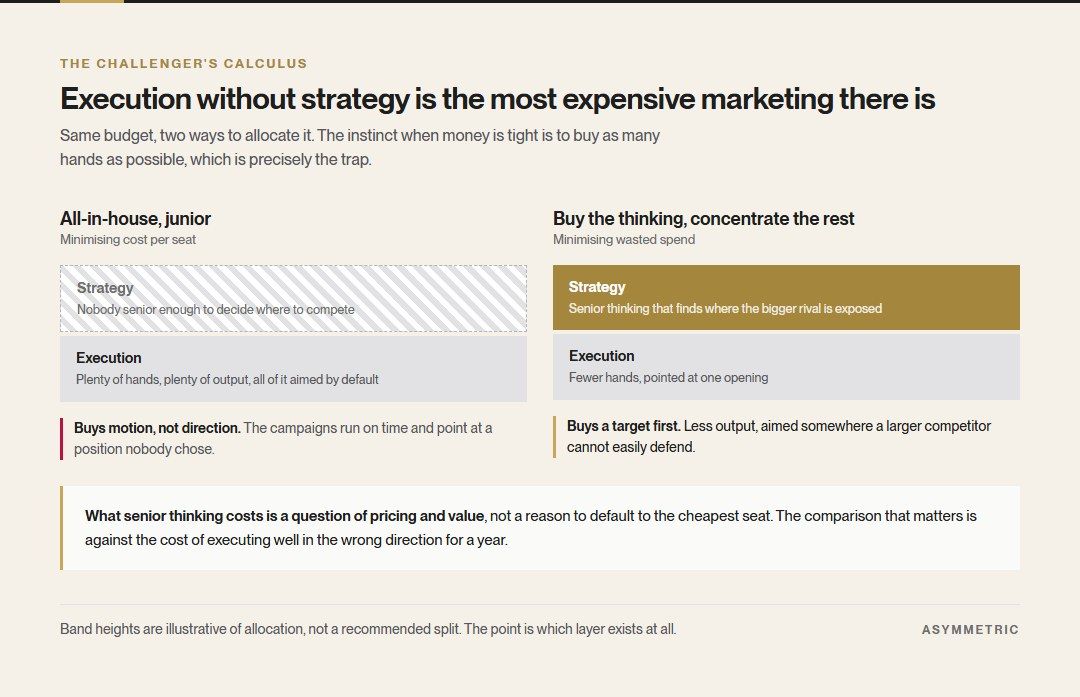
For a smaller company taking on a larger rival, the instinct is to minimize cost by doing it all in-house with junior staff. That usually buys execution with no strategy behind it, the most expensive marketing there is. The higher-leverage move is to buy the senior strategic thinking, often through an agency, that finds where a bigger competitor is exposed, then execute concentrated against it. What that costs is a question of agency pricing and value, not a reason to default to the cheapest seat.
The costs that don't appear in the comparison
Comparing a salary against a retainer misses several real costs, and they mostly sit on the in-house side because they're absorbed rather than invoiced.
Recruitment takes time and frequently fails first time. A senior marketing hire is months of searching, and a mis-hire costs the search again plus the quarter that was lost. That risk is real whatever the salary line says.
Ramp is the second. Even a strong hire takes months to understand the business well enough to make good decisions, and that period is paid at full rate for partial output.
Key-person risk is the third and the least discussed. One in-house marketer holding the entire strategy is a single point of failure, and when they leave the knowledge goes with them. An agency has the same problem in reverse, which is why the documentation question matters: whatever the arrangement, the record of what was tried and learned should end up somewhere you keep.
None of this makes in-house the wrong answer. It makes the comparison a total-cost question rather than a rate question, and the rate question is the one most companies run.
Challenges of Outsourcing
- Onboarding and alignment: Your agency team will need time to learn your business and voice. When working with an outsourced team, communication challenges can arise and require careful management. Coordinating with external teams matters to ensure smooth collaboration and alignment with your internal goals.
- Less control: You’re entrusting your brand to an external marketing agency, so choosing the right one is essential. Understanding the structure and relationships of these outsourced teams helps ensure quality and tailored marketing efforts.
- Serving multiple clients: Agencies juggle projects for various clients, including other clients in similar industries, which could impact the level of personalization and attention your business receives.
Still, when you’re scaling or need help with marketing processes like project management, email automation, or Google Ads, the benefits can far outweigh the downsides. However, it’s important to protect company data and ensure data security when collaborating with external agencies, and to ground every initiative in key questions for effective marketing campaigns so your outsourced efforts stay aligned with clear objectives.
Choosing Between the Two: Key Considerations

If you’re asking, “Should we build an in-house team or hire a full-service agency?” The answer depends on a few key factors. When making this decision, it’s key to consider the importance of a comprehensive digital marketing strategy, as this will guide your efforts and ensure all channels work together to achieve your business goals, including how you balance inbound marketing to attract customers with any outbound tactics.
In-house marketing offers greater control over messaging and brand voice, making aligning campaigns with your internal business strategy easier. However, execution may be slower than an agency, and scaling your team to include experts in every discipline can be time-consuming and expensive. In contrast, external marketing agencies can deploy campaigns quickly thanks to their existing infrastructure and team of specialists. Agencies also offer greater scalability and broader expertise across digital marketing channels, SEO, content creation, and web development. The marketing expertise agencies provide often includes specialized skills and industry knowledge that may be difficult to replicate internally. Some agencies focus on a single industry, which can provide deep expertise but may also lead to repetitive strategies and limit creative approaches compared to more generalized agencies. Additionally, agencies typically have a dedicated creative team that can quickly modify digital assets and respond to evolving marketing needs, ensuring agility in campaign execution.
Agencies often work with multiple clients simultaneously so you may have less influence over timelines and direction. Working with a client-focused agency that prioritizes individual client needs can help foster a sense of partnership and ensure your goals remain a top priority. While in-house teams are best when you need complete control and long-term brand stewardship, agencies shine when you need speed, specialized knowledge, or additional bandwidth for short-term or complex initiatives.
Many companies today opt for a hybrid model-keeping internal staff for day-to-day brand management while bringing in agency support for larger marketing efforts, niche campaigns, or specialized execution. Most companies choose agency marketing for cost savings and access to specialized skills, but it’s important to manage expectations regarding agency workload and resource availability. Both models can help increase brand awareness through content marketing and social media, reaching broader audiences and supporting your marketing objectives. Digital marketing is essential for promoting a business online, primarily through PPC advertising and social media platforms, which can drive high-value traffic and boost visibility, especially when guided by a structured digital marketing strategy for Madison businesses or a customer-centric system like the Asymmetric Marketing Engine.
Decide on capability, not just cost
If you're weighing building a team against hiring a partner, deciding it on capability, speed, and where your real advantage lies, rather than headline cost, is the conversation worth having.
Frequently asked questions
Is it better to hire a marketing agency or build an in-house team?
Neither is universally better. The real trade-off is fixed cost and control (in-house) versus variable cost and ready expertise (agency). In-house wins when marketing is core, ongoing, and benefits from deep product knowledge; an agency wins when you need senior expertise immediately, breadth across channels, or flexibility. For many companies a hybrid beats both.
Is an in-house team cheaper than an agency?
Not necessarily. A senior in-house team is a large fixed cost, salaries, benefits, tools, and months of ramp, committed before any results. An agency converts that into a variable cost with expertise on day one. A junior in-house team is cheaper but often underperforms a good agency, so cost alone is the wrong way to decide.
When should a company keep marketing in-house?
When marketing is a core, continuous function, when deep product and customer knowledge materially improves the work, and when you have enough sustained volume to fully utilize specialists, provided you can actually hire and retain senior talent. Mature companies with steady demand and a clear strategy often benefit most from owning the capability.
What is a hybrid marketing model?
A hybrid pairs a lean in-house core, often a marketing lead and a coordinator who own institutional knowledge, the brand, and day-to-day work, with an agency that supplies strategy and specialized execution that would be wasteful to hire full-time. It captures the knowledge of in-house and the expertise of an agency without fully paying for either alone.
Is it cheaper to hire a marketing agency or build an in-house team?
Neither is cheaper in the abstract, and comparing a salary against a retainer misses most of the real cost. In-house carries recruitment time, the risk of a mis-hire, months of ramp paid at full rate for partial output, and key-person risk when the one person holding the strategy leaves. An agency converts that fixed commitment into a variable one and brings senior expertise immediately, at the cost of less day-to-day control. The useful question is total cost of the capability rather than the rate.
How do you split work between an in-house team and an agency?
Divide on decision rights rather than task lists. In-house owns what depends on knowing the business: brand voice, customer relationships, commercial context, the calendar, and the final say on what gets committed. The agency owns what depends on seeing many businesses: where you can compete and win, the competitive picture, specialised execution, and the uncomfortable opinion an internal hire has career reasons to soften. The usual failure point is approvals, so agree in advance what the agency can ship without review.
How small is too small for an in-house marketing team?
A lean core is usually a marketing lead plus a coordinator. Below that nobody has the time to direct an agency properly, so you end up with an expensive vendor rather than a partner. Well above it and you're paying twice for the same capability. The constraint is rarely headcount in the abstract; it's whether someone internal has enough capacity to make decisions quickly, because an arrangement where every piece of work waits on one person with a day job stalls regardless of how good either side is.
What are the benefits of keeping marketing in-house?
An in-house team offers: Greater control over brand messaging and tone Faster internal communication and alignment Deep familiarity with your business goals and customers Easier integration with other departments, like sales or product An in house marketer can work closely with other departments to ensure alignment and effective communication. This dedicated staff member is immersed in your company culture, understands your core values, and brings comprehensive digital marketing expertise tailored to your specific needs.
Are marketing agencies cost-effective for small to mid-sized businesses?
Yes, especially when you factor in the cost of full-time salaries, training, tools, and benefits. Most agencies offer flexible pricing models and provide access to a large team of marketing specialists, which can be more cost-effective than hiring full-time staff for every skill set. This means you benefit from a broader range of expertise without the overhead of building a whole team.
What should my in-house marketing team include to be effective?
A strong in-house team typically includes: A Marketing Manager or Director Content Creators (writers, video, design) SEO and Paid Ads Specialists Social Media Managers Analysts or someone with data fluency Having an entire team with diverse digital marketing skills matters for comprehensive in-house marketing. Relying on a single individual limits the effectiveness and breadth of your marketing campaigns, as no one person can cover all areas of expertise needed for successful digital marketing.
About the author

Mark Hope
Founder, President & Chief Strategy Officer, Asymmetric Marketing
Mark Hope is the Founder, President & Chief Strategy Officer of Asymmetric Marketing. His career spans elite military service, senior leadership at two of the largest companies in their categories, and founding several companies of his own. It's the common thread behind how Asymmetric helps smaller companies out-compete bigger ones.
Mark began his career in U.S. Army Special Operations, serving from 1977 to 1988 in the 1st and 3rd Battalions of the 75th Ranger Regiment and as an Operator in 1st Special Forces Operational Detachment–Delta (Delta Force). What that world runs on (careful planning, reading your opponent, and winning from a position of disadvantage) is the foundation of how he helps smaller companies win today.