

May 12, 2026
How Marketing Agency Pricing Works: Models and Cost Drivers
What a marketing agency costs depends less on the number than on what it buys. The common pricing models, what really drives the cost, and how to tell whether a price is fair for what you get.
By Mark Hope, Founder, President & Chief Strategy Officer, Asymmetric Marketing

Ask what a marketing agency costs and you get a useless answer: anywhere from a few hundred dollars a month to six figures. The number is unhelpful because price is downstream of a more important question, what you're actually buying. A cheap retainer that buys junior execution of a strategy nobody set is more expensive than a higher fee that buys senior thinking which actually moves revenue. This guide covers how marketing agency pricing works, the common models, what really drives the cost, and how to tell whether a price is fair for what you get.
Key takeaways
- Marketing agency pricing comes in a handful of models: monthly retainer, per-project, hourly, performance-based, percentage of ad spend, and value-based.
- The headline number matters less than what it buys, senior strategy versus junior production.
- Cost is driven by scope, the seniority of the people doing the work, and whether you're paying for thinking or just execution.
- Cheap is expensive when it buys activity that serves no strategy; the waste is the wasted spend, not the fee.
- Judge a price by whether the agency ties its work to leads and revenue and puts experienced people on it, not by the rate alone.
The common marketing agency pricing models
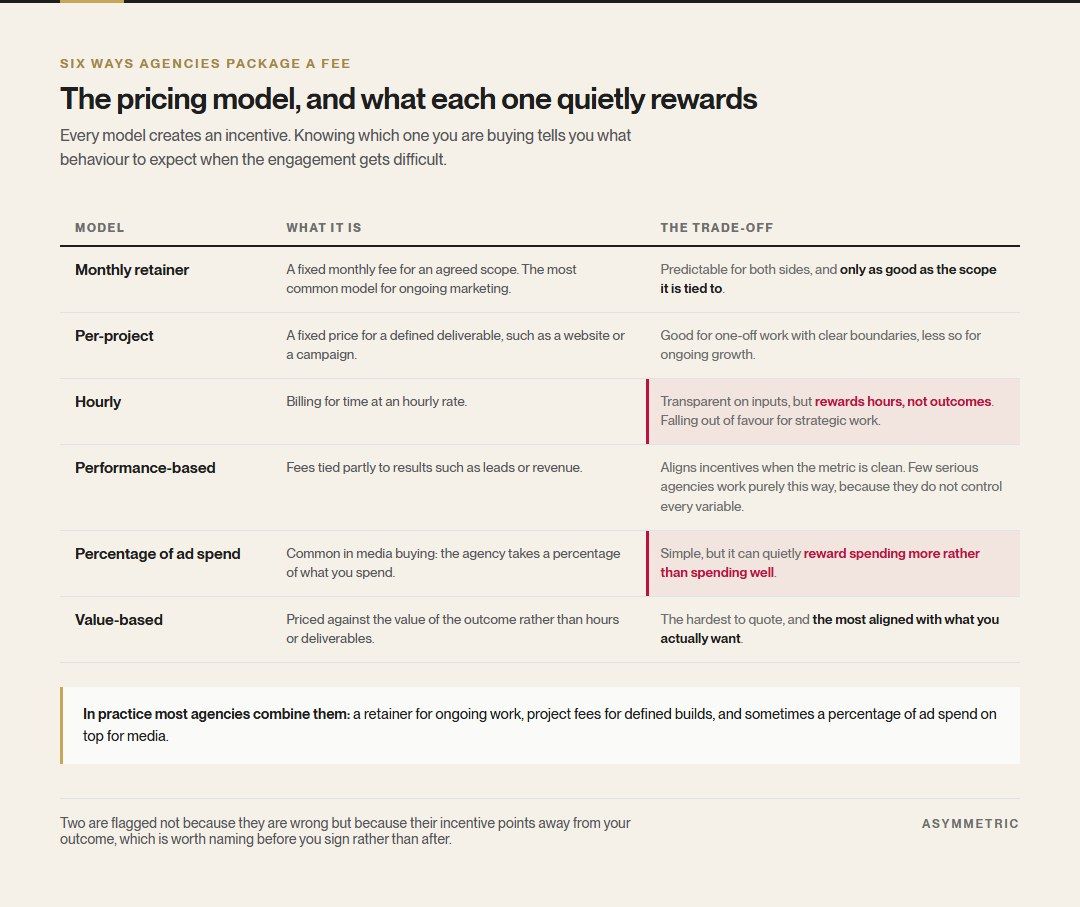
Agencies package their fees in a few standard ways, each with trade-offs:
- Monthly retainer: a fixed monthly fee for an agreed scope of work. The most common model for ongoing marketing; predictable for both sides, but only as good as the scope it's tied to.
- Per-project: a fixed price for a defined deliverable, like a website or a campaign. Good for one-off work with clear boundaries, less so for ongoing growth.
- Hourly: billing for time at an hourly rate. Transparent on inputs but it rewards hours, not outcomes, so it's falling out of favor for strategic work.
- Performance-based: fees tied partly to results, such as leads or revenue. Aligns incentives when the metric is clean, but few serious agencies work purely this way because they don't control every variable.
- Percentage of ad spend: common in media buying, the agency takes a percentage of what you spend on ads. Simple, but it can quietly reward spending more rather than spending well.
- Value-based: pricing tied to the value of the outcome rather than the hours or deliverables. The hardest to quote and the most aligned with what you actually want.
Most agencies use a retainer for ongoing work and project fees for defined builds, sometimes with a percentage of ad spend on top for media.
What actually drives the cost
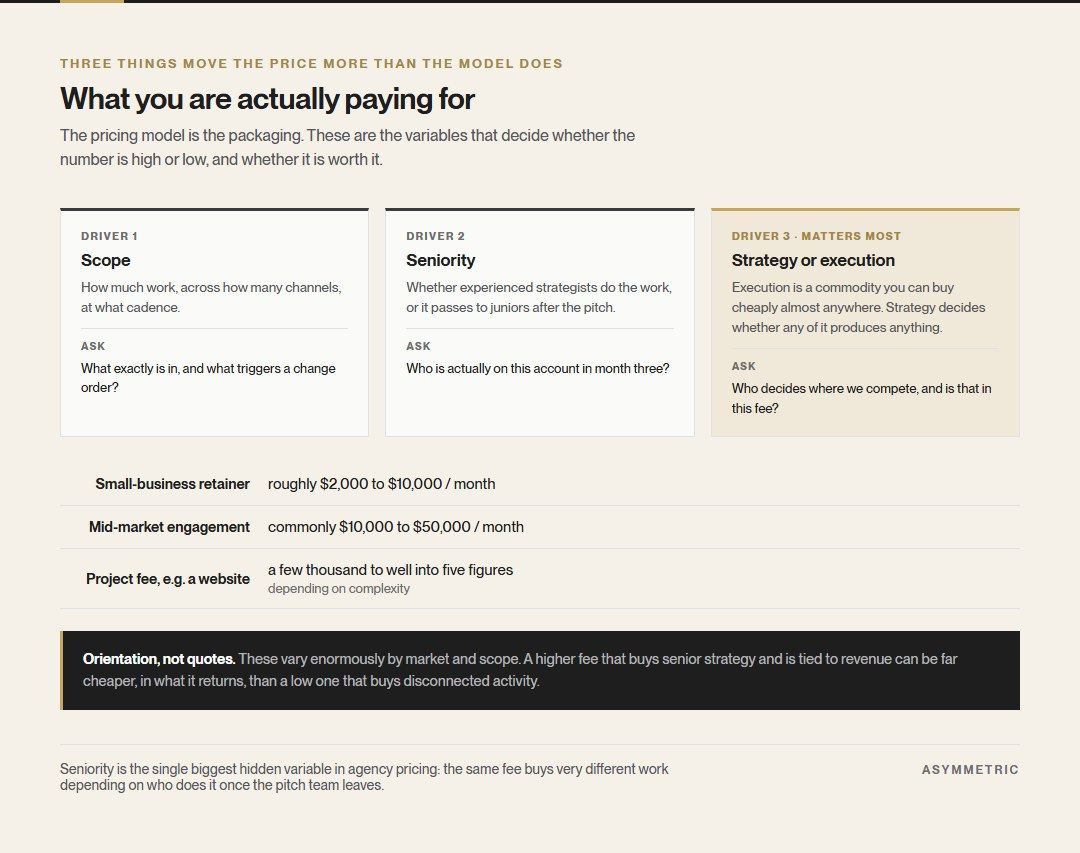
Three things move the price far more than the model does. The first is scope: how much work, across how many channels, at what cadence. The second is seniority: whether experienced strategists do the work or it passes to juniors after the pitch, which is the single biggest hidden variable in agency pricing. The third, and the one that matters most, is whether you're paying for strategy or just execution. Execution is a commodity you can buy cheaply almost anywhere. Strategy, the decision about where to compete and how to win, is what determines whether all that execution produces anything. Pay only for execution and you get activity. Pay for strategy and the execution finally has a target.
Typical ranges (with a caveat)
Honest numbers, with the caveat that they vary enormously by market and scope. Small-business retainers often run from roughly $2,000 to $10,000 a month; mid-market engagements commonly land between $10,000 and $50,000 a month; project fees for something like a website range from a few thousand to well into five figures depending on complexity. Treat these as orientation, not quotes. A higher fee that buys senior strategy and is tied to revenue can be far cheaper, in what it returns, than a low one that buys disconnected activity.
How to tell whether a price is fair
The same discipline that applies to choosing any marketing agency applies to judging its price. Ask what the fee actually buys: senior people or juniors, strategy or just deliverables. Ask whether the agency ties its work to outcomes like leads and revenue, or to outputs like impressions and post counts. Be wary of a price so low it can only fund junior execution, and of a percentage-of-spend model that rewards bigger budgets rather than better ones. A fair price is one where what you pay maps to thinking that moves the business, not hours logged or assets produced.
The challenger's view: pay for the thinking
For a smaller company competing against a larger rival, the temptation is to minimize the fee. That's the wrong economy. The expensive line item was never the agency retainer; it's the budget wasted behind a weak strategy. The highest-return spend is on the thinking that finds where a bigger competitor is exposed and concentrates your limited resources there, the heart of asymmetric marketing. Buy that, and the execution is worth paying for. Skip it, and no rate is cheap enough to save the result.
Key Factors Influencing Marketing Agency Pricing

Understanding marketing agency costs involves several key factors. The scope of work provided by marketing agencies significantly influences the pricing. More comprehensive services typically lead to higher costs, encompassing a broader range of activities and strategies. A full-service digital marketing agency offering SEO to social media management will charge more than an agency specializing in a single service.
Agency expertise is another critical element that impacts pricing. Agencies with a proven track record of delivering results efficiently often command higher fees. Their established reputation and ability to achieve measurable outcomes offer clients a sense of security and assurance.
Additionally, industry specialization can also affect pricing. Agencies with niche knowledge and experience in specific industries may charge a premium for their specialized services. This specialization ensures that the agency can effectively tailor strategies to address unique business challenges.
Lastly, evaluating potential ROI matters when considering agency fees. Assessing the value received from the costs incurred helps clients determine whether the investment is worthwhile. Considering these factors helps businesses handle the complex digital marketing agency pricing and make informed decisions about their marketing spend.
Detailed Breakdown of Marketing Services Costs
Digital marketing services encompass various strategies to enhance a business’s online presence. These services typically include:
- SEO
- PPC advertising
- Social media marketing
- Content marketing
- Email marketing
Each service has its own set of costs, influenced by factors such as the scope of work, agency expertise, and industry specialization.
The average monthly digital marketing cost in 2024 ranges from $51 to $10,000, depending on the required complexity and breadth of services. Evaluating the return on investment (ROI) allows businesses to measure the value received against the digital marketing costs incurred.
In the following subsections, we’ll examine the specific costs associated with each type of service.
Tips for Comparing Marketing Agency Prices

When comparing marketing agency prices, consider the value offered, transparent reporting, clear goals, and a proven track record. Evaluating the value provided, expertise, track record, results achieved, included services, and alignment with business goals can help you make an informed decision.
Assess each agency’s specific services and deliverables to ensure all your marketing needs are met. This includes understanding the scope of services and how they align with your marketing objectives. Always align the agency’s goals with your business objectives to ensure the best value for your investment.
Considering these factors helps businesses compare marketing agency prices effectively and choose the agency that offers the best value for their budget.
How to Measure and Communicate Results
Measuring and communicating marketing campaign results matters for demonstrating the value of your investment. Transparency in reporting, including acknowledging both successes and challenges, fosters trust and collaboration with clients. Effective communication involves creating clear, concise reports that clients can easily understand.
Data visualization techniques like graphs and charts help clients quickly grasp key performance indicators. Organizing reports into sections based on different channels or campaigns aids client clarity and navigation. Including images of ads or social media posts in reports enhances client understanding of campaign performances.
Reports should focus on metrics aligning with the client’s objectives to avoid overwhelming them with unnecessary data. Comments and notes within reports provide valuable context and insights into the data for clients. Regularly sending reports, such as monthly, strengthens the client-agency relationship and demonstrates commitment.
Pay for what actually moves the business
If you're weighing agency fees and want to know whether a price buys strategy or just activity, that's the conversation worth having before you sign anything.
Frequently asked questions
How much does a marketing agency cost?
It ranges widely: small-business retainers often run roughly $2,000 to $10,000 a month, mid-market engagements $10,000 to $50,000 a month, and project fees from a few thousand into five figures. But the number matters less than what it buys, senior strategy or junior execution. A higher fee tied to revenue can be cheaper in return than a low one that funds disconnected activity.
What are the marketing agency pricing models?
The common ones are monthly retainer (fixed fee for ongoing scope), per-project (fixed price for a defined deliverable), hourly, performance-based (fees tied to results), percentage of ad spend (common in media buying), and value-based (priced to the outcome). Most agencies use a retainer for ongoing work plus project fees for defined builds.
What drives the cost of a marketing agency?
Three things, more than the pricing model: scope (how much work across how many channels), seniority (whether experienced strategists or juniors do the work), and whether you're paying for strategy or just execution. Execution is a commodity; strategy is what makes the execution produce results, and it's what justifies a higher fee.
Is a cheaper marketing agency a better deal?
Usually not. A price so low it can only fund junior execution of a strategy nobody set is more expensive than a higher fee that buys senior thinking which moves revenue. The costly line item is rarely the retainer, it's the budget wasted behind a weak strategy. Judge the price by what it buys, not the rate.
What is a percentage-of-ad-spend pricing model?
Common in media buying, the agency charges a percentage of what you spend on ads. It's simple and scales with the work, but it can quietly reward spending more rather than spending well, so it's worth pairing with outcome metrics like cost per acquisition to keep incentives aligned.
What should I budget for digital marketing services?
Digital marketing budgets vary greatly depending on your goals, industry, and the services you need. Small businesses typically allocate 7-10% of their revenue to marketing, while larger companies may dedicate even more. For specific digital marketing services like SEO, PPC, or content marketing, it’s essential to have a clear strategy in place to ensure your budget is optimized for ROI.
About the author

Mark Hope
Founder, President & Chief Strategy Officer, Asymmetric Marketing
Mark Hope is the Founder, President & Chief Strategy Officer of Asymmetric Marketing. His career spans elite military service, senior leadership at two of the largest companies in their categories, and founding several companies of his own. It's the common thread behind how Asymmetric helps smaller companies out-compete bigger ones.
Mark began his career in U.S. Army Special Operations, serving from 1977 to 1988 in the 1st and 3rd Battalions of the 75th Ranger Regiment and as an Operator in 1st Special Forces Operational Detachment–Delta (Delta Force). What that world runs on (careful planning, reading your opponent, and winning from a position of disadvantage) is the foundation of how he helps smaller companies win today.