

October 18, 2024
Best Practices for Crafting an Effective Pillar Page
A pillar page anchors a topic cluster and ranks for competitive head terms, if you build it right. Here are the best practices: comprehensive scope, navigable structure, two-way cluster linking, and the right keyword.
By Mark Hope, Founder, President & Chief Strategy Officer, Asymmetric Marketing

A pillar page is the anchor of a topic cluster: a single, comprehensive page that covers a broad subject in depth and ties together the more specific articles around it. Done well, it ranks for competitive head terms, earns topical authority, and gives readers one authoritative place to understand a subject. Done poorly, it's just a long page that buries the reader and signals nothing to search engines. The difference comes down to a handful of best practices.
Key takeaways
- A pillar page is a single comprehensive page on a broad topic that links to, and is linked from, a cluster of supporting articles.
- Cover the full topic without padding: long because the subject requires it, not to hit a word count.
- Structure for navigation, clear headings and, on longer pillars, a table of contents.
- Link the cluster in both directions; that internal linking is what signals topical authority.
- Target one broad head term for the pillar and narrower long-tail terms for the cluster pages.
What a pillar page is
A pillar page is the centerpiece of the pillar-and-cluster model, an approach to content structure popularized by HubSpot, in which one broad, authoritative page anchors a set of narrower articles that each go deep on a subtopic. The pillar covers the whole subject and links out to the cluster; each cluster page covers one piece and links back up. Together they tell a search engine that the pages form a coherent topic and that the pillar is the authority on it. (For the underlying strategy and how the pieces fit, see our guide to pillar content.)
Cover the topic comprehensively, without padding
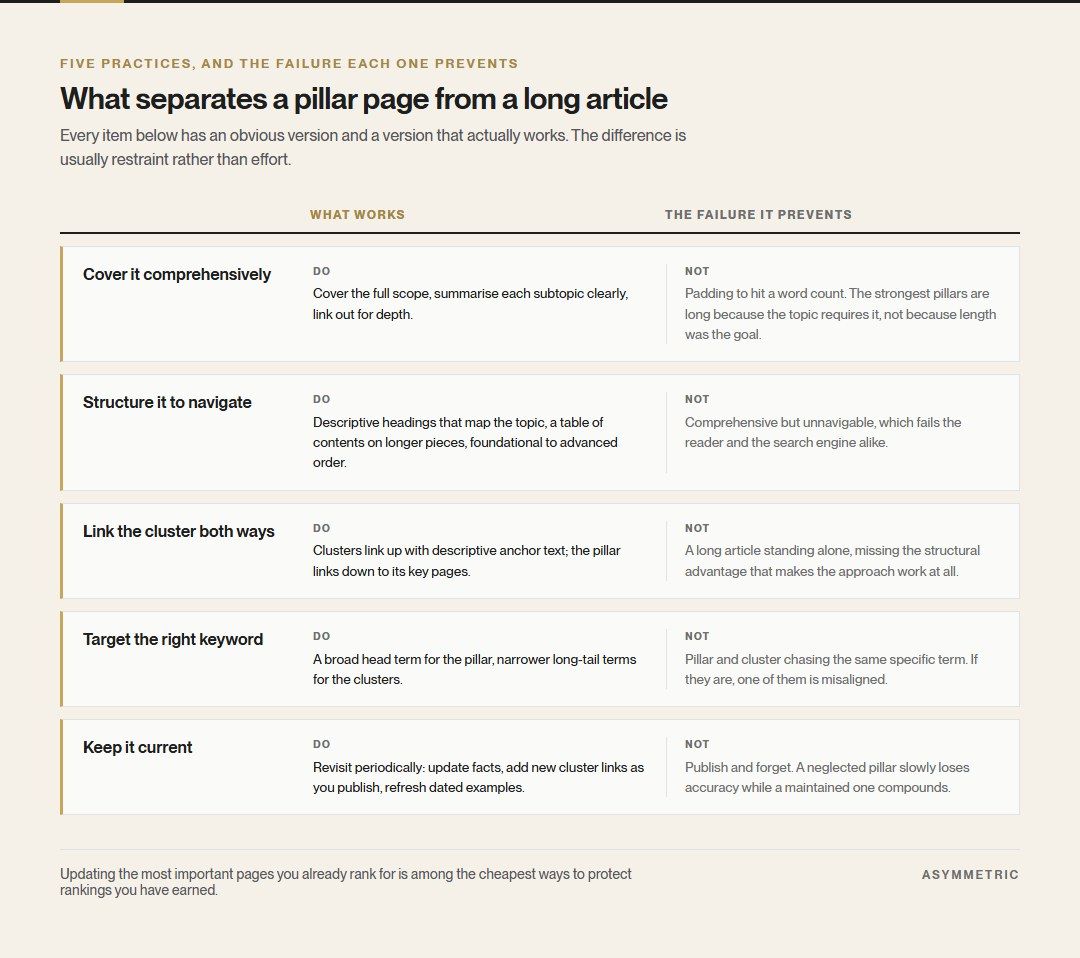
A pillar page should address a broad topic thoroughly enough that a reader leaves understanding the whole subject, while linking out to cluster pages for the depth on each subtopic. The balance matters: comprehensive doesn't mean endless. Cover the full scope of the topic, summarize each subtopic clearly, and resist the urge to pad with filler to hit a word count. The strongest pillars are long because the topic genuinely requires it, not because length was the goal.
Structure it so readers can handle
Because a pillar page is long, structure is what keeps it usable. Use clear, descriptive headings that map the topic, so a reader can scan the page and jump to what they need. A table of contents at the top helps on longer pillars. Short paragraphs, meaningful subheads, and a logical order from foundational to advanced all make a dense page feel manageable. A pillar that's comprehensive but unnavigable fails the reader and the search engine alike.
Link the cluster in both directions
The defining feature of a pillar page is its connection to a cluster of supporting articles. Every cluster page should link up to the pillar with descriptive anchor text, and the pillar should link down to its key cluster pages. This internal linking is what tells a search engine the pages form a coherent topic and that the pillar is the authority on it. Without that linking, a pillar page is just a long article standing alone, missing the structural advantage that makes the whole approach work.
Target the right keyword
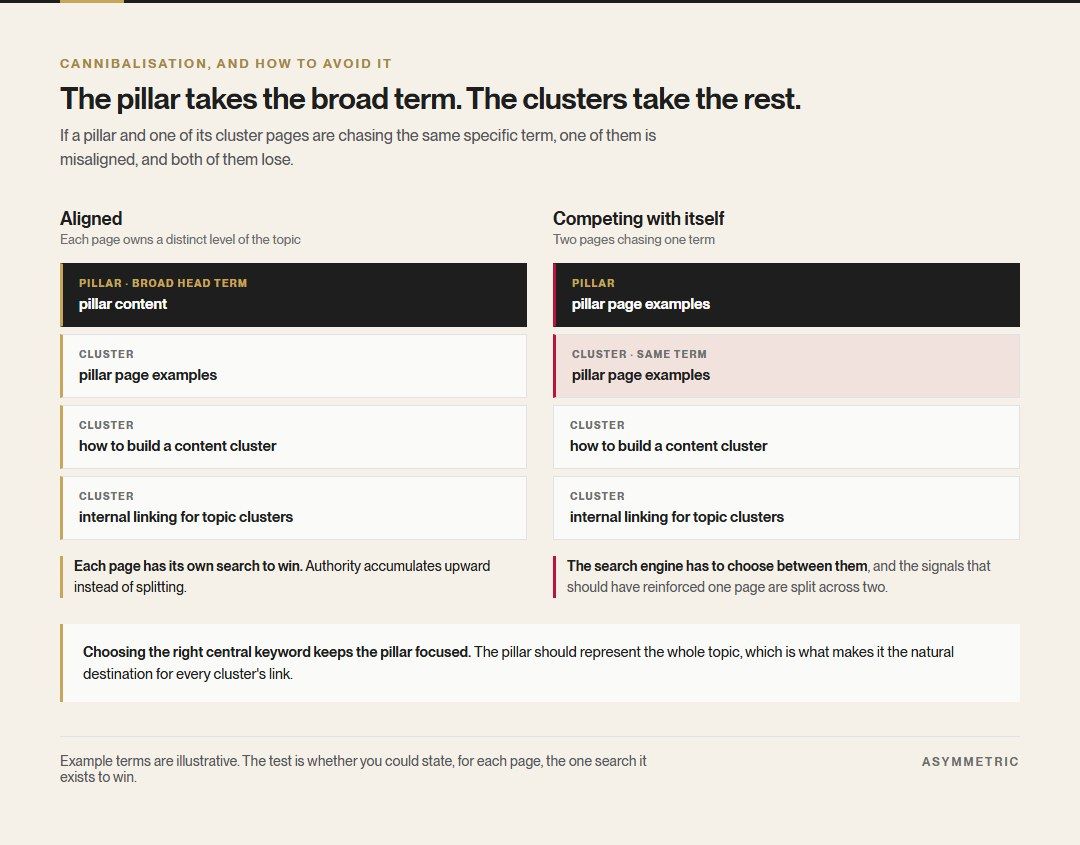
A pillar page should target a broad, high-value head term that represents the whole topic, while its cluster pages target the narrower, long-tail terms around it. Choosing the right central keyword keeps the pillar focused and prevents it from competing with its own cluster pages. If the pillar and a cluster page are both chasing the same specific term, one of them is misaligned.
Keep it current
How long should a pillar page be?
The honest answer is that length is an output rather than a target, and treating it as a target is how pillar pages get padded into something nobody finishes reading.
The test is coverage. A pillar page should address every subtopic a reader needs to understand the whole topic, at enough depth that they leave with the shape of it, then link out for the detail. If you can name a question a reasonable reader would still have and your page doesn't touch it, the page is short. If you're restating a point you already made in different words, it's long.
In practice most pillar pages land somewhere between 1,500 and 3,000 words, not because that range is optimal but because that's what covering a broad topic properly tends to require. Pages far above it are usually trying to be the cluster as well as the pillar, which defeats the structure: the depth belongs on the cluster pages where it can rank for its own terms.
The failure worth avoiding is writing to a word count somebody quoted. Search engines don't reward length; they reward covering what the searcher needed. A comprehensive 1,800-word pillar beats a padded 4,000-word one, and the padded version is also worse to maintain.
How to update a pillar page without breaking it
Keeping a pillar current is easy to agree with and rarely scheduled, so it slips until the page is quietly wrong. A light quarterly pass is usually enough.
Check the facts that carry dates or figures first, because those are what age visibly and what a reader will spot. Then check the links: cluster pages you've published since should be linked from the pillar, and any that were retired should be cleaned up rather than left pointing nowhere.
Add new subtopics to the pillar as you publish them, but resist rewriting the structure each time. A pillar page accumulates authority partly through stability, and reorganising the headings every quarter throws away the signal you built. Add sections; don't reshuffle them without reason.
One thing worth doing deliberately: when you materially revise a pillar, say so and date it. Readers reasonably want to know whether a guide reflects the current state of a fast-moving topic, and a page that quietly changes gives them no way to tell.
A pillar page is a long-term asset, and a topic evolves. Revisit it periodically to update facts, add new subtopics and cluster links as you publish them, and refresh examples that have dated. A well-maintained pillar compounds in value over time, while a neglected one slowly loses accuracy and relevance. Updating the content and freshness signals of your most important pages is among the cheapest ways to protect rankings you've already earned.
Build pillars that anchor your content
A strong pillar page is the centerpiece of content that ranks as a system rather than a pile of posts. If you want to structure your content into pillars and clusters that build real topical authority, that's the work we do.
Frequently asked questions
What is a pillar page?
A pillar page is a single, comprehensive page that covers a broad topic in depth and anchors a cluster of more specific supporting articles. It links out to those cluster pages and they link back up, which signals to search engines that the pages form a coherent topic and that the pillar is the authority on it.
What are the best practices for a pillar page?
Cover the topic comprehensively without padding, structure it with clear headings (and a table of contents on long pillars), link the cluster in both directions with descriptive anchor text, target one broad head term, and keep it updated as the topic evolves and new cluster pages publish.
How long should a pillar page be?
As long as the topic genuinely requires and no longer. Pillar pages are typically long because they cover a broad subject comprehensively, but length is a byproduct of thorough coverage, not a target. Padding to hit a word count buries the reader and weakens the page.
What is the difference between a pillar page and a cluster page?
A pillar page covers a broad topic comprehensively and targets a head term; a cluster page goes deep on one subtopic and targets a narrower long-tail term. The pillar links down to its cluster pages and each cluster page links back up to the pillar, forming the topic cluster.
What is the difference between a pillar page and a landing page?
A pillar page exists to cover a topic thoroughly and rank across a cluster of related searches. A landing page exists to convert traffic you've already paid for or sent there. Pillar pages are long, heavily internally linked, and updated over time. Landing pages are short, focused on one action, and often don't need to rank at all.
Are pillar pages still relevant?
Yes, and more so as search shifts toward AI answers. A pillar page that genuinely covers a topic gives an answer engine one source to draw from instead of a dozen thin posts. What's changed is that padding no longer works. Length only helps when it adds something a reader can use.
About the author

Mark Hope
Founder, President & Chief Strategy Officer, Asymmetric Marketing
Mark Hope is the Founder, President & Chief Strategy Officer of Asymmetric Marketing. His career spans elite military service, senior leadership at two of the largest companies in their categories, and founding several companies of his own. It's the common thread behind how Asymmetric helps smaller companies out-compete bigger ones.
Mark began his career in U.S. Army Special Operations, serving from 1977 to 1988 in the 1st and 3rd Battalions of the 75th Ranger Regiment and as an Operator in 1st Special Forces Operational Detachment–Delta (Delta Force). What that world runs on (careful planning, reading your opponent, and winning from a position of disadvantage) is the foundation of how he helps smaller companies win today.