


Pillar content is the foundation of a content strategy that search engines and readers both reward. A pillar is a comprehensive page covering a broad topic in depth, surrounded by a cluster of related, more specific pages that each link back to it. Together the pillar and its cluster signal that you cover a subject thoroughly, which is increasingly how rankings and AI answers are won. The web has moved away from rewarding one thin post per keyword and toward rewarding genuine depth across a topic. This very site is built that way, with pillar pages on competitive strategy and clusters of supporting articles around each one.
Key takeaways
- Pillar content is a structure where one comprehensive pillar page anchors a cluster of supporting articles, all interlinked.
- It builds topical authority: the linking tells search engines the pages form a coherent topic and that the pillar is the authority on it.
- The three parts are the pillar page (broad), the cluster pages (narrow subtopics), and the internal links that connect them.
- Build it in sequence: choose a broad topic, map the subtopics, write the pillar and clusters, then link them in both directions.
- The internal links are the most-neglected and most-important part; without them it's just a pile of posts.
The idea is simple, but doing it well takes a plan. Here's what pillar content is, why it matters more than ever, and how to build it step by step.
What pillar content is
A pillar content structure has three parts. The pillar page is a long, authoritative page that covers a broad topic comprehensively, the kind of page someone could read to understand the subject as a whole. The cluster content is the set of narrower pages, each going deep on a specific subtopic the pillar only summarizes. And the internal links are the connective tissue: every cluster page links up to the pillar, and the pillar links down to its cluster. That linking isn't decoration. It's what tells a search engine the pages belong together and that the pillar is the authority on the topic. Some people call the central page cornerstone content, which is the same idea under a different name.
Why pillar content matters
Search has moved away from rewarding a separate thin page for every keyword and toward rewarding topical authority, a demonstrated depth across a whole subject. A single comprehensive pillar supported by a cluster of focused articles signals that depth far better than a scattering of unconnected posts. The structure also helps the answer engines that increasingly sit between a search and a click. AI systems that summarize and cite sources favor content that covers a topic clearly and completely, and a well-built pillar is exactly that. There's a practical SEO benefit too: internal links from cluster pages concentrate authority on the pillar, helping it rank for competitive head terms, while the cluster pages capture the long-tail searches around them. Done well, the structure ranks better than the sum of its parts.
Pillar pages, clusters, and cornerstone content
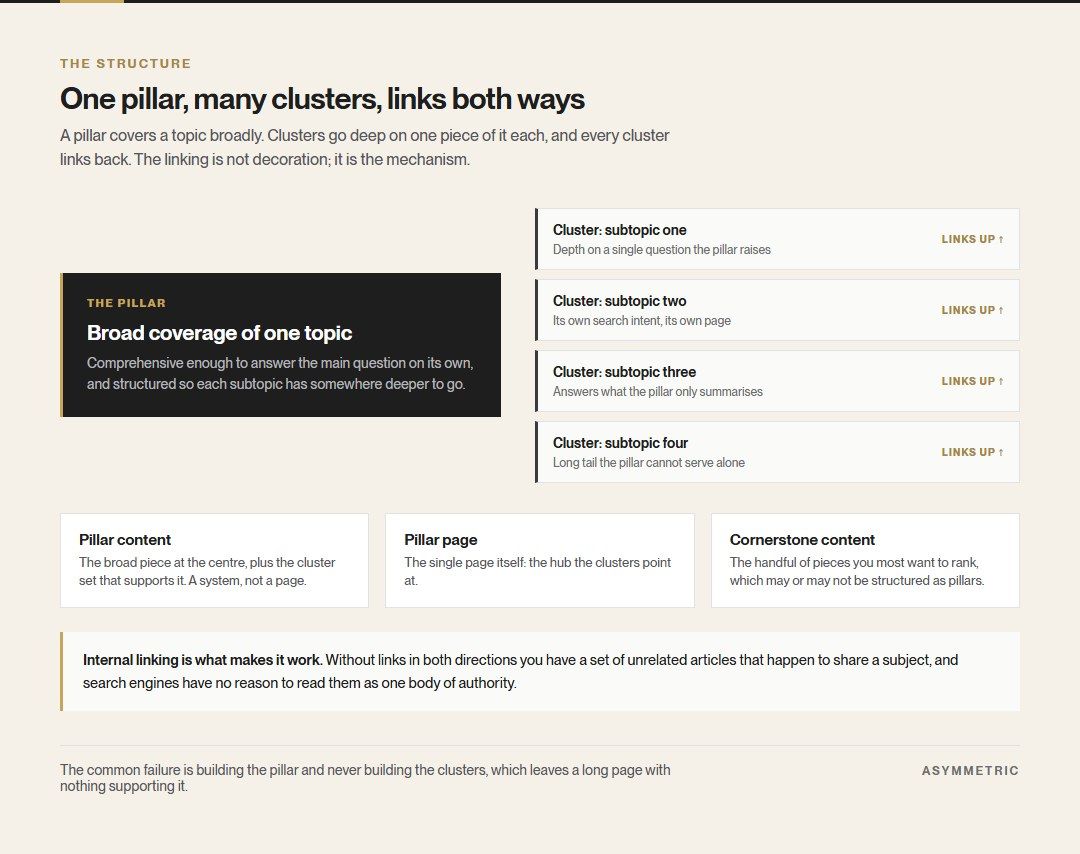
The vocabulary can be confusing, so it helps to separate the terms. A pillar page is the broad, central page. Cluster content, sometimes called supporting content, is the collection of specific pages around it. Cornerstone content is another name for your most important pillar pages, the ones you most want to rank. Separately, social media content pillars are a different concept entirely: the few recurring themes a brand posts about on its social channels. The two ideas share a word but solve different problems, and it's worth being clear which one you mean before you plan.
How to build a pillar, step by step
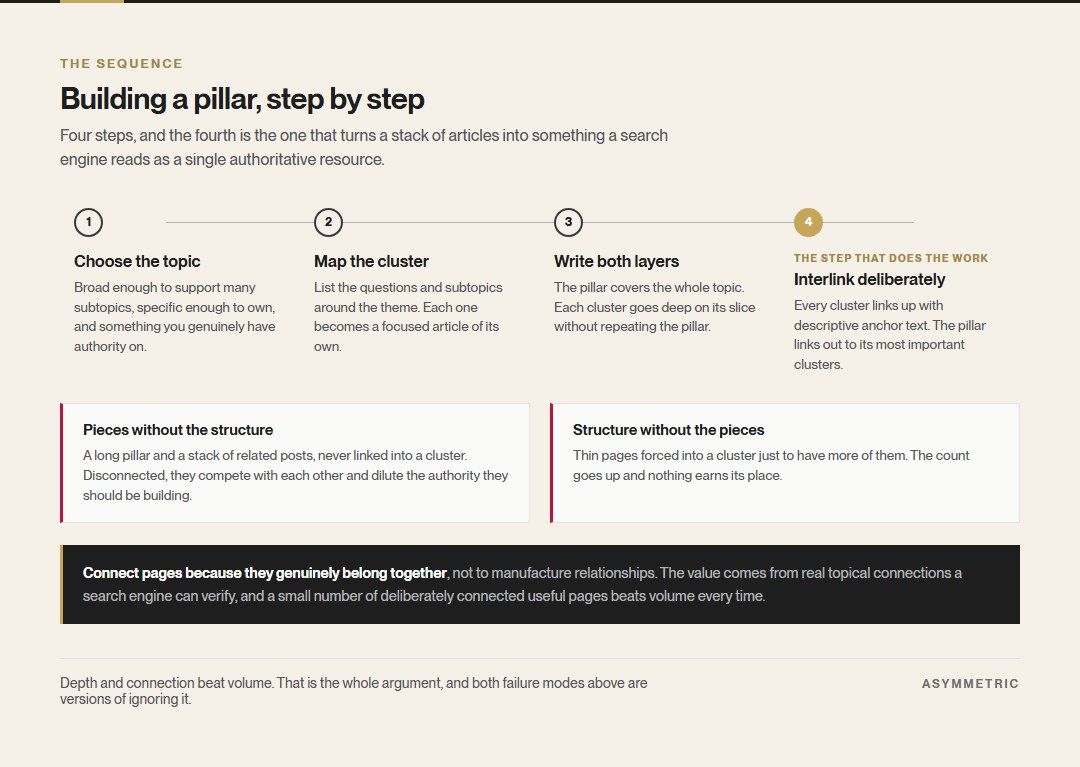
Building pillar content follows a clear sequence. First, choose a broad topic you genuinely have authority on and that matters to your customers, wide enough to support many subtopics but specific enough to own. Second, map the cluster by listing the specific questions and subtopics around that theme, each of which becomes a focused article. Third, write the pillar page as a comprehensive overview of the whole topic, and write each cluster page to go deep on its slice without repeating the pillar. Fourth, interlink deliberately: every cluster page links to the pillar with descriptive anchor text, and the pillar links out to the key cluster pages. The result is a structured body of content that search engines read as a single authoritative resource rather than a pile of separate posts.
Internal linking is what makes it work
The internal links are the part most often neglected and the part that does the most. Without them, a pillar page and its cluster are just unconnected articles that happen to share a topic. With them, they become a recognized cluster, and the authority each page earns flows to the others. Use descriptive anchor text that signals the linked page's subject, link every supporting page to its pillar, and link the pillar to its most important supporting pages. Keep the structure honest: connect pages because they genuinely belong together, not to manufacture relationships, since the value comes from real topical connections a search engine can verify.
A common mistake to avoid
The frequent failure is producing the pieces without the structure: writing a long pillar and a stack of related posts, then never linking them into a coherent cluster. Disconnected, they compete with each other and dilute your authority instead of building it. The opposite mistake is forcing thin pages into a cluster just to have more of them. Both miss the point. A strong pillar structure is a small number of genuinely useful pages, deliberately connected, each earning its place. Depth and connection beat volume.