

May 26, 2026
The Purchase Path: The Marketing Funnel That Actually Works
The purchase path is the real journey a customer takes from first awareness to purchase and loyalty. Its stages, the common funnel mistakes that quietly leak customers, and how to find and fix the leak that costs you most.
By Mark Hope, Founder, President & Chief Strategy Officer, Asymmetric Marketing

Every customer travels a path from never having heard of you to buying, and ideally to buying again. The purchase path, often drawn as a marketing funnel, is the map of that journey. Its value isn't the tidy diagram; it's diagnostic. A funnel shows you where customers fall out, and the single biggest leak is almost always where your marketing is quietly wasting money. Find that leak and you've found your highest-return fix.
Key takeaways
- The purchase path is the journey a customer takes from awareness to consideration to decision, and then to retention and advocacy.
- Drawn as a funnel, it's a diagnostic tool: it shows where prospects drop out so you can fix the stage that leaks most.
- The most common mistake is pouring budget into the top while the real loss is a mid- or bottom-funnel leak.
- Each stage needs a different job, content and reach up top, proof and comparison in the middle, a clear path to act at the bottom.
- Concentrate on the leak that costs the most, not on adding more traffic to a funnel that already leaks.
How to measure each stage without perfect data
The framework only earns its keep if you can see where people fall out, and most operators assume that requires analytics they don't have. It does not. Each stage has a rough proxy available to almost everyone.
Awareness is the easiest to approximate: branded search volume, direct traffic, and impressions for the terms you care about. If nobody is searching your name and impressions are flat, the top of the path is genuinely empty rather than leaking.
Consideration shows up as behaviour on your own site. Pages per session on the pages that matter, time on the comparison and pricing pages, and returning visitors. A prospect weighing options reads more than one page and usually comes back.
Decision is the clearest of the four, because it's the point where someone raises their hand: enquiries, demos booked, quotes requested. It's also the one most often measured as a single number when it should be measured as a rate against the stage before it.
Retention and advocacy are repeat purchase, renewal, and referrals. Referrals in particular are worth counting deliberately rather than noticing anecdotally, because they're the clearest evidence the last stage is working.
None of these are precise. They don't need to be. You're looking for the stage where the drop is disproportionate, and a rough number is enough to find it.
What each leak actually looks like
Top, middle, and bottom of the funnel
You'll see the stages written as ToFu, MoFu, and BoFu, which is shorthand for top, middle, and bottom of the funnel. The labels are worth knowing because most tools and agencies use them, and they map onto the same stages by different names.
Top of the funnel is where someone learns the problem exists, or that you do. They're not shopping yet. The job here is to be findable and to be clear about what you solve, which is why search and content do most of the work at this stage.
Middle of the funnel is comparison. The buyer knows what they want and is working out who to get it from. This is where case studies, pricing clarity, and anything that answers an objection earns its place. It's also the stage most businesses under-serve, because it's less visible than awareness and less satisfying than a closed sale.
Bottom of the funnel is the decision itself, and the work is removing friction. A form that asks for too much, a quote that takes four days, or an unanswered question will cost you buyers who had already chosen you.
Tactics that fit each stage
A tactic isn't good or bad on its own, it's suited to a stage or it isn't. Running a bottom-of-funnel offer at people who've never heard of you is the most common way to waste a budget, and it usually gets diagnosed as a creative problem.
At the top, the useful tactics reach people who aren't looking for you specifically: search content aimed at the problem rather than your product, social, PR, and anything that earns attention without asking for a decision. Measure reach and new visitors, not conversions.
In the middle, the tactics answer questions: comparison pages, case studies, demos, email sequences, and reviews. Measure whether people move, not whether they buy. The number that matters is how many people who saw a comparison page came back.
At the bottom, the tactics remove reasons to hesitate: clear pricing, a short form, fast response, a guarantee, retargeting for people who nearly finished. Measure close rate and time to respond.
For a smaller business competing against a larger one, the middle is usually where the opening is. Large competitors spend heavily on awareness and answer questions badly, so a business that answers them properly takes buyers who were already in the market.
Two funnels can lose the same total number of people and need opposite fixes, so it helps to know what each failure feels like from the inside.
An awareness leak looks like quiet. Few enquiries, but the ones that arrive close well. Nobody is rejecting you; they don't know you exist. The fix is reach and a position clear enough to remember, and the mistake is assuming the offer is wrong when it's never being seen.
A consideration leak looks like busy traffic and few enquiries. People arrive, read, and go elsewhere. This is a proof problem: they can't tell why you rather than the three alternatives open in other tabs. More traffic makes it worse, because it pours more people into the same comparison you're losing.
A decision leak is the most frustrating and the most fixable. Enquiries arrive, conversations happen, and nothing closes. Usually the friction is procedural rather than persuasive: a slow response, an unclear next step, a quote that takes a week. Speed of response alone fixes a surprising share of it.
A retention leak is invisible in the funnel entirely, which is why it runs the longest before anyone notices. Revenue looks acceptable because new customers replace departing ones, and the cost only becomes obvious when acquisition slows.
The stages of the purchase path
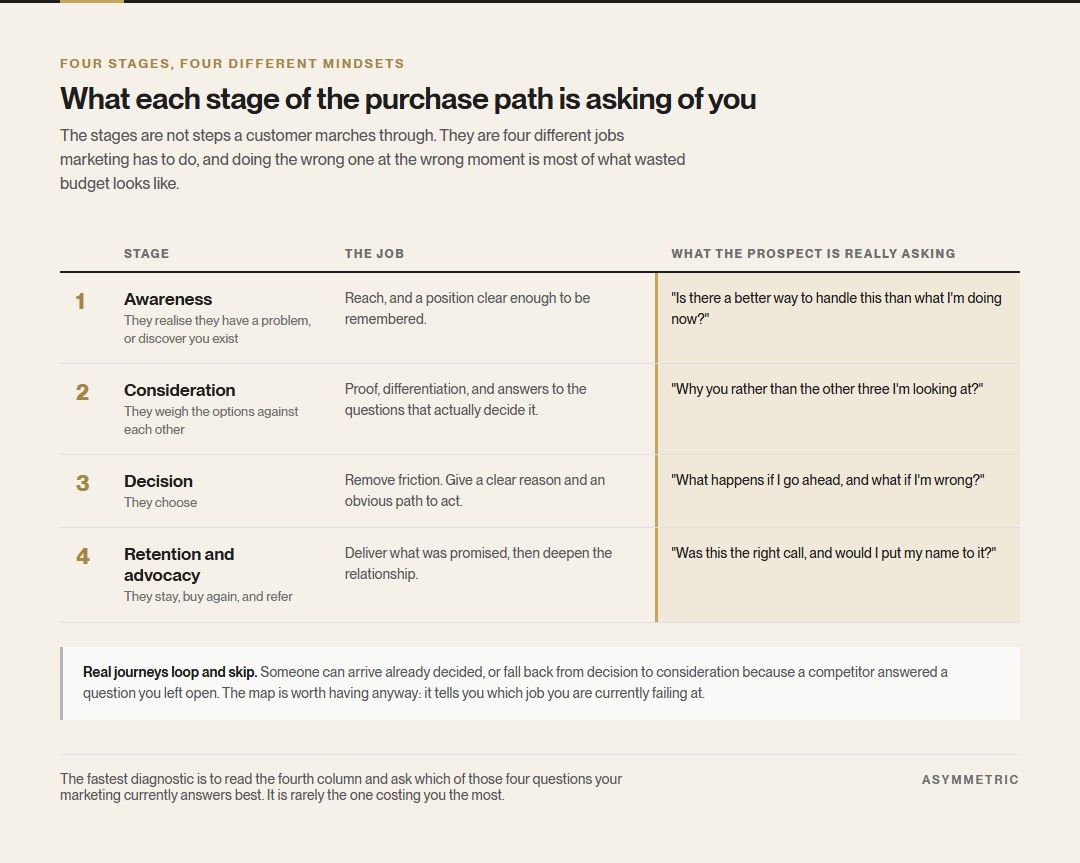
The path is usually broken into stages, each describing a different mindset:
- Awareness: the prospect realizes they have a problem or discovers you exist. The job here's reach and a clear position.
- Consideration: they weigh options and compare. The job is proof, differentiation, and answering the questions that decide a purchase.
- Decision: they choose. The job is removing friction and giving a clear, compelling reason and path to act.
- Retention and advocacy: after the purchase, they stay, buy again, and refer. The job is delivering on the promise and deepening the relationship.
The stages aren't rigid steps, real journeys loop and skip, but they're a useful map of the jobs marketing has to do.
The funnel's real value: finding the leak
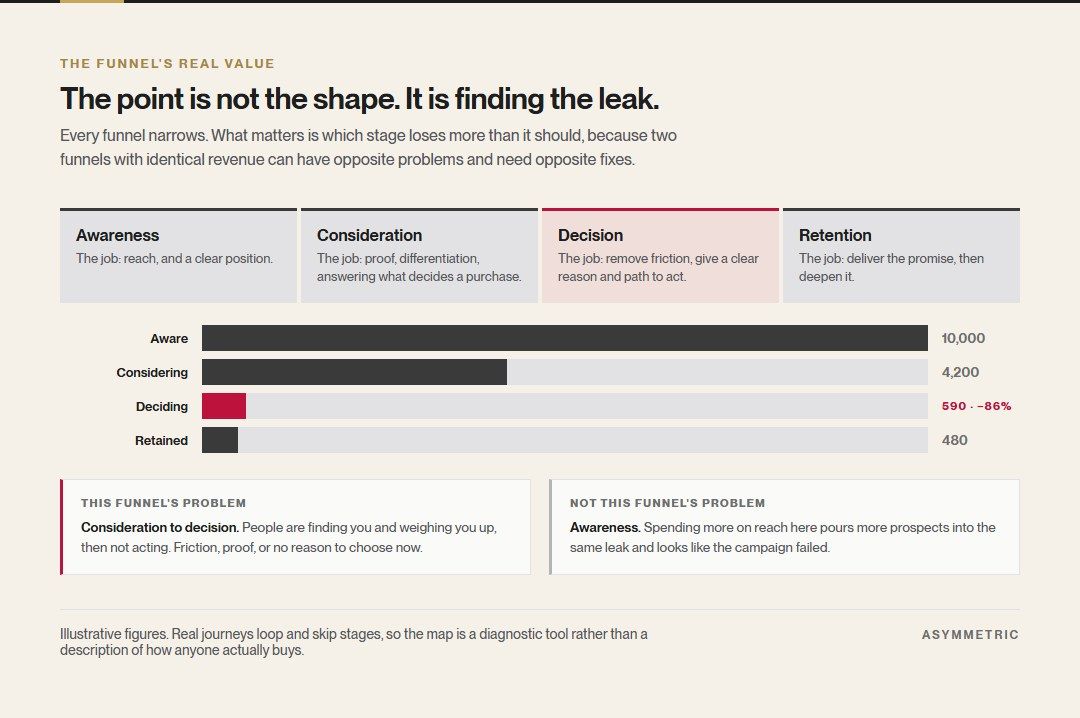
The point of the framework isn't to admire the shape; it's to measure where people fall out. A funnel that loses most prospects between consideration and decision has a very different problem from one that never builds awareness, and they demand opposite fixes. Measuring the drop-off at each stage turns a vague sense that marketing is underperforming into a specific, fixable diagnosis: this stage, this leak, this much lost.
Common funnel mistakes
Marketing funnel vs sales funnel
The two overlap enough to cause arguments. The marketing funnel covers everything up to the point a buyer is ready to talk. The sales funnel covers what happens after, through the stages a salesperson manages: qualified, proposal, negotiation, closed.
In a business with no sales team the two collapse into one, and the checkout is the handoff. In a business with a sales team the handoff is where most measurement breaks, because marketing counts leads and sales counts opportunities, and nobody agrees which leads should have counted.
The fix is boring and it works: agree what qualifies a lead to pass over, in writing, and then measure the pass rate. A low pass rate isn't a sales problem or a marketing problem, it's a definition problem, and it shows up as an argument about lead quality that repeats every quarter.
How B2B and B2C funnels differ
The stages are the same. What changes is how many people are in them and how long they take.
A B2C purchase usually has one decision-maker and can run from awareness to purchase in a single session. The funnel is short, volume is high, and the leaks are mostly friction: page speed, a checkout that asks too much, a price that appears late.
A B2B purchase has several people involved, each with a different reason to say no, and it runs over weeks or months. The person researching often isn't the person signing. That changes what the middle of the funnel has to do: it has to arm an internal champion with something they can forward to a finance lead who never visited your site.
It also changes measurement. In B2C you can usually see the whole path. In B2B the most important conversations happen where you can't observe them, so the honest measures are stage-to-stage movement and closed revenue rather than attribution for every touch.
The same errors recur. The most expensive is pouring budget into the top of the funnel, more traffic, more awareness, when the real loss is a mid- or bottom-funnel leak that more traffic only feeds into. Others: treating every stage with the same message, so consideration-stage buyers get awareness-stage fluff; obsessing over a vanity metric like traffic while conversion quietly leaks, the same trap as judging a campaign on click-through rate alone; and ignoring retention entirely, spending everything to acquire customers who then churn. A funnel that leaks at the bottom turns every dollar spent at the top into waste.
How to use the purchase path
Map your actual stages, measure the drop-off between each, and find the biggest leak. Then concentrate your effort there rather than spreading it evenly, the same logic of concentration over matching that governs sound strategy. Fixing the stage that loses the most customers returns more than any amount of new traffic poured into a funnel that already leaks. The discipline is to let the data, not the org chart or the loudest channel, decide where the work goes.
Find the leak that's costing you most
If your marketing feels busy but the customers don't convert, the problem is a specific leak in the purchase path, and finding and fixing it's the work we do.
Frequently asked questions
What is the purchase path?
The purchase path is the journey a customer takes from first becoming aware of a problem or a brand, through considering options, to deciding and buying, and then to retention and advocacy. Often drawn as a marketing funnel, it maps the different jobs marketing must do at each stage of a buyer's mindset.
What are the stages of the marketing funnel?
Awareness (the prospect discovers a problem or your brand), consideration (they compare options), decision (they choose and buy), and retention and advocacy (they stay, repurchase, and refer). The stages are a map rather than rigid steps, since real journeys loop and skip, but each needs a different marketing job.
What is the most common marketing funnel mistake?
Pouring budget into the top of the funnel, more traffic and awareness, when the real loss is a mid- or bottom-funnel leak that more traffic only feeds into. Other common mistakes are using one message for every stage, chasing vanity metrics while conversion leaks, and ignoring retention so acquired customers churn.
How do you use the purchase path to improve marketing?
Map your actual stages, measure the drop-off between each, and find the biggest leak. Then concentrate effort on that stage rather than spreading it evenly. Fixing the point that loses the most customers returns far more than pouring new traffic into a funnel that already leaks; let the data decide where the work goes.
Is the marketing funnel outdated?
The criticism is fair in one way: real buyers don't move in a straight line, and they loop back and forth. But the marketing funnel isn't a description of behavior, it's a diagnostic. Its job is to show you where you're losing people, and it still does that better than anything simpler.
About the author

Mark Hope
Founder, President & Chief Strategy Officer, Asymmetric Marketing
Mark Hope is the Founder, President & Chief Strategy Officer of Asymmetric Marketing. His career spans elite military service, senior leadership at two of the largest companies in their categories, and founding several companies of his own. It's the common thread behind how Asymmetric helps smaller companies out-compete bigger ones.
Mark began his career in U.S. Army Special Operations, serving from 1977 to 1988 in the 1st and 3rd Battalions of the 75th Ranger Regiment and as an Operator in 1st Special Forces Operational Detachment–Delta (Delta Force). What that world runs on (careful planning, reading your opponent, and winning from a position of disadvantage) is the foundation of how he helps smaller companies win today.