

October 1, 2024
Product Market Development: Definition, Strategy, and Practical Uses
Product market development grows a proven product by taking it into new markets. Here are the four Ansoff Matrix growth paths, what a market development product is, and how to choose the path with the best odds.
By Mark Hope, Founder, President & Chief Strategy Officer, Asymmetric Marketing

Product market development, or PMD, is a growth strategy built around one question: how do you grow once you already have a product that works? The clearest framework for answering it's the Ansoff Matrix, which lays out four ways to grow along two axes, existing versus new products and existing versus new markets. Product market development sits across those options, and choosing the right one is the difference between growth that compounds and growth that burns cash.
The instinct when growth stalls is to build something new. Often the better move is to take what already works somewhere new. Understanding the four paths, and which one your situation actually calls for, is what keeps a growth decision from becoming an expensive guess.
Key takeaways
- Product market development is the growth strategy of taking an existing, proven product into a new market, one of four growth paths in the Ansoff Matrix.
- The four paths are market penetration, market development, product development, and diversification, ranked roughly from lowest to highest risk.
- Market development is often the most asymmetric path: you carry a proven strength into territory where incumbents are weak, rather than betting on an unproven product.
- The right path is a strategic choice driven by where your real advantage lies and where a competitor has left an opening, not a default.
- A growth move provokes a competitive response, so the chosen path is worth pressure-testing before you commit the budget behind it.
What product market development is
Product market development is the discipline of growing a proven product by expanding the market it serves. It's grounded in the Ansoff Matrix, a strategic planning tool introduced by Igor Ansoff in his 1957 Harvard Business Review article "Strategies for Diversification." The matrix maps growth on two axes, products and markets, each either existing or new, producing four distinct growth strategies. Naming the path you're actually on is the first step, because each carries a different level of risk and demands a different kind of evidence before you invest.
The four growth paths of the Ansoff Matrix
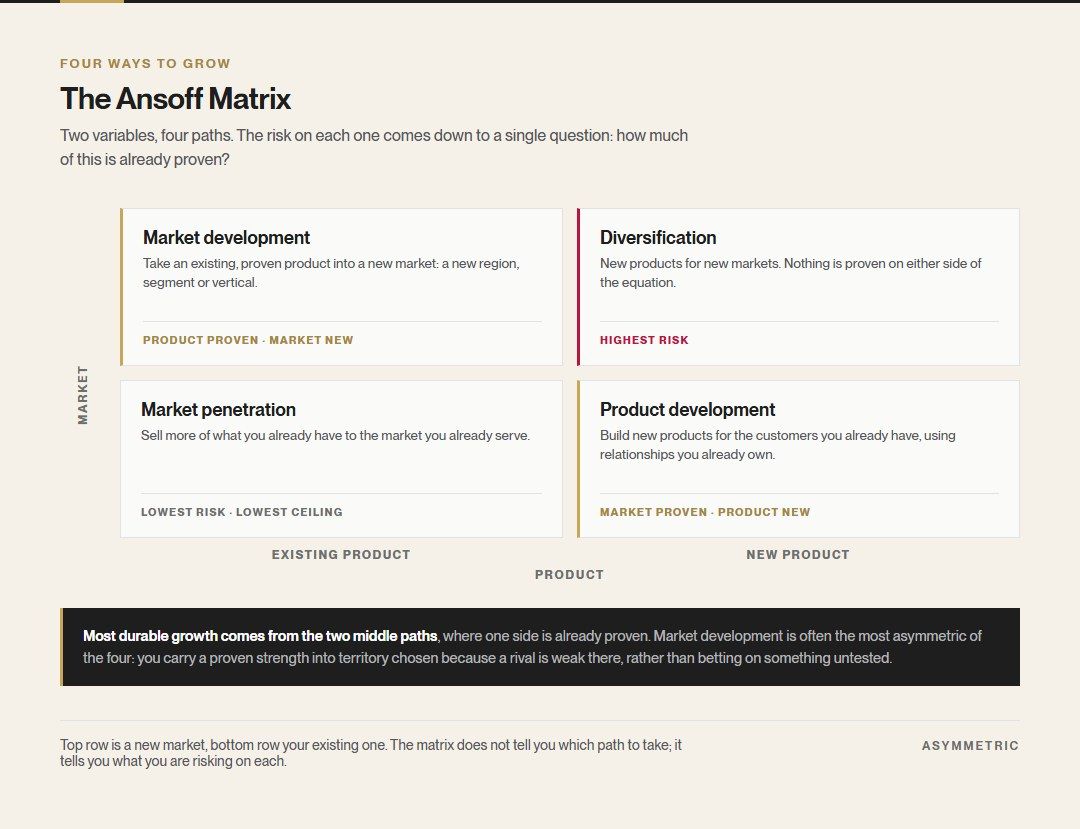
The Ansoff Matrix names four ways to grow:
- Market penetration: sell more of your existing products to your existing market. The lowest-risk path, and usually the first to be exhausted.
- Market development: take your existing products to a new market, whether a new region, segment, or use case. Lower risk than building something new, because the product is already proven.
- Product development: build new products for your existing market, using customer relationships you already have.
- Diversification: new products for new markets. The highest risk, because nothing is proven on either axis.
Most durable growth comes from the two middle paths, where one side of the equation is already known and only the other carries real risk. A market development product is simply a proven product introduced to a new audience: a regional brand going national, a consumer tool repackaged for business buyers, or a domestic product entering a new country.
Market development: growth where you're already strong
Market development, taking a proven product into a new market, is often the most asymmetric of the four. You're not betting on an unproven product; you're carrying an existing strength into territory where incumbents may be weak. The discipline is choosing the right new market, which is a competitive question as much as a customer one. A clear read of the new market's competitors, where they're exposed and where your product's strengths matter most, is what separates a market-development move that wins from one that walks into a fight already lost. This is where a disciplined competitor analysis earns its keep.
Market penetration: selling more of what you already sell
Market penetration is the lowest-risk quadrant of the Ansoff Matrix because nothing about it is new. Same product, same market, more of it. You're competing for a larger share of demand that already exists and that you already know how to serve.
The levers are ordinary: win customers from a competitor, get existing customers buying more often, or convert people who considered you and didn't buy. Pricing moves, loyalty programs, better sales follow-up, and fixing the leaks in your own funnel all sit here.
The limit is that penetration works until the market is saturated or a larger competitor decides to defend. If you're already the share leader and growth has flattened, more effort in this quadrant buys less each time. That's usually the signal to look at the two middle paths instead.
For a challenger, penetration is often the right first move anyway, because it tests whether the problem is the market or the execution. If you can't win share in a market you understand, a new market won't fix that.
Product development: new products for the customers you already have
Product development keeps the market and changes the product. You're building something new for people who already know you, which means the expensive part of growth, earning trust and attention, is already paid for.
This path suits businesses with a strong customer relationship and a clear read on what those customers still struggle with. The research is cheaper here than anywhere else in the matrix, because you can ask. A service business adding a retainer tier, or a product company adding an accessory line, is working this quadrant.
The risk sits in execution rather than demand. You know who's buying, but you don't yet know whether you can build and support the new thing profitably. Development cost, delivery capacity, and the drag on your existing product are the things that sink this path, not a missing audience.
The common mistake is treating an adjacent product as free growth because the customer list already exists. A new product still needs its own economics, and a list that likes you isn't the same as a list that wants this.
Diversification: the path that fails most often
Diversification means new products for new markets, and it's the only quadrant where nothing is proven. You're learning a product and an audience at the same time, with no existing strength carrying any of the weight.
It splits into two kinds. Related diversification stays near something you already do, sharing a capability, a channel, or a supply chain. Unrelated diversification shares nothing, and it's usually a bet on capital or management rather than on any advantage you hold.
Businesses end up here for two very different reasons. Sometimes it's a genuine strategic move to escape a declining core. More often it's a reaction to boredom or to a flattening line on a chart, which is the version that fails.
The honest test before committing: name the specific advantage you carry into the new market. If the answer is money or ambition rather than a capability a competitor there lacks, you're funding someone else's learning curve. For most smaller businesses, the two middle paths produce more growth for less risk, and diversification is worth holding until one of them is genuinely exhausted.
Choosing the right path
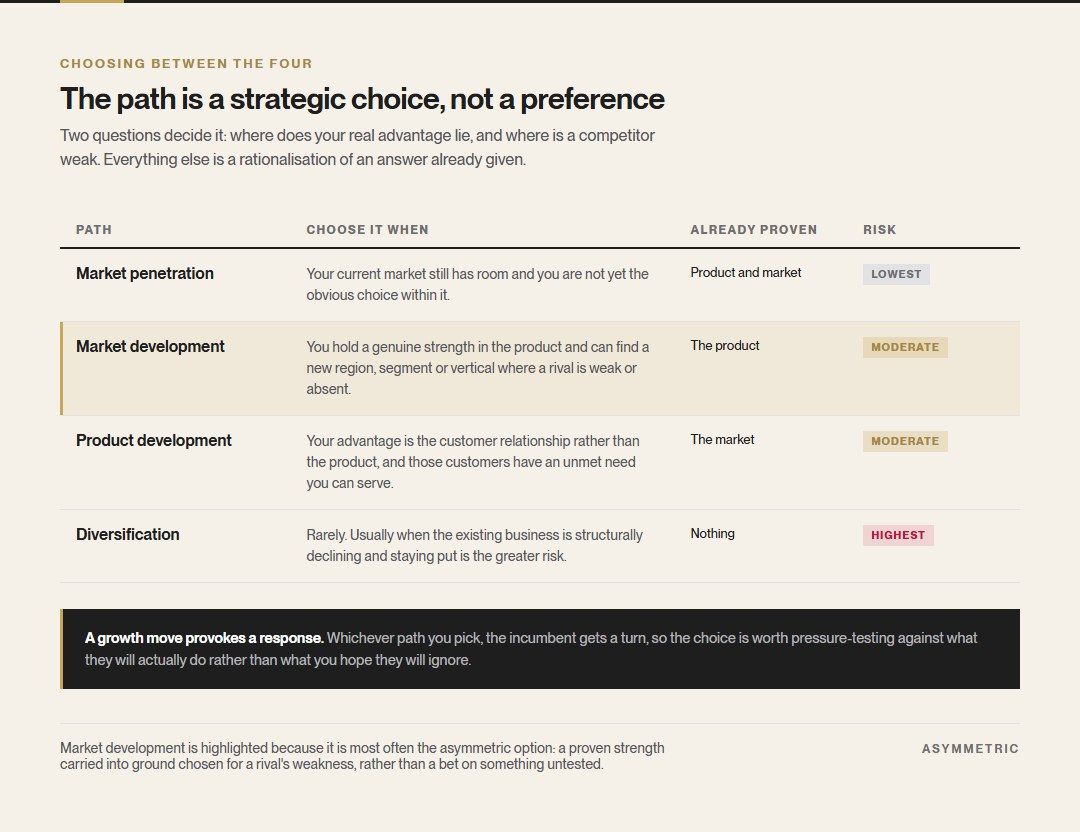
The choice among the four is a strategic decision, not a default. It depends on where your real advantage lies, how much risk you can carry, and where a competitor has left an opening. The strongest growth move is usually the one that takes a strength you already have into a place where it meets a need a rival serves poorly, which is the same principle, choose the battlefield, that runs through all asymmetric marketing. And because a growth move provokes a competitive response, the option you pick is worth pressure-testing in a business wargame before you commit the investment behind it.
Ansoff Matrix vs BCG Matrix
These two get confused because both are four-box grids about growth, but they answer different questions. The Ansoff Matrix asks which direction to grow: which combination of product and market you should pursue next. The BCG Matrix asks where to put money among things you already own.
BCG sorts an existing portfolio by market share and market growth, producing the familiar stars, cash cows, question marks, and dogs. It's a funding decision about current lines of business. Ansoff is a direction decision about the next move.
In practice they work in sequence. BCG tells you which parts of the business are throwing off cash and which are consuming it. Ansoff tells you where to point the cash that comes out. A business with a healthy cash cow and no obvious growth path is exactly the case where the Ansoff question matters most.
If you only have one product and one market, BCG has nothing to sort and Ansoff is the more useful of the two.
How to build an Ansoff Matrix for your business
Start by naming your current position precisely. Which product, sold to which market, is producing most of your revenue today? Vagueness here makes every quadrant look plausible, which is the usual reason the exercise produces nothing.
Then write one concrete option in each box. Not a category, an option: the specific new segment you'd enter, the specific product you'd build, the specific customers you'd take share from. Four real options are more useful than four labels.
Score each on two things. How much of your existing advantage carries over, and how a competitor would respond if the move worked. The second question is the one most teams skip, and it's the one that decides whether a good idea survives its first year.
Rank the options by odds rather than by size of prize. The largest market is usually the one where your advantage transfers least. Pick the path where something you already do well is still worth something on the other side, and pressure-test it before committing budget.
Grow on the path with the best odds
If you're deciding how to grow, whether a proven product into a new market or a new product for the customers you have, choosing the path with the best odds is the work we do.
Frequently asked questions
What is product market development?
Product market development is a growth strategy that expands the market for a proven product. Framed by the Ansoff Matrix, it most often refers to market development: taking an existing, validated product to a new market, region, segment, or use case rather than building something new. It's usually lower-risk than product development or diversification because the product is already proven.
What is the Ansoff Matrix?
The Ansoff Matrix is a strategic planning tool introduced by Igor Ansoff in 1957 that maps four growth strategies along two axes, products and markets, each either existing or new. The four paths are market penetration (existing product, existing market), market development (existing product, new market), product development (new product, existing market), and diversification (new product, new market).
What is an example of a market development product?
A market development product is a proven product introduced to a new audience. Examples include a regional food brand expanding nationally, a consumer software tool repackaged and sold to business buyers, or an established domestic product entering a new country. In each case the product itself is unchanged; what is new is the market it serves.
What is the difference between market development and product development?
Market development takes an existing, proven product into a new market, so the product is the known quantity and the market carries the risk. Product development builds a new product for an existing market, so the customer base is known and the product carries the risk. Both are lower-risk than diversification, which introduces a new product to a new market with nothing proven on either axis.
Which growth strategy is best?
There's no universally best path; the right one depends on where your real advantage lies, how much risk you can absorb, and where a competitor has left an opening. The strongest move usually carries an existing strength into a market where a rival serves a need poorly. Because any growth move provokes a competitive response, the chosen path is worth pressure-testing before the budget is committed.
About the author

Mark Hope
Founder, President & Chief Strategy Officer, Asymmetric Marketing
Mark Hope is the Founder, President & Chief Strategy Officer of Asymmetric Marketing. His career spans elite military service, senior leadership at two of the largest companies in their categories, and founding several companies of his own. It's the common thread behind how Asymmetric helps smaller companies out-compete bigger ones.
Mark began his career in U.S. Army Special Operations, serving from 1977 to 1988 in the 1st and 3rd Battalions of the 75th Ranger Regiment and as an Operator in 1st Special Forces Operational Detachment–Delta (Delta Force). What that world runs on (careful planning, reading your opponent, and winning from a position of disadvantage) is the foundation of how he helps smaller companies win today.