

October 14, 2024
Leading in a BANI World: Foresight You Can Actually Operationalize
VUCA and BANI name the chaos; neither tells you what to do about it. How the military plans when prediction is impossible: reverse planning, contingency branches, and the one discipline almost no business has, Commander's Intent.
By Mark Hope, Founder, President & Chief Strategy Officer, Asymmetric Marketing

VUCA. BANI. The acronyms get wheeled out in every keynote about "these uncertain times," nodded at solemnly, and then nothing changes. They're a sophisticated-sounding way to say it's chaotic out there. And naming the weather has never once helped anyone sail in it.
The useful question was never which acronym best describes the chaos. It's what you do differently once you accept that the future is genuinely unpredictable. And here's the thing most boardrooms talking about "uncertainty" have never confronted: there's a profession that has operated under real uncertainty, the kind measured in lives, not quarters, for a very long time, and it solved this problem without ever pretending it could predict the future.
I came up in it. In Special Operations, you plan knowing the situation will change the instant you make contact. Prediction isn't just hard; it's the wrong goal. You don't plan to forecast the future. You plan so you win in several of them. That distinction is the whole of strategic foresight, and the military has three disciplines that make it real. None of them is an acronym.
Key takeaways
- VUCA and BANI both diagnose an unpredictable world; neither tells you what to do about it.
- In genuine uncertainty, prediction is the wrong goal. The edge is positioning to win across several futures, not forecasting one.
- The military operationalizes this with three disciplines: reverse planning, contingency and branch planning, and Commander's Intent.
- Commander's Intent is the one almost no business has: communicate the why deeply enough that the team adapts toward the objective when the plan breaks.
- Foresight names what might happen; preparation is what you carry because of it, and a wargame is where both get rehearsed.
What VUCA and BANI actually describe (and why it isn't enough)
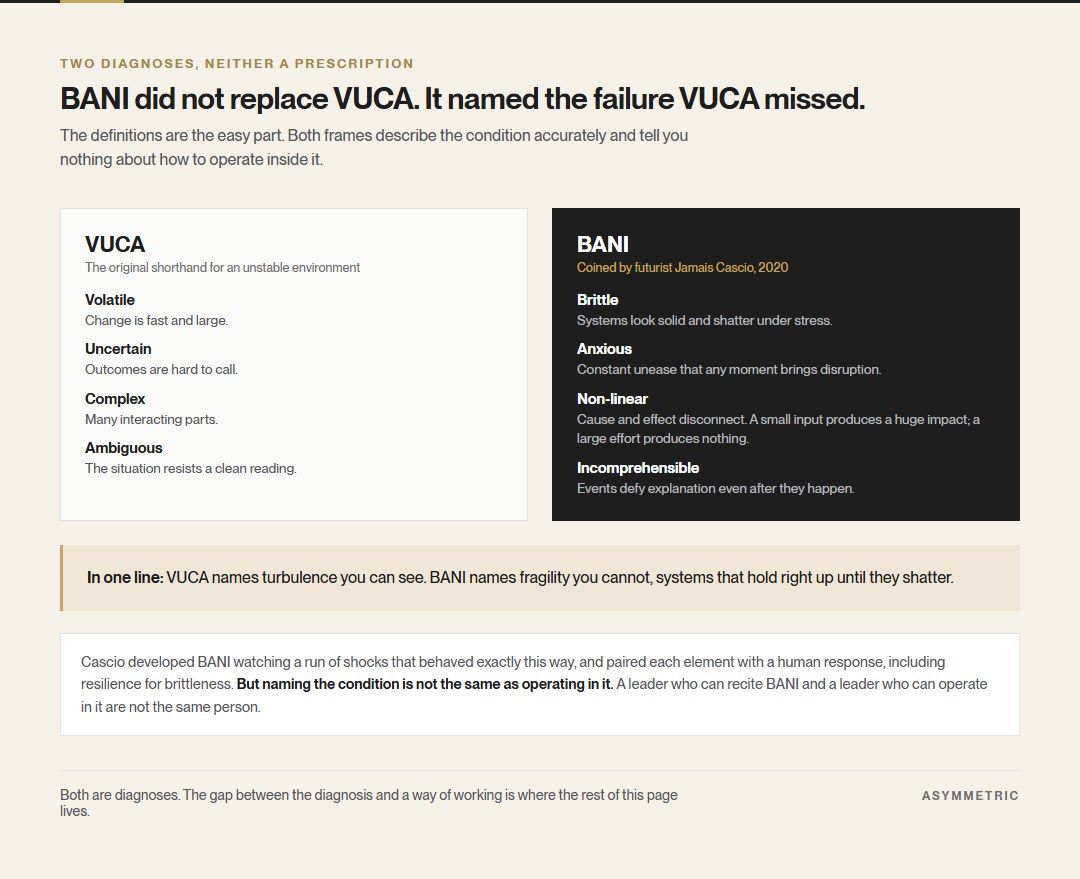
Quickly, because the definitions are the easy part:
- VUCA, Volatile, Uncertain, Complex, Ambiguous. The original shorthand for an unstable environment.
- BANI, Brittle, Anxious, Non-linear, Incomprehensible. A newer frame for a world that looks stable right up until it snaps.
BANI vs VUCA, in one line: VUCA names turbulence you can see; BANI names fragility you cannot, systems that hold right up until they shatter. BANI didn't replace VUCA so much as describe the failure mode VUCA missed. Both are diagnoses. They name the problem accurately and prescribe nothing.
Where BANI comes from
What each letter in BANI means
Brittle describes systems that look solid right up to the moment they fail completely. A supply chain optimized so tightly that one closed port stops production is brittle. So is a business where most revenue runs through one channel. The warning sign isn't visible stress, it's the absence of slack.
Anxious describes the state of the people inside those systems. When failure is sudden rather than gradual, everyone hesitates, decisions get deferred upward, and teams wait for certainty that isn't coming. Anxiety is a strategic problem, not a wellbeing footnote, because it slows the organization down at exactly the moment speed matters.
Nonlinear describes the broken relationship between cause and size of effect. A small input produces an enormous outcome, or a large effort produces almost nothing. Ordinary planning assumes proportionality, and in a nonlinear environment that assumption quietly stops holding.
Incomprehensible describes what happens when more information stops producing more understanding. You have the data, the dashboards, and the reports, and the answer still isn't in there. Adding another data source usually makes this worse rather than better.
BANI vs VUCA: what actually changed
VUCA came out of the US Army War College in the late 1980s to describe the post-Cold-War environment: volatile, uncertain, complex, ambiguous. It moved into business vocabulary and stayed there for thirty years.
The argument for replacing it is that VUCA describes a world that's hard to predict, and assumes prediction is still the goal. Volatility implies things swing around a knowable centre. Uncertainty implies better information would help. Both suggest that a smarter forecast would solve the problem.
BANI, coined by the futurist Jamais Cascio in 2020, describes a world where that assumption has broken. Brittle isn't volatile, it's stable until it shatters. Incomprehensible isn't ambiguous, it means more information won't resolve it. The shift is from hard to predict toward not worth trying to predict.
Whether BANI replaces VUCA or extends it is mostly an argument about labels. The useful part is the implication: if better forecasting can't save you, the investment moves to how fast you notice and how well you're prepared to respond, which is a different budget line and a different set of habits.
The BANI framework was coined by futurist Jamais Cascio in 2020, as a successor to VUCA built for a world VUCA no longer captured. Each letter names a feature of that world. Brittle systems look solid but shatter under stress. Anxiety describes the constant unease of operating where any moment can bring disruption. Non-linearity means cause and effect are disconnected, so a small input can produce a huge impact while a large effort produces nothing. And incomprehensible means events often defy explanation even after they happen.
Cascio developed BANI watching a run of shocks, the pandemic, accelerating climate change, and political instability, that behaved exactly this way: stable until they were not, with impact wildly out of proportion to cause. BANI is a diagnosis of that condition. Cascio also paired each element with a human response, including resilience for brittleness and empathy and mindfulness for anxiety. But naming the condition isn't the same as operating in it. A leader who can recite BANI and a leader who can operate in it aren't the same person, and the gap between them is everything this page is about.
Why prediction is the wrong goal
What each condition asks of a leader
The model is only useful if each letter points at something to do differently.
Brittleness asks for slack where it matters. That means a second supplier before you need one, cash reserves sized to a bad quarter rather than an average one, and revenue that doesn't depend on a single channel. Slack looks like waste on a spreadsheet and it's the thing that keeps a brittle system standing.
Anxiety asks for clear intent. When people know what outcome matters and why, they can act without waiting for permission, which is the only thing that keeps decisions moving when nobody is certain. Vague direction plus an anxious team produces paralysis every time.
Nonlinearity asks for small reversible bets instead of one large committed one. If effect size is unpredictable, the sensible response is to make more attempts at lower cost and keep the ability to stop.
Incomprehensibility asks for judgement rather than more dashboards. It means deciding what you'd do under several plausible futures instead of trying to identify the right one, and rehearsing those responses before you need them.
In a genuinely non-linear world, forecasting is a trap. Commit to a single predicted future, and you've built a strategy that's optimized for exactly one outcome and fragile against all the others, you get punished the moment a different future arrives, which it will. The edge was never a better prediction. It's positioning to win across several futures at once. Which is precisely what military planning is built to do.
The three disciplines that replace prediction
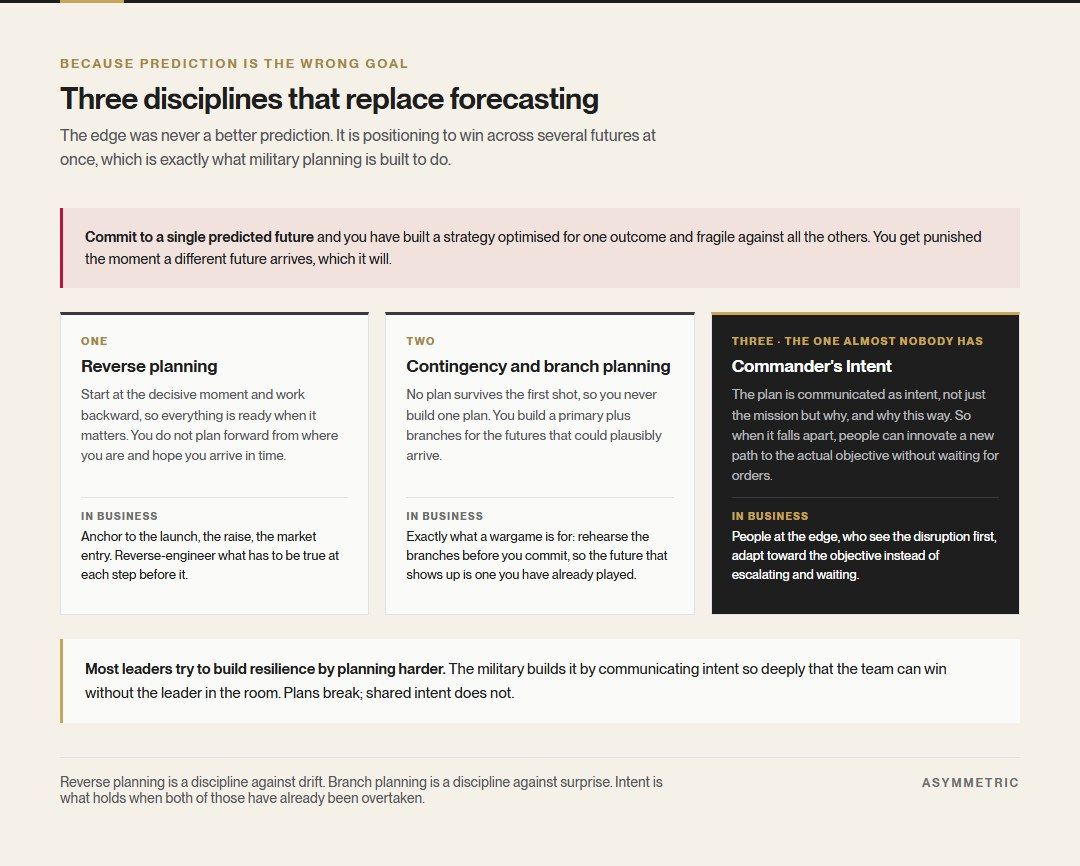
1. Reverse planning. Tactical planning starts at the decisive moment, D-Day, H-Hour, and works backward to ensure everything is ready when it matters. You don't plan forward from where you're and hope you arrive in time. You fix the moment that has to go right and back-plan for its readiness. In business: anchor to the decisive event, the launch, the raise, the market entry, and reverse-engineer what has to be true at each step before it, instead of planning forward and discovering you're not ready when the moment comes. Reverse planning is a discipline against drift.
2. Contingency and branch planning. Because no plan survives the first shot, you never build a single plan. You build a primary plan plus branches for the futures that could plausibly arrive, so that when reality diverges from the assumption, you're not improvising from zero; you're executing a branch you already thought through. This is the literal operational version of "win across several futures." And it's exactly what a business wargame is for: you rehearse the branches, multiple competitor and market responses, before you commit, so the future that actually shows up is one you've already played.
3. Commander's Intent, the one almost no business has. This is the discipline that matters most, and the one leaders have been handed the least. In a military operation, the plan isn't communicated only as what to do. It's communicated as intent, not just the mission, but why we're doing it, and why this way. The reason is precise: when the plan falls apart, and it will, every soldier who understands the actual objective can innovate a new path to it without waiting for orders. They're not frozen, and they're not executing a now-wrong plan to the letter. They're adapting toward the real goal because they know what it is. Translate that to an organization in a BANI world, and it's transformative. The thing that makes a company resilient under uncertainty isn't a better plan, plans break. It's shared intent. When everyone understands not just their task but the why behind the overall strategy, the organization stays oriented as the situation changes. People at the edge, the ones who see the disruption first, adapt toward the objective instead of escalating and waiting. Most leaders try to build resilience by planning harder. The military builds it by communicating intent so deeply that the team can win without the leader in the room.
Foresight and preparation are partners
Strategic foresight is the discipline of identifying what might happen, the futures and contingencies worth taking seriously. Preparation is what you carry because of it. Foresight without preparation is a smart forecast you can't act on; preparation without foresight is a heavy pack full of the wrong supplies. The two together are why a prepared challenger looks lucky: when the opening a foresight exercise anticipated finally appears, the preparation to seize it's already in place.
How we operationalize this
We don't sell a "foresight workshop" with these as bullet points on a slide. These disciplines, reverse planning, contingency thinking, Commander's Intent, are part of the intellectual toolkit we bring into strategy sessions and wargames, alongside the rest of the canon we actually use: Sun Tzu's Art of War (win without fighting, know your adversary, the role of the unexpected), Boyd's OODA loop (out-cycling a competitor's ability to react), and Blue Ocean Strategy (competing where rivals aren't, rather than where they are).
The point of naming the canon isn't credentialism. It's that foresight isn't a single trick: it's the synthesis of several hard-won bodies of thought, applied together to a specific client situation. The wargame is where that synthesis becomes operational: it's the room where the branches are rehearsed, the intent is stress-tested, and the strategy is played against the futures it has to survive, before a dollar is committed to any one of them.
The leader's real job in a BANI world
It isn't to predict, and it certainly isn't to project confidence that the situation doesn't warrant. It's to build an organization that stays oriented and moves fast when the plan breaks: anchored to a decisive objective (reverse planning), prepared for several futures rather than betting on one (contingency), and aligned on why deeply enough to adapt without waiting for orders (intent). Name the chaos if you like. Then build the thing that wins inside it.
Build a strategy that survives contact
Naming the uncertainty is easy and free. Building a strategy that wins across the futures that could actually arrive, and an organization that adapts when the plan breaks, is the work.
Frequently asked questions
What is a BANI world?
BANI describes a world that's Brittle, Anxious, Non-linear, and Incomprehensible. Coined by futurist Jamais Cascio in 2020, it frames an environment that looks stable right up until it snaps, where cause and effect are disconnected and events often defy explanation even after they happen. It's a diagnosis of modern uncertainty, not a prescription for operating in it.
What's the difference between VUCA and BANI?
VUCA (Volatile, Uncertain, Complex, Ambiguous) names turbulence you can see; BANI (Brittle, Anxious, Non-linear, Incomprehensible) names fragility you cannot, systems that hold until they shatter. BANI didn't replace VUCA so much as describe the failure mode VUCA missed. Both are diagnoses that name the problem accurately and prescribe nothing.
How do you build strategy for an uncertain (VUCA/BANI) world?
Stop trying to predict and start positioning to win across several futures. The military does this with three disciplines: reverse planning (anchor to the decisive moment and back-plan readiness), contingency and branch planning (a primary plan plus branches for plausible futures), and Commander's Intent (communicating the why so the team adapts when the plan breaks). A business wargame is where those get rehearsed.
What is Commander's Intent and how does it apply to business?
Commander's Intent communicates not just the mission but why, so that when the plan falls apart, everyone who understands the real objective can improvise a path to it without waiting for orders. In business it's the source of genuine resilience: when people understand the why behind the strategy, the organization stays oriented and adapts as the situation changes, rather than executing a now-wrong plan to the letter.
What is the difference between foresight and preparation?
Strategic foresight identifies what might happen, the futures and contingencies worth taking seriously. Preparation is what you carry because of it. Foresight without preparation is a smart forecast you can't act on; preparation without foresight is a heavy pack full of the wrong supplies. Together they're why a prepared challenger looks lucky when the anticipated opening finally arrives.
About the author

Mark Hope
Founder, President & Chief Strategy Officer, Asymmetric Marketing
Mark Hope is the Founder, President & Chief Strategy Officer of Asymmetric Marketing. His career spans elite military service, senior leadership at two of the largest companies in their categories, and founding several companies of his own. It's the common thread behind how Asymmetric helps smaller companies out-compete bigger ones.
Mark began his career in U.S. Army Special Operations, serving from 1977 to 1988 in the 1st and 3rd Battalions of the 75th Ranger Regiment and as an Operator in 1st Special Forces Operational Detachment–Delta (Delta Force). What that world runs on (careful planning, reading your opponent, and winning from a position of disadvantage) is the foundation of how he helps smaller companies win today.