

Marketing attribution tracks which marketing channels drive conversions. It helps you measure the impact of each touchpoint across the full customer journey, ensuring every interaction is considered. You can make informed decisions to improve your strategies and ROI using marketing attribution. This article will cover models, tools, and best practices.
Key Takeaways
- Marketing attribution measures the influence of various channels on crucial business metrics, aiding marketers in optimizing their strategies and budget allocation.
- Choosing the right attribution model is crucial. Single-touch models offer simplicity, while multi-touch models provide a more comprehensive view of the customer journey.
- Integrating AI enhances marketing attribution by accurately identifying successful touchpoints, enabling informed decisions and resource allocation for improved ROI.
Understanding Marketing Attribution
Marketing attribution is the process of measuring the impact of different marketing channels. Marketing attribution is the process of assigning credit to the marketing touchpoints that influence a conversion, helping to identify which activities drive outcomes. It focuses on key business metrics like meetings, pipeline, and revenue. Marketers need to grasp digital marketing attribution to understand the impact and effectiveness of their marketing efforts. Attribution reports track the success of these efforts, revealing which channels or touchpoints contribute most to desired outcomes.
The complexity of modern customer journeys necessitates a comprehensive approach to attribution. The customer journey can be complex and non-linear, making it essential for marketers to track various customer touchpoints and marketing activities to understand consumer behavior and optimize marketing efforts. By mapping out all marketing touchpoints that influence a purchase decision, marketers gain valuable insights into the interactions that lead to conversions. This understanding helps identify the top marketing channels driving conversions and provides a detailed overview of each customer journey, from initial contact to purchase.
Marketing attribution helps marketers understand the interactions that lead to a conversion point and identify the top marketing channels that drive conversions. Analyzing these insights allows businesses to focus on the channels and touchpoints that yield the highest returns, optimizing their marketing strategies.
Why is Marketing Attribution Important?

Understanding why marketing attribution is necessary begins with recognizing its role in analyzing the impact of marketing strategies throughout the customer journey. Attribution provides data that justifies marketing expenses, revealing the effectiveness of different marketing initiatives. This data-driven approach helps brands optimize their marketing budget by identifying the most effective channels and strategies.
Compelling marketing attribution enhances ROI by identifying the touchpoints that lead to conversions. Aligning attribution insights with critical B2B marketing KPIs gives a comprehensive view of performance and enables businesses to make strategic adjustments for improved efficiency. Effective marketing attribution can lower customer acquisition costs by eliminating wasteful spending on marketing tactics that aren't capturing consumer attention or moving them through the customer funnel. Understanding touchpoint effectiveness allows companies to refine their remarketing efforts and improve audience relevance.
Attribution processes can automate evaluations, providing relevant and accurate metrics for future marketing decisions. Applying disciplined marketing budget planning strategies alongside these insights saves time and ensures that marketing strategies are continually refined based on the latest data insights.
Types of Marketing Attribution Models
Marketing attribution models assign different credit to each interaction along the customer journey and can be divided into two main categories: single-touch models, which credit one interaction, and multi-touch models, which distribute credit across multiple interactions. Single-touch attribution models focus on a single interaction, such as the first or last touchpoint, while multi-touch attribution models distribute credit among several touchpoints.
Common attribution models include Linear, Time Decay, U-Shaped, and Data-Driven. Last-click attribution is a widely used single-touch approach that assigns all credit to the last interaction before conversion, but it may not provide a complete view of the customer journey compared to multi-touch models. Attribution models aim to determine campaign performance and understand how different touchpoints contribute to conversion. Selecting the right marketing attribution model helps businesses identify the most influential interactions and optimize their marketing efforts. Connecting attribution with a well-defined purchase path across awareness, consideration, and decision stages is also important for measuring and understanding customer journeys that span multiple online and offline touchpoints, ensuring accurate evaluation of marketing channels' effectiveness.
Single-Touch Attribution Models
Single-touch attribution models focus on a single interaction in the customer journey, assigning credit to one touchpoint. First-touch attribution gives full credit to the first interaction a customer has with a brand, helping identify channels that generate initial interest. Conversely, last-touch attribution assigns all credit to the final touchpoint—the last interaction before conversion—and is commonly used for shorter sales cycles. In summary, first-touch attribution assigns all credit to the first interaction a customer has with a brand, while last-touch attribution gives all credit to the final interaction before conversion.
While single-touch attribution models provide clear insights into marketing performance, they have limitations. They can miss the entire consumer buying process and overlook multiple touchpoints influencing the customer journey.
Despite these limitations, they offer a straightforward approach to understanding marketing efforts’ initial or final impact.
Multi-Touch Attribution Models
Multi-touch attribution models measure all interactions before a conversion, providing a more comprehensive customer journey overview. Linear attribution distributes credit equally across every touchpoint in the customer journey, offering insights into overall marketing performance. Using multi-touch models helps marketers understand the full customer journey and prevents cutting channels that play supporting roles. Time decay attribution values touchpoints based on their proximity to the conversion event, giving more weight to recent interactions.
The u shaped model is a position-based approach that assigns significant credit to the first touchpoint and the point where the customer becomes a qualified lead, while sharing the remaining credit among other interactions to reflect their roles in the conversion process. In last-click attribution, a landing page—such as a product or thank you page—may receive credit for conversions or leads. The W-shaped attribution model gives equal credit to the first, last, and mid-funnel interaction, distributing the remaining credit among other touchpoints.
These multi-touch models provide richer insights than single-click attribution models, allowing marketers to make informed decisions.
Choosing the Right Attribution Model
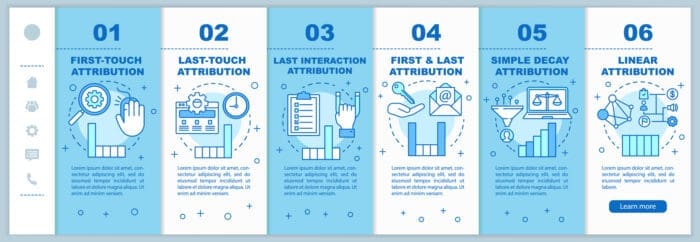
Choosing an appropriate attribution model is crucial for accurately assessing the customer journey and optimizing marketing strategies effectively. Different brands have unique marketing strategies, making it essential to be selective when choosing an attribution model.
Factors such as sales cycle length, online vs. offline activities, and the complexity of the marketing strategy impact the choice of an attribution model. For instance, the time decay attribution model, which assigns more weight to interactions closer to the final purchase, is useful for long sales cycles. Position-based attribution models, which give significant credit to both the initial and final touchpoints, are suitable for complex sales processes.
Custom attribution models allow businesses to create tailored approaches reflecting their specific customer behavior and marketing strategies. Embedding those models in a structured strategic, operational, and tactical marketing plan ensures they support broader goals. Multi-touch attribution models may be more effective for addressing customer retention and gaining insights into all customer interactions leading to a conversion across multiple channels. The choice of attribution model directly influences budget allocation, guiding marketers to invest efficiently in multi-channel strategies. Additionally, marketing attribution models can shift how a business perceives the value of its channels, impacting strategic decisions. Finalizing the attribution model choice should reflect the organization’s business needs and marketing complexities.
Implementing Marketing Attribution Tools
Marketing attribution tools like Google Analytics, Adjust, and Ruler Analytics offer valuable insights into customer interactions and marketing effectiveness. These tools feature backend tracking, customizable reports, and multi-touch interaction analysis. Ad platforms are also a critical component, feeding conversion data back into marketing systems and enabling performance optimization across multiple campaigns. For example, Google Ads implements data-driven attribution (DDA) to evaluate the effectiveness of different marketing touchpoints, using machine learning to improve conversion tracking and credit assignment.
When selecting a marketing attribution tool, consider your business goals, key questions, and integration possibilities with existing systems. Asking structured questions that shape effective marketing campaigns at this stage keeps attribution aligned with strategy. Keep in mind that siloed data across different platforms can complicate the process of creating a unified attribution report, making it difficult to accurately assess the contribution of various marketing activities to conversions. Platforms such as Google Analytics, Rockerbox, Dreamdata, and Windsor.ai offer unique functionalities, such as customer journey insights and extensive integrations, that enhance overall attribution effectiveness, especially when paired with ongoing digital marketing strategy insights for SMBs.
Google Analytics and Attribution Reports
Google Analytics stands out as a cornerstone tool for marketers seeking to understand how different marketing channels contribute to conversions throughout the customer journey. With its robust tracking capabilities, Google Analytics enables businesses to monitor website traffic, user behavior, and conversion rates across multiple touchpoints. By leveraging attribution reports within Google Analytics, marketers can assign credit to specific marketing channels—such as organic search, paid search, email, or social media—based on their influence on conversions.
One of the key strengths of Google Analytics is its flexibility in applying various attribution models. Marketers can choose from last-click, first-click, linear, or time decay attribution models to analyze how each touchpoint impacts the path to conversion. For example, the time decay attribution model gives more credit to marketing efforts that occur closer to the final conversion, helping businesses understand which recent interactions are most influential. Conversely, the linear attribution model assigns equal credit to all touchpoints, offering a holistic view of the entire customer journey.
Attribution reports generated in Google Analytics provide actionable insights that help marketers optimize their strategies. For instance, by comparing the conversion rates of users who arrive via organic search versus those from paid search, marketers can make informed decisions about budget allocation and campaign focus. These data-driven insights empower businesses to refine their marketing efforts, ensuring that resources are directed toward the most effective channels and touchpoints.
Ultimately, Google Analytics attribution reports are essential for understanding the interplay between different marketing channels, assigning credit accurately, and driving continuous improvement in marketing performance.
Best Practices for Effective Marketing Attribution

Aligning marketing and sales data throughout the sales funnel is a best practice for effective marketing attribution. Attribution insights help connect marketing and sales channels, providing a clearer understanding of the customer journey and enabling optimization of marketing initiatives for improved ROI. Attribution reporting assists stakeholders by showing how marketing efforts impact business goals.
Defining clear marketing goals and integrating CRM systems with attribution tools enhances the effectiveness of attribution strategies by providing comprehensive insights into marketing impact. Using the marketing funnel as a framework helps marketers understand customer journeys, track interactions at various stages, and analyze touchpoints within attribution models. Campaign optimization can be informed by attribution data, allowing marketers to adjust messaging at different stages for better results.
Educate Your Stakeholders
Effectively communicating marketing attribution results requires identifying and providing the right stakeholders with useful data. Consistently sharing updated reports and valuable data helps support relationships with stakeholders in marketing attribution.
Managing stakeholders’ expectations, recognizing potential data inaccuracies, and using attribution analysis to clarify marketing strategy effectiveness are key to gaining stakeholder support.
Define Clear Goals
Setting clear marketing attribution goals helps evaluate campaign success and determine key performance indicators, which is essential for customizing attribution models to meet specific business needs. Partnering with growth marketing specialists focused on experimentation and retention can further align attribution goals with scalable acquisition. Identifying conversion sources or understanding content roles in the customer journey are key objectives in marketing attribution.
Defining conversion events helps clarify what constitutes a successful user journey.
Integrate CRM and Attribution Tools
Integrating CRM with attribution tools improves tracking and understanding of customer interactions over time. This integration provides comprehensive insights into marketing impact, improving both marketing and sales performance.
Combining CRM data with attribution analysis provides a holistic view of the customer journey, enabling more informed decisions, especially when supported by an experienced full‑service digital marketing agency that can act on those insights.
Common Challenges in Marketing Attribution
The complexity of consumer journeys complicates tracking and measuring the effectiveness of all marketing channels. Different attribution models can yield varying results, causing confusion about which channel effectively drives conversions. Attribution models often overvalue direct response channels while undervaluing upper-funnel activities, leading to underinvestment in brand awareness and demand creation efforts. They also struggle to account for the interdependencies among various marketing touchpoints.
The increasing focus on consumer privacy, such as the lack of third-party cookies and increased privacy regulations, exacerbates challenges in attribution. Expert guidance from strategic marketing thought leaders like Mark Hope can help teams adapt their approaches. The reliance on deterministic attribution can create blind spots, as it typically only tracks identifiable interactions, missing the impact of impressions and other non-click interactions that influence customer decisions. Using a hybrid model—an integrated approach that combines multi-touch attribution with last-click and impression-level modeling—can help adapt to privacy regulations and provide a more comprehensive view, especially for upper-funnel activities.
Traditional attribution models can overlook crucial interactions, especially outside digital environments, neglecting offline interactions vital for understanding overall marketing effectiveness. Difficulties arise when tracking offline touchpoints, complicating the attribution of conversions. In the context of marketing mix modeling (MMM), media spend serves as a key input in statistical models that analyze and optimize marketing performance, accounting for external factors and market conditions.
The Role of AI in Modern Marketing Attribution
AI algorithms identify which actions and touchpoints lead to success, significantly enhancing ROI. Generative AI provides deeper insights, accurately attributing campaign success to actions and helping optimize strategies.
AI empowers marketers to measure impact and allocate resources efficiently, making it invaluable for modern marketing attribution.
How to Measure Marketing Attribution Effectively

Collecting marketing interaction data is the first step in creating trustworthy attribution reports. Tracking ad clicks is crucial as a measurable action for attribution and conversion tracking, but relying solely on ad clicks can overlook broader brand awareness efforts and the full customer journey. AI enhances measurement and attribution by linking consumer interactions with ads to online and offline behaviors. When deciding the time period for marketing attribution analysis, consider business type, seasonality, and sales cycle length.
A visual analytics dashboard helps identify patterns and clarify the average sales cycle timeline in marketing attribution. Different attribution models in platforms like HubSpot help analyze the buyer journey, and marketers can develop their own model by assigning personalized attribution weights based on industry insights, channels, and buyer behaviors. After choosing an attribution model, the next step is to analyze the obtained data. Integration tools like HubSpot and Google Analytics help link information to specific contacts, improving attribution analysis.
Analyzing attribution data helps understand the value of interactions in relation to marketing efforts. Common challenges include combining offline and online data. Advanced tools help organizations without in-house data science capabilities implement effective attribution. Using a unified measurement approach that combines marketing attribution with methods like incrementality testing and marketing mix modeling can provide a more complete understanding of what drives performance and support informed budget decisions, particularly when collaborating with experienced marketing agency partners who can interpret and act on the data.
Using Attribution Data to Optimize Campaigns
Attribution model insights can enhance customer experience by pinpointing key interaction points within the buyer’s journey. Attribution reporting improves marketing efforts by enabling marketers to respond more effectively to customer needs. AI-generated audience insights enable more precise targeting and enhance personalization in marketing campaigns. Integrating revenue data with advertising platforms helps optimize ad spend and maximize ROI by analyzing how different channels contribute to revenue.
Machine learning algorithms suggest creative optimizations to improve marketing content engagement. AI integration allows marketers to make real-time adjustments to campaigns based on data analysis. AI uses predictive analytics based on past data to identify optimal times and locations for ad placements.
Understanding customer interactions helps identify and motivate potential buyers through various marketing channels and touchpoints, aligning offerings to customer preferences and improving future product development.
Adapting to the Privacy-First Landscape
The marketing landscape is rapidly evolving as third-party cookies are phased out and privacy-first measurement becomes the new standard. This shift challenges marketers to rethink how they collect and use attribution data, moving away from traditional attribution models that often assign all the credit to a single touchpoint. Instead, there is a growing emphasis on leveraging first-party data and zero-party data—information that users willingly share—to track customer journeys and assign credit to specific touchpoints.
To achieve accurate attribution in this privacy-first environment, marketers are increasingly turning to machine learning and statistical models. Data-driven attribution models, powered by machine learning, analyze complex customer journeys and assign credit based on the actual impact of each touchpoint on conversions. This approach moves beyond the limitations of traditional attribution models, providing a more nuanced and reliable understanding of marketing effectiveness.
Google Analytics supports this transition with privacy-friendly features such as user IDs, which allow marketers to track user behavior across devices while respecting user privacy. By focusing on first-party and zero-party data, marketers can build trust with their audiences, ensuring transparency and giving users control over their data.
Adapting to the privacy-first landscape not only helps marketers comply with evolving regulations but also enables them to create more effective, data-driven marketing strategies. By embracing advanced attribution models and prioritizing user consent, businesses can continue to optimize their marketing efforts and achieve meaningful business outcomes in a world without third-party cookies.
Summary
In summary, mastering marketing attribution involves understanding its importance, choosing the right model, and implementing effective tools and best practices. Each offers unique insights into the customer journey from single-touch to multi-touch models. It's important to recognize that not all platforms are created equal—some may lack certain features or data access compared to others, which can impact attribution accuracy. Businesses can enhance their attribution accuracy and optimize their marketing strategies by leveraging AI and integrating CRM systems.
By applying the insights gained from this guide, marketers can improve their campaign effectiveness, optimize their budget allocation, and ultimately drive better business outcomes. The journey of mastering marketing attribution is continuous, but the right approach can significantly improve marketing performance and ROI.

Frequently Asked Questions About Marketing Attribution
What is marketing attribution?
Marketing attribution measures how different marketing channels contribute to essential business outcomes like meetings, pipelines, and revenue. It enables organizations to understand the effectiveness of their marketing efforts.
Why is marketing attribution important?
Marketing attribution is essential as it allows businesses to evaluate the effectiveness of their marketing strategies across the customer journey, justify their marketing expenditures, and optimize budgets by identifying the most impactful channels.
What are the different types of marketing attribution models?
Marketing attribution models primarily fall into two categories: single-touch models, which attribute success to one interaction, and multi-touch models, which allocate credit across multiple interactions. Understanding these models is essential for accurately assessing the effectiveness of your marketing strategies.
How do AI and machine learning improve marketing attribution?
AI and machine learning enhance marketing attribution by precisely linking success to specific actions and touchpoints. This enables deeper insights and real-time adjustments to campaigns based on data analysis, leading to more effective marketing strategies.
What are the common challenges in marketing attribution?
Marketing attribution faces common challenges, such as the intricate nature of consumer journeys, adherence to privacy regulations, and the difficulties associated with tracking offline interactions. Addressing these issues is essential for accurate attribution and meaningful insights.

Ready to Master Marketing Attribution?
Discover how the right attribution model can transform your marketing strategy and boost ROI.
Contact Us: Schedule a Consultation
Explore tailored solutions for your business with our expert team.
Read More: Explore Our Insights

About the author
Mark A. Hope is the co-founder and Partner at Asymmetric Marketing, an innovative agency dedicated to creating high-performance sales and marketing systems, campaigns, processes, and strategies tailored for small businesses. With extensive experience spanning various industries, Asymmetric Marketing excels in delivering customized solutions that drive growth and success. If you’re looking to implement the strategies discussed in this article or need expert guidance on enhancing your marketing efforts, Mark is here to help. Contact him at 608-410-4450 or via email at mark.hope@asymmetric.pro.